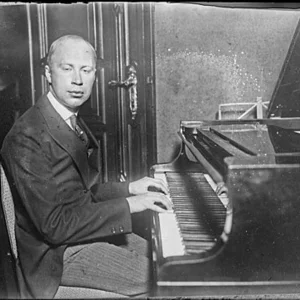

Russian, then Soviet, composer, pianist and conductor, one of the greatest musicians of the 20th century. His work, marked by a biting lyricism and great rhythmic inventiveness, spans symphonies, operas, ballets and film scores.
Sergei Prokofiev
Sergei Sergeyevich Prokofiev
6 min read
Frequently asked questions
Key Facts
- Born in 1891 in Sontsovka (Russian Empire), died in 1953 in Moscow on the same day as Stalin
- Composed Peter and the Wolf in 1936, a musical tale for orchestra meant to introduce children to the instruments
- Created the ballet Romeo and Juliet (1935-1938), whose 'Dance of the Knights' is famous worldwide
- Composed the score for Sergei Eisenstein's film Alexander Nevsky (1938)
- Left Russia after the 1917 revolution, then returned for good to the USSR in 1936
Works & Achievements
A musical tale for children in which each character is represented by an instrument; one of the most performed educational works in the world.
A ballet after Shakespeare, whose “Dance of the Knights” has become universally famous.
A symphony written in the manner of Haydn but with a modern touch; a triumph of elegance and musical wit.
A whimsical, satirical opera premiered in Chicago, whose famous March has remained popular.
Music for Eisenstein's film, later a cantata, celebrating Russian resistance; a high point of film music.
A vast symphony composed during the war, seen as a hymn to the greatness of the human spirit.
A monumental opera after Tolstoy's novel, the fruit of more than ten years of work.
Anecdotes
A child prodigy, Prokofiev composed his first little opera, *The Giant*, at the age of 9, and had it performed by his family. At 13, he was already enrolled at the Saint Petersburg Conservatory, where his teachers found him insolent but incredibly gifted.
For his musical tale *Peter and the Wolf* (1936), Prokofiev had the brilliant idea of assigning an instrument to each character: the flute for the bird, the oboe for the duck, the French horn for the wolf. The work thus teaches children to recognize the timbres of the orchestra, and remains one of the most performed classical pieces in the world.
Prokofiev died on March 5, 1953, exactly the same day as Stalin. With the whole country's attention turned toward the dictator's death, the passing of the great composer went almost unnoticed, and it was very difficult to find flowers for his funeral, as they had all been requisitioned for Stalin.
A great chess enthusiast, Prokofiev once faced world champion José Raúl Capablanca in a simultaneous exhibition and managed to beat him. He used to say that chess was for him a “music of thought.”
In 1948, the Soviet regime accused Prokofiev of “formalism,” an artistic crime invented by those in power. Several of his works were banned, and the composer, ill and impoverished, had to write letters of self-criticism in order to survive.
Primary Sources
My mother played the piano, and it was while listening to her that the desire to compose was born in me. I was five and a half years old when I wrote my first piece.
The chief failing is to seek originality at any cost. On the contrary, one must say what one has to say, simply and clearly.
The composers Shostakovich, Prokofiev, Khachaturian... represent the formalist tendency, alien to the Soviet people.
Key Places
Village in the Russian Empire, in present-day Ukraine, where Prokofiev was born and spent his childhood on the agricultural estate managed by his father.
Prestigious Russian music school where Prokofiev studied composition, piano and conducting from the age of 13.
Capital where Prokofiev settled in the 1920s, collaborating with Diaghilev's Ballets Russes at the heart of European artistic life.
Country where Prokofiev took refuge after the 1917 revolution; the Chicago Opera premiered his opera “The Love for Three Oranges” in 1921.
Soviet capital where Prokofiev returned to live permanently in 1936, knew glory and then the disgrace of 1948, and where he died in 1953.
Typical Objects

The central instrument for Prokofiev, who was both a composer and a virtuoso pianist, on which he created and performed his technically formidable works.

A large notebook in which the composer writes down all the instrumental parts of a symphony or a ballet. In it, Prokofiev invented highly original combinations of tone colors.

A small stick used by Prokofiev when he himself conducted the premieres of his works, in Europe, the United States, and the USSR.

A lifelong passion for Prokofiev, who played against great masters. He saw chess as an exercise in logic close to musical composition.

The medium of the emerging cinema for which Prokofiev composed famous scores, notably for Eisenstein's films “Alexander Nevsky” and “Ivan the Terrible”.

A small notebook that Prokofiev kept with him to jot down right away the melodic ideas that came to mind, while traveling as well as at home.
School Curriculum
Vocabulary & Tags
Key Vocabulary
Tags
Daily Life
Morning
Prokofiev rose early and worked with rigorous, almost methodical discipline. Mornings were often devoted to composition, at his writing desk, where he jotted down his ideas with great precision.
Afternoon
Afternoons might be taken up with orchestra rehearsals, work at the piano, or correcting scores. While on tour, he prepared his concerts as a pianist-interpreter of his own works.
Evening
In the evening, he attended or took part in concerts, spent time with other artists, or relaxed over a game of chess, his favorite pastime, which he played with great passion.
Food
Like many Russians of his era, he enjoyed traditional cuisine, but his final years in the USSR were marked by wartime privations and material hardship brought on by his fall from favor.
Clothing
Elegant and mindful of his appearance, especially during his years in the West, Prokofiev wore fashionable city suits and, it is said, loved brightly colored ties and socks.
Housing
He lived in turn in apartments in Saint Petersburg, residences in the West (the United States, Paris, Bavaria), and then, after returning to the USSR, in a Moscow apartment and a dacha in the countryside.