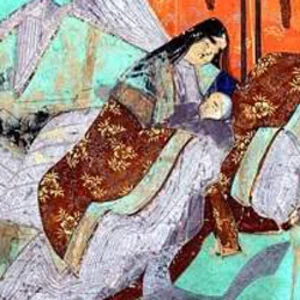

Empress consort of Emperor Ichijō and daughter of regent Fujiwara no Michinaga, Shōshi was one of the most influential women in Heian-period Japan. Her court was a leading intellectual and artistic hub, most notably welcoming the author Murasaki Shikibu.
Shōshi(988 — 1074)
Shōshi
Japon
9 min read
Frequently asked questions
Key Facts
- Born around 988, daughter of Fujiwara no Michinaga, the most powerful regent of Heian Japan
- Became empress consort (chūgū) of Emperor Ichijō in 999
- Her court welcomed Murasaki Shikibu, author of The Tale of Genji (c. 1008)
- Mother of two emperors: Go-Ichijō and Go-Sūjaku
- Died in 1074, after a long life marking the zenith of the Fujiwara clan
Works & Achievements
It was under the patronage of Shōshi that Murasaki Shikibu wrote the Genji Monogatari, considered the world's first psychological novel. The empress herself is said to have asked Murasaki to keep writing in order to enrich her court and rival that of Empress Teishi.
Shōshi gathered around her the greatest learned women of her time: Murasaki Shikibu, Izumi Shikibu, and other ladies-in-waiting whose writings have endured through the centuries. This court became the cradle of classical Japanese literature and the defining model for later aristocratic courts.
Shōshi gave birth to the future Emperor Go-Ichijō (1008) and the future Emperor Go-Suzaku (1009), securing dynastic continuity during a period of absolute Fujiwara dominance. As imperial mother, she oversaw their training in court rites, poetry, and the arts.
After the death of Emperor Ichijō, Shōshi wielded considerable political influence as mother of two successive emperors. Her moral authority offset the formal seizure of power by her father and then her brothers, making her an essential mediating figure in the intrigues of the court.
After taking Buddhist vows, Shōshi received the honorary title of Jōtōmon'in and became a venerated figure of piety. She funded religious ceremonies, supported temples, and embodied the ideal of the great aristocratic lady who, having withdrawn from the world, devotes herself to the life beyond — a recurring theme in Heian literature.
Anecdotes
Shōshi entered the imperial palace at the age of eleven, sent by her father, the all-powerful regent Fujiwara no Michinaga, to become consort to Emperor Ichijō. The court already had another empress, Teishi, the monarch's favorite — the coexistence of these two rival courts sparked a literary and artistic rivalry unmatched in the history of Japan.
It was in Shōshi's court that Murasaki Shikibu wrote the *Genji Monogatari*, considered the world's first novel. The lady-in-waiting also kept a diary — the *Murasaki Shikibu Nikki* — describing in precise detail the ceremonies, poetry contests, and rivalries that animated the empress's chambers.
In 1008, at the birth of the future Emperor Go-Ichijō, his father Michinaga composed one of the most celebrated poems in Japanese history: “This world, I feel, is truly mine — like the full moon, with nothing lacking.” The arrival of a male heir carrying Fujiwara blood indeed cemented the family's absolute dominion over the throne.
Shōshi lived to the age of eighty-six — an exceptional longevity for the era — outliving her husband, her all-powerful father, and both of her sons who had become emperors. After taking Buddhist vows under the name Jōtōmon'in, she remained a venerated figure at court for decades, a living witness to the zenith and then the decline of Fujiwara splendor.
Shōshi's court practiced *waka* poetry competitions with an almost athletic intensity. The ladies-in-waiting had to compose verses on the spot, respond to an impromptu stanza by a nobleman, or allude to a classical poem from the *Man'yōshū*. This mastery of language was a mark of social distinction as much as an artistic pursuit.
Primary Sources
Her Majesty wore a crimson outer robe and underrobes of immaculate white. Her hair, beautifully arranged, fell to either side of her face with perfect grace.
The Minister of the Left [Michinaga] brought the princess to the palace, and the emperor received her with great ceremony. The ladies-in-waiting vied with one another in beauty and elegance, and the ceremonies followed one after another without interruption.
On the third day of the eighth month, the empress gave birth to a healthy prince. The joy at the palace is indescribable; prayers were offered at all the great temples of the capital.
Michinaga arranged for his daughters to occupy the highest positions beside the emperors. By this means, he governed the empire with an authority that no other regent had possessed before him.
Among the ladies the late emperor had loved, there was one who, though not of the highest rank, enjoyed a particular favor that aroused the jealousy of her rivals.
Key Places
The official residence of the emperor and the heart of power, Shōshi spent most of her life as imperial consort within its walls. It was in her apartments there that Murasaki Shikibu wrote and read the Genji Monogatari aloud at court.
The Fujiwara clan's family residence in the capital, where Shōshi spent her childhood before being introduced to the imperial court. Major family ceremonies, including the births of her sons, were held there in part.
A Buddhist temple founded by Fujiwara no Michinaga in 1020 to display his piety and power, it was nicknamed "the matchless abode." Shōshi took part in the magnificent inauguration ceremonies described in the Eiga Monogatari.
The imperial capital founded in 794 was the sole setting of Shōshi's life; a high-ranking aristocrat, she almost never left it. It was within this carefully ordered urban space that Heian civilization flourished, with Shōshi as one of its central figures.
The Fujiwara owned a villa in this town on the banks of the Uji River, south of Kyoto; the final chapters of the Genji Monogatari — the "Uji Chapters" — are set in precisely this landscape that Murasaki Shikibu knew from Shōshi's court.
Typical Objects

Indispensable instruments of court life, they were used to compose waka poems exchanged during poetry competitions or conveyed on sheets of perfumed paper. Mastery of calligraphy was for Shōshi and her ladies-in-waiting a mark of cultural refinement on a par with music.

The aristocratic musical instrument par excellence, the koto was played during nocturnal gatherings at court. Chronicles describe musical evenings in Shōshi's apartments, where her ladies-in-waiting — Murasaki Shikibu foremost among them — played from behind silk curtains.

Folding screens adorned with nature scenes or calligraphed poems defined the intimate space of the imperial apartments and served as a medium for poetic exchanges. They were also offered as highly prestigious diplomatic gifts between noble families.

The blending and recognition of incense fragrances formed a refined art — *kōdō* — practiced at Shōshi's court. Each lady-in-waiting had her own distinctive incense blend, and robes were deliberately perfumed by hanging them above glowing embers.

A portable medium for poetic exchange, the fan was decorated with landscapes and calligraphed inscriptions; offering one bearing an improvised poem was a codified social gesture. Dedicated fans circulated between rival courts as markers of cultural prestige.

After the death of her husband in 1011, Shōshi gradually drew closer to Buddhism before taking religious vows in 1026–1028. Prayer beads, crafted from rock crystal or sandalwood according to one's rank, were the daily devotional accessory of the great ladies of the late Heian period.
School Curriculum
Vocabulary & Tags
Key Vocabulary
Daily Life
Morning
The day began before dawn with Buddhist and Shintō prayers and offices, recited before the inner altars of the imperial apartments. Shōshi then received her ladies-in-waiting's report on messages received overnight — poetic notes from nobles, requests for audience, court news — and dictated her replies in calligraphed verse.
Afternoon
Afternoons were devoted to collective cultural activities: waka poetry competitions where the ladies composed responses in turn to a given stanza, music sessions on the koto or flute, or illustrated card games (uta-garuta) based on memorizing classical poems. Shōshi also oversaw her household affairs and received protocol visits from dignitaries.
Evening
Evenings could extend very late, by the light of oil lamps, during the major seasonal festivals celebrated according to a precise calendar inherited from Chinese practices. Official banquets alternated poetic recitations, music and dance performances, and the tasting of elaborate dishes served on black lacquerware. Full-moon nights gave rise to poetic open-air contemplations from the palace galleries.
Food
Heian aristocratic cuisine was austere in appearance but highly elaborate in its presentation: steamed white rice, vegetable and seaweed broths, dried or marinated fish, seasonal fruits, and sweet rice cakes (mochi). Meat was avoided for Buddhist reasons; fermentation (umeboshi, miso) played a central role. Meals were served on small individual trays, and their arrangement followed strict rules of protocol.
Clothing
Shōshi wore the jūnihitoe ('twelve layers'), the formal attire of high-court ladies consisting of layered robes whose colored edges had to form harmonious gradients visible at the wrists and collar. These gradients — known as kasane no irome — followed a very precise seasonal color code; mismatching one's colors was a serious social offense. In winter, the total weight of the costume could exceed twenty kilograms.
Housing
Shōshi's imperial apartments in the Dairi consisted of a succession of rooms with sliding partitions, separated by painted folding screens and silk curtains (kichō) behind which ladies-in-waiting remained half-hidden during visits from men. The floor was covered with tatami and rush mats; furniture was limited to lacquered chests, low tables, and wooden pillows. All space was arranged according to the principles of sinicized feng shui (onmyōdō) to avoid inauspicious directions.
Historical Timeline
Period Vocabulary
Liens externes & ressources
Références
Œuvres
Mécénat du Genji Monogatari
vers 1004-1012
Constitution d'un salon littéraire de cour
vers 1005-1012
Naissance et éducation de deux empereurs
1008-1011
Exercice de la régence maternelle informelle
1011-1036
Conversion bouddhiste et vie monastique (Jōtōmon'in)
vers 1026-1074