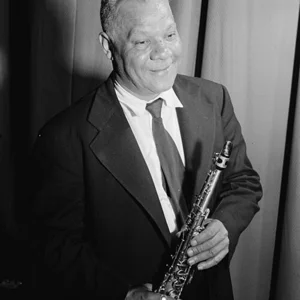

Sidney Bechet was an American clarinetist and soprano saxophonist, one of the first great jazz soloists. Born in New Orleans, he was a major figure of traditional jazz and ended his life famous in France.
Sidney Bechet(1897 — 1959)
Sidney Bechet
États-Unis
6 min read
Frequently asked questions
Key Facts
- Born in 1897 in New Orleans, the birthplace of jazz
- As early as 1919, he performed in Europe with the Southern Syncopated Orchestra and was noticed by the conductor Ernest Ansermet
- A pioneer of the soprano saxophone as a solo instrument in the jazz of the 1920s
- Settled in France in the 1950s, where he became a popular star
- Composed the hit “Petite Fleur” (1952) and died in 1959 in Garches
Works & Achievements
A cover of Gershwin's song for Blue Note; this hit revived his career and remains a high point of jazz.
A tour de force in which Bechet plays all the instruments himself through overdubbing, a technical feat that has remained famous.
A lively tune inspired by Creole folklore, one of his first major hits with the French public.
His best-known composition, a wistful melody on the soprano saxophone, sold in millions of copies around the world.
A piece composed while he was settling on the French Riviera, a witness to his roots in France.
The story of his life, published after his death, a precious testimony on the origins of jazz in New Orleans.
Anecdotes
In 1919, during a London tour by the Southern Syncopated Orchestra, the famous Swiss conductor Ernest Ansermet heard the young Bechet play. Deeply moved, he wrote in a journal that Bechet was an “artist of genius”: it was one of the very first times a classical music critic took jazz seriously.
Still in London around 1920, Bechet bought a soprano saxophone in a shop, an instrument that was rare and neglected at the time. Its powerful tone and wide vibrato would become his signature: you can recognize a Bechet record from the very first notes.
In 1928, in Montmartre, a quarrel between musicians escalated into a shootout in the street; bystanders were wounded. Bechet was sentenced to eleven months in prison in France, then expelled from the country—which would nonetheless become his adopted homeland twenty years later.
In 1941, Bechet pulled off a technical tour de force: he recorded the tune “The Sheik of Araby” entirely on his own, playing six instruments one after another (clarinet, saxophones, piano, bass, drums), layered onto the tape. It was a true “one-man band”.
Having become a huge star in France, Bechet died on May 14, 1959, in Garches, on the exact day of his 62nd birthday. His composition “Petite Fleur” had sold millions of copies, and a statue would later be erected in his honor in Antibes.
Primary Sources
There is in the Southern Syncopated Orchestra an extraordinary clarinet virtuoso... I wish to set down the name of this artist of genius; as for myself, I shall never forget it — it is Sidney Bechet.
In it, Bechet recounts his early days in New Orleans and describes music as a legacy handed down by the elders, a way of saying what words cannot express.
Key Places
Bechet's birthplace and the cradle of jazz, where he learned the clarinet as a child in a musical Creole family.
A stop on his 1919 European tour; here he bought his soprano saxophone and, it is said, played before King George V.
The hub of musical life where he recorded and played in the clubs; he also ran a tailor's shop here during the Depression.
The capital of postwar jazz, where he triumphed in 1949 and played in the cellar clubs of Saint-Germain-des-Prés.
A French Riviera resort where he celebrated his wedding in 1951; a square and a statue honor his memory there today.
A town in the Paris region where Sidney Bechet died on 14 May 1959, his birthday.
Typical Objects

A straight-bodied instrument with a brilliant sound that Bechet took up around 1920; he made it his trademark and popularized its use in jazz.

Bechet's first instrument, learned in childhood in New Orleans; he played it with great virtuosity throughout his life.

A shellac disc spinning at 78 revolutions per minute, the format on which Bechet cut his recordings and which spread his music around the world.

The score of his most famous composition, sold in millions of copies and covered by countless orchestras.

Tools from the tailoring shop he ran in New York during the Great Depression, when traditional jazz sold poorly.

The sharp attire he favored on stage, in keeping with the jazz musicians of the era, who cared about their appearance.
School Curriculum
Vocabulary & Tags
Key Vocabulary
Tags
Daily Life
Morning
While touring 1950s France, Bechet often woke up late at his hotel, after a concert that had ended in the middle of the night. The morning was spent rehearsing a few tunes and maintaining his instruments, the clarinet and the soprano saxophone.
Afternoon
The afternoon was devoted to traveling by train or car to the next town, to recording sessions in the studio, or to interviews with journalists. His many fans recognized him in the street.
Evening
The evening was the most important moment: the concert. In a hall or a smoky jazz cellar, Bechet set the audience ablaze with his powerful vibrato, piling up improvised solos until very late.
Food
Attached to his Louisiana roots, Bechet loved Creole cuisine, rich and spicy, like gumbo. In France, he gladly savored the local fare and the fine wines of his adopted country.
Clothing
Like many jazz musicians, he took great care with his appearance: an elegant suit, a tie, and a hat. On stage, this refined look was part of the show.
Housing
After a life of hotels and travels between the United States and Europe, he finally settled in the Paris region, splitting his time between Paris and the gentle warmth of the French Riviera.