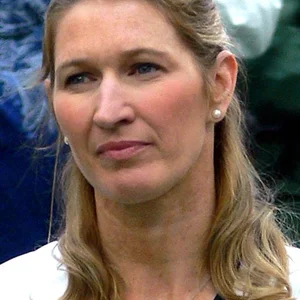

Steffi Graf is a German tennis player, considered one of the greatest champions in the history of the sport. In 1988, she achieved the unique feat of the “Golden Slam” by winning all four major tournaments and the Olympic gold medal in the same year.
Steffi Graf(1969 — ?)
Steffi Graf
Allemagne
5 min read
Frequently asked questions
Key Facts
- Born on June 14, 1969, in Mannheim, Germany
- Achieved the “Golden Slam” in 1988: the four Grand Slam tournaments plus the Olympic gold medal in Seoul in the same year, an unprecedented feat
- Won 22 Grand Slam singles titles over the course of her career
- Held the world number 1 ranking for a record 377 weeks, including 186 consecutive weeks
- Ended her career in 1999 after a final victory at the French Open
Works & Achievements
Her first major victory, at age 17, launching her dominance over world tennis.
A unique feat in history: all four majors and Olympic gold in the same year.
The all-time record for longevity at the top of the rankings, men and women combined.
A tally that places her among the very greatest players in the history of tennis.
Her last major title, won just before leaving the sport at the height of her powers.
The charitable organization she founded to help children traumatized by war and crises.
Anecdotes
In 1988, Steffi Graf achieved a feat never repeated since: the “Golden Slam.” She won all four major tournaments (Australian Open, French Open, Wimbledon, US Open) AND the Olympic gold medal at the Seoul Games, all in the same year. No player, man or woman, has done it since.
Her forehand was so formidable that journalists nicknamed her “Fräulein Forehand” (Miss Forehand in German). She struck that shot with such power and precision that it became the main weapon of her game.
Steffi Graf spent 377 weeks ranked world number 1, an all-time record for both men and women that long stood unmatched. That amounts to more than seven cumulative years at the summit of world tennis.
In 1999, after winning the French Open, she announced her retirement at just 30 years old, while still at the top. She then married American champion Andre Agassi in 2001; the couple form one of the most decorated duos in the history of sport.
Her career was marked by her rivalry with Yugoslav player Monica Seles. In 1993, Seles was stabbed in the middle of a match by an unbalanced fan of Graf; deeply shaken, Steffi later visited her rival in the hospital, a gesture that moved the world of tennis.
Primary Sources
I have accomplished everything I wanted to accomplish. I no longer feel the joy I once did. The time has come to leave.
Steffi Graf holds the record for longevity at the world number 1 ranking with 377 weeks, including a record run of 186 consecutive weeks.
Women's tennis, ladies' singles: gold medal awarded to Steffi Graf (FRG), the first Olympic tennis champion since the sport's return to the official program.
Key Places
City in West Germany where Steffi Graf was born on June 14, 1969. She grew up in the nearby region of Brühl.
The most prestigious tennis tournament in the world, played on grass. Graf won seven singles titles there, making it her most successful tournament.
Grand Slam tournament played on clay, where Graf won six titles, including her very first in 1987 and her last in 1999.
Host of the 1988 Olympic Games where Graf won the gold medal, sealing her historic Golden Grand Slam.
City where Steffi Graf settled after her career, with her husband Andre Agassi, and where they raise their children.
Typical Objects

The player's primary instrument, made of composite fibers and tightly strung. Graf used it for her famously devastating forehand.

A small ball covered in fluorescent yellow felt, designed to bounce on the courts. The yellow color was adopted for better visibility on television.

The supreme reward won in Seoul in 1988, the centerpiece of her Golden Slam. A symbol of world sporting excellence.

Cups awarded to the winners of the four major tournaments, such as Wimbledon's silver plate (the Venus Rosewater Dish). Graf won 22 of them in singles.

A white dress or skirt and polo shirt, traditional especially at Wimbledon, where the dress code requires white. Designed for freedom of movement.

Terry-cloth accessories worn on the forehead and wrists to absorb sweat during long matches. Characteristic of 1980s-90s tennis.
School Curriculum
Vocabulary & Tags
Key Vocabulary
Daily Life
Morning
A champion's day began early, with an intense physical workout: running, strength training and speed drills. Steffi Graf was renowned for her tremendous discipline and her exceptional physical condition.
Afternoon
The afternoon was devoted to sessions on the court: repeated groundstrokes, serves, footwork and practice matches. She tirelessly perfected her legendary forehand.
Evening
Evenings were used for recovery: treatments, massages, stretching and rest to take care of her body. During tournaments, she avoided going out in order to stay focused on the competition.
Food
Like any elite athlete, her diet was balanced and rich in carbohydrates (pasta, rice) for energy, in protein for the muscles and in fruit. Hydration was essential during long matches.
Clothing
On the court, she wore lightweight tennis outfits; at Wimbledon, white was mandatory. A headband, wristbands and special shoes for clay or grass completed the gear.
Housing
Originally from Brühl near Mannheim, she lived a life of constant travel between the tournaments of the world circuit. After her career, she settled in Las Vegas in the United States.
Historical Timeline
Period Vocabulary
Liens externes & ressources
Références
Œuvres
Premier titre du Grand Chelem à Roland-Garros
1987
Le Grand Chelem doré
1988
377 semaines numéro 1 mondiale
1987-1997
22 titres du Grand Chelem en simple
1987-1999
Victoire de Roland-Garros 1999 et retraite
1999
Fondation Children for Tomorrow
1998