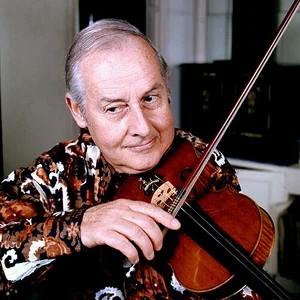

Stéphane Grappelli (1908-1997) was a French jazz violinist who co-founded the Quintette du Hot Club de France with guitarist Django Reinhardt. A leading figure of gypsy jazz, he raised the violin to the status of a jazz solo instrument over a career spanning nearly sixty years.
Stéphane Grappelli(1908 — 1997)
Stéphane Grappelli
Italie, France, royaume d'Italie
7 min read
Frequently asked questions
Key Facts
- Born on January 26, 1908 in Paris, died on December 1, 1997 in the same city
- Co-founded the Quintette du Hot Club de France with Django Reinhardt in 1934
- Settled in London during the Second World War (1939-1945)
- Led a long international career after the war, taking part in many collaborations (notably with violinist Yehudi Menuhin)
- Received an honorary Victoire de la Musique in 1997 for his lifetime achievement
Works & Achievements
Together with Django Reinhardt, Grappelli created an all-string band (violin, three guitars, double bass), with no drums or brass. A revolution that gave European jazz an identity of its own.
One of the Quintet's very first recordings, which introduced audiences to the sound of Grappelli's violin trading lines with Django's guitar.
Co-written with Django, this tune became one of the most frequently played standards of Gypsy jazz, covered all around the world.
A concert and live album recorded in Basel bringing together Grappelli, Stuff Smith, Svend Asmussen and Jean-Luc Ponty: a summit gathering the greatest jazz violinists.
A series of records uniting jazz and classical music, huge successes that introduced Grappelli to a new audience and revived his international career.
At over 80 years old, Grappelli composed the violin soundtrack for this film, proof of his exceptional artistic longevity.
Anecdotes
When the First World War broke out, Stéphane's father, of Italian origin, was called up, and the little boy, who had already lost his mother, was placed in a Parisian orphanage where he suffered from hunger. On his return, his father gave him a violin and even briefly enrolled him at Isadora Duncan's dance school. Stéphane then learned largely on his own, by listening to street musicians and records.
As a teenager, Grappelli earned his living playing the violin and piano in Parisian cinemas to accompany silent films. When talking pictures spread in the late 1920s, hundreds of musicians lost their jobs: Stéphane then turned to dance-hall and music-hall orchestras, where he discovered jazz.
It was while playing in Grégor's orchestra, around 1931, that Stéphane met the guitarist Django Reinhardt. During breaks, backstage, the two musicians improvised jazz together purely for pleasure. From these sessions was born, in 1934, the Quintette du Hot Club de France, one of the first major European jazz groups.
In September 1939, the Quintet was on tour in London just as the Second World War was declared. Django immediately returned to France, but Stéphane chose to stay in England, where he spent the entire war playing. The two friends would not be reunited until the end of the conflict.
In the 1970s, aged over sixty, Grappelli enjoyed a second youth by recording successful albums with the famous classical violinist Yehudi Menuhin. Two worlds that seemed utterly opposed — jazz and classical music — came together for the span of a single bow.
Primary Sources
The 78 rpm records cut between 1934 and 1939 are the direct sonic testimony of Grappelli's art. On them you can hear his violin trading lines with Django's guitar on tracks like 'Dinah' (1934) and 'Minor Swing' (1937).
In it, Grappelli recounts their first backstage improvisations and the birth of the Quintette: 'We started playing together and it was as if we had known each other forever.'
A series of recordings bringing together the jazz violinist and the great classical violinist Yehudi Menuhin. These records, huge commercial successes, document the improbable meeting of two musical traditions.
For this film set in May 1968, Louis Malle entrusted the score to the violin of Grappelli, by then over 80 years old. The music proves the artist's exceptional longevity, as he remained active until the very end of his life.
Key Places
Grappelli's birthplace, where he grew up in poverty, learned music, and spent most of his career. He died here in 1997, loyal to the capital of European jazz.
The prestigious institution where the young Stéphane took music theory and violin lessons in the mid-1920s, earning a medal there. This classical training would later enrich the refinement of his jazz playing.
It was in the orchestra performing here that Grappelli met Django Reinhardt around 1931. Their backstage improvisations paved the way for the birth of the Quintette du Hot Club de France.
Caught by the declaration of war in 1939 while on tour there, Grappelli remained throughout the Second World War. He continued his career there, separated from Django, who had stayed in occupied France.
The famous jazz festival on the shores of Lake Geneva regularly welcomed Grappelli in the later part of his career. These concerts confirmed his status as a living legend of jazz.
Typical Objects

A lifelong instrument, Grappelli turned it into a major solo voice in jazz, a role usually reserved for brass instruments or the piano. His lyrical, elegant playing became his unmistakable signature.

Essential to any violinist, the bow allowed Grappelli his long, singing phrases and rapid runs. He alternated between bowing and pizzicato (plucked strings) to vary the colors of his improvisation.

Grappelli was also an excellent pianist, an instrument on which he accompanied silent films in his youth. He used it to compose and even devoted some of his recordings to it.

The recording medium of the interwar years, fragile and limited to three minutes per side. It was thanks to these records that the Quintet's music spread across Europe and made Grappelli's violin known.

Renowned for his elegance, Grappelli always performed impeccably dressed, in a dark suit or a tuxedo. This refined attire reflected the distinguished image of jazz he projected in concert halls.

An essential tool of recording sessions, the microphone captured the violin's delicate tone, more subdued than that of brass instruments. Mastering it allowed Grappelli to establish a fragile instrument at the heart of recorded jazz.
School Curriculum
Vocabulary & Tags
Key Vocabulary
Daily Life
Morning
Like many musicians who played late into the night, Grappelli got up late. His morning often began with a coffee and a long stretch of work on the violin: scales, exercises, and the search for new musical ideas.
Afternoon
The afternoon was devoted to rehearsals with the Quintet and to recording sessions in the studio, where each side of a record had to fit into three minutes. In between, he would meet up with other musicians in the cafés of Paris.
Evening
The evening was the heart of his profession: concerts, dances, dance halls, cabarets, and clubs where he often played until the middle of the night. It was on stage, in the exchange with the audience and his fellow musicians, that he gave the best of himself.
Food
Coming from a poor childhood marked by hunger at the orphanage, Grappelli later enjoyed the simple food of Parisian bistros. On tour, meals were irregular, grabbed between two trains or two concerts, washed down with coffee.
Clothing
Renowned for his elegance, he always performed impeccably dressed: a dark suit, white shirt, and a bow tie or a carefully chosen necktie. This distinguished appearance contributed to the refined image he gave of jazz.
Housing
After a wretched childhood in Paris, Grappelli lived mainly in apartments in the capital, interspersed with long hotel stays during his countless tours around the world.