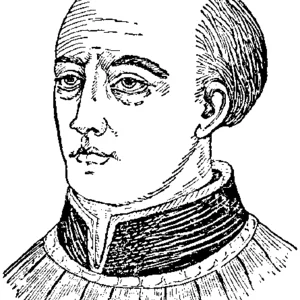

Archbishop of Canterbury in the 12th century, he clashed fiercely with King Henry II of England over the rights and freedoms of the Church. Murdered in his cathedral in 1170, he was canonized as early as 1173.
Thomas Becket
Thomas Becket
9 min read
Frequently asked questions
Key Facts
- Born around 1118 in London, the son of a Norman merchant
- Appointed Chancellor of England by Henry II in 1155, he became the king's close friend
- Elected Archbishop of Canterbury in 1162, he dramatically changed his attitude toward the king
- Exiled in France from 1164 to 1170 after refusing to sign the Constitutions of Clarendon
- Murdered in Canterbury Cathedral on December 29, 1170, by four knights loyal to the king
Works & Achievements
A vast collection of letters addressed to the Pope, to bishops across Europe, and to King Henry II. These letters are the primary doctrinal source of his thinking on the independence of the Church and the supremacy of divine law over royal law.
A landmark legal and theological act: by refusing to sign the sixteen articles that would have subjected the Church to royal authority, Becket established the principle of separation between spiritual and temporal power, leaving a lasting mark on medieval canon law.
From the basilica of Vézelay, Becket pronounced the excommunication of Henry II's leading advisors. This dramatic act demonstrated that the exiled archbishop still wielded formidable spiritual and political power.
Intense diplomatic exchanges with the papacy, in which Becket negotiated moral support and protection while pressing the Pope to firmly condemn royal encroachments on ecclesiastical liberties.
Compilations of miracles attributed to Becket, written by monks at Canterbury. These collections, translated into vernacular languages, spread his cult throughout Europe and formed the basis for his canonization.
Anecdotes
On the evening of 29 December 1170, four knights of King Henry II entered Canterbury Cathedral and ordered Becket to submit to the king. He refused to flee, declared he was ready to die for the Church, and was hacked to pieces before the high altar. According to chroniclers, his brains were scattered across the flagstones, and the faithful dipped their hands in his blood, convinced they were witnessing the birth of a saint.
Thomas Becket had been King Henry II's most loyal friend — his brilliant and worldly chancellor, fond of hunting and feasting. His appointment as Archbishop of Canterbury in 1162 transformed him radically: he took to wearing a hair shirt, fasted, and washed the feet of the poor each morning, becoming the most austere churchman in England. Henry II never forgave what he experienced as a betrayal.
Within weeks of his death, miracles were reported at his tomb: the blind given sight, the lame made to walk, children raised from the dead. The flood of pilgrims was so overwhelming that the cathedral had to be enlarged. In less than three years, Pope Alexander III canonised him — an exceptionally short delay for the time, reflecting the immense political and spiritual power of his martyrdom.
In 1174, Henry II made his way barefoot to Canterbury, wearing a hair shirt beneath his royal garments. He prostrated himself before Becket's tomb and asked every bishop and monk present to flog him as a sign of public penance. This extraordinary act showed how far the martyr had raised his spiritual authority, compelling the most powerful king in the Western world to humble himself.
Becket's relics became the most visited pilgrimage site in medieval Europe, rivalling Rome and Santiago de Compostela. Chaucer, two centuries later, would immortalise this ceaseless flow of travellers in his Canterbury Tales. A small vial of water mixed with a few drops of his blood — known as 'the water of Thomas' — was traded across Christendom as a universal cure.
Primary Sources
"The impious knights, brandishing their swords, cried out: 'Where is the traitor?' Thomas stepped forward: 'Here I am — no traitor, but a priest of God.' And they struck him on the head until the crown of his skull was severed."
"Clerks cited and accused of any matter shall, when summoned by the king's justice, come before the king's court to answer there concerning matters which shall seem to the king's court to be answerable there."
"I cannot betray the Church of God, nor surrender the liberties she holds from Christ, even if the whole world were to turn against me."
"The blessed Thomas, Archbishop of Canterbury, having shed his blood in defence of justice and the liberties of the Church, is enrolled in the catalogue of the holy martyrs."
"When April with his sweet showers has pierced the drought of March to the root… then folk long to go on pilgrimages, and palmers seek foreign shores, and distant shrines in sundry lands — and especially to Canterbury."
Key Places
Site of Becket's martyrdom on 29 December 1170 and home to his venerated tomb. It became England's foremost pilgrimage destination and one of the most visited in Europe for three centuries.
Cistercian refuge where Becket spent two years in exile (1164–1166) under the protection of the King of France. This place of prayer and spiritual resistance shaped his religious radicalism.
Town where Becket resided for several years under the protection of the exiled Pope Alexander III. It was here that he issued his thundering excommunications against the advisors of Henry II.
Royal residence where the Constitutions of Clarendon (1164) were drawn up and presented to Becket, triggering the fatal conflict. His refusal to sign them there marked the point of no return.
Merchant district in the City of London where Thomas Becket was born around 1118, the son of a prosperous Norman merchant. This urban, middle-class background stands in sharp contrast to his rise to the top of the church hierarchy.
Typical Objects

A curved staff of precious metal symbolizing the archbishop's pastoral authority. Becket was holding it at the moment of his assassination, affirming by this gesture that he died as a shepherd of his flock, not as a political rebel.

A garment of rough horsehair worn next to the skin as an act of mortification. Discovered beneath Becket's robes after his death, infested with vermin, it stunned those present and immediately helped forge his reputation as a saint.

A small flask containing a few drops of the martyr's blood diluted in holy water. These liquid relics circulated throughout medieval Europe, sold to pilgrims as a miraculous remedy against illness and a means of divine protection.

Official documents bearing the pope's lead seal or the archbishop's wax seal. Becket made extensive use of these to issue his excommunications and legally defend the liberties of the Church against royal encroachments.

The tip of Richard le Breton's sword snapped on the cathedral flagstones after slicing off the top of Becket's skull. This metal fragment was preserved as a relic, a symbol of the martyrdom willingly accepted.

A band of white wool decorated with black crosses, bestowed by the pope upon archbishops as a sign of metropolitan authority. Becket's pallium symbolized his authority as directly bound to Rome, above the English crown.

A reliquary of gold and precious stones that held Becket's remains in Canterbury Cathedral. The ultimate destination of thousands of pilgrims for three centuries, it was destroyed on the orders of Henry VIII in 1538.
School Curriculum
Vocabulary & Tags
Key Vocabulary
Tags
Lieu
Daily Life
Morning
The archbishop rose before dawn for Matins, the first of the seven canonical hours. After the sung prayer in Latin with his canons, he washed the feet of a dozen poor people — a daily practice he had established after his spiritual conversion. He then donned his heavy liturgical vestments to celebrate Mass at the cathedral's high altar.
Afternoon
The afternoon was devoted to administering the ecclesiastical province: receiving clergy and abbots who came to plead their cases, dictating letters to his secretary, and studying canonical texts. Becket also received nobles and royal messengers, turning every meeting into a tense negotiation over the respective limits of secular and religious authority. Occasionally, a session of spiritual reading punctuated this intense activity.
Evening
Before Vespers and Compline, Becket withdrew for an examination of conscience and reading of the Church Fathers. Communal meals with his clergy were plain: little meat, no excess wine, and sacred texts read aloud. On the evening of his murder, he had refused to bar the cathedral doors, declaring that a church must never be turned into a fortress.
Food
Since taking office as archbishop, Becket observed strict fasting: no meat on days of abstinence, reduced portions, little wine. He ate with his canons in the refectory, sharing the same common fare as the community. The lavish banquets of his days as royal chancellor belonged to a past he publicly renounced.
Clothing
In liturgical settings, Becket wore the cope, chasuble, and gold miter encrusted with precious stones — garments of great symbolic richness befitting his rank as Primate of England. Beneath them, against his skin, he secretly wore a hair shirt and a rough undergarment. At his death, the monks discovered these penitential garments infested with vermin, evidence of his hidden asceticism.
Housing
The archbishop resided in the archiepiscopal palace adjoining Canterbury Cathedral — a complex of reception halls, a scriptorium, a private chapel, and private apartments. During his exile in France, he lived in the abbeys of Pontigny and Sens, subject to the monastic rule and sleeping in a monk's cell. Those years of exile deepened both his spirituality and his doctrinal uncompromising stance.
Historical Timeline
Period Vocabulary
Visual Style
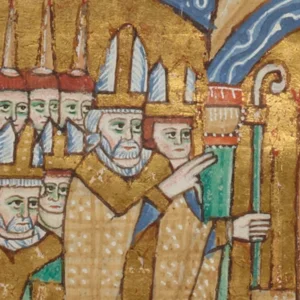
Style enluminure romane anglaise du XIIe siècle : fond or, figures hiératiques aux drapés stylisés, iconographie du martyre avec épées et sang, palette de bleu outremer, vermillon et pourpre épiscopal.
Sound Ambience
Atmosphère de cathédrale médiévale anglaise : chant grégorien, cloches canoniales, murmures de pèlerins et échos de pierre froide sous les voûtes de Cantorbéry.
Liens externes & ressources
Références
Œuvres
Correspondence de Thomas Becket (Epistolae)
1162-1170
Refus des Constitutions de Clarendon
1164
Excommunications de Vézelay
1166
Correspondance avec le pape Alexandre III
1164-1170
Tradition hagiographique — Miracula Sancti Thomae
à partir de 1171