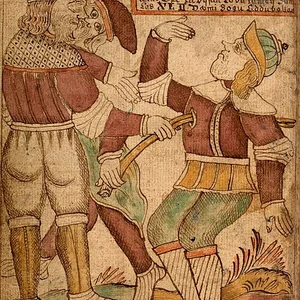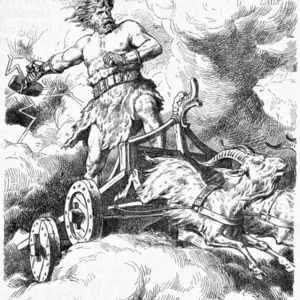

Thor is the god of Thunder and Lightning in Norse mythology. Son of Odin, he is the protector of humans and gods against the giants. He is depicted with his magical hammer Mjölnir, one of the most powerful weapons in the nine worlds.
Frequently asked questions
Key Facts
- Thor is the son of Odin, the father of all Norse gods, and Jörð, the goddess of the earth
- He wields the hammer Mjölnir, forged by dwarves, which always returns to its thrower
- Thor regularly battles the giants, the traditional enemies of the gods, to protect Midgard (the world of humans)
- During Ragnarök (the end of the world), Thor fights the serpent Jörmungandr in an apocalyptic battle in which he meets his death
- The tales of Thor are compiled in the Poetic Edda and the Prose Edda, foundational texts of Norse mythology written in Iceland in the 13th century
Works & Achievements
A legendary weapon forged by dwarves, capable of returning to its owner after being thrown and of destroying any adversary. A symbol of Thor's power and his dominion over the forces of nature.
A series of epic battles in which Thor confronts the giants (Jötnar) to protect Asgard and Midgard. These fights illustrate his role as defender of the cosmic order against chaos.
A legendary quest in which Thor retrieves his stolen hammer by disguising himself as a bride. A comic and adventurous tale that showcases the god's cunning beyond his sheer brute strength.
An attempt to capture the monstrous cosmic serpent that encircles Midgard, revealing Thor's ambition to confront the existential threats facing the nine worlds.
The prophesied battle in which Thor faces Jörmungandr at the end of the world, slaying the serpent but succumbing to its venom. It represents the eternal struggle between order and chaos.
The role of a protective deity for farmers, warriors, and the established order, venerated by the Norse peoples to ensure good harvests and victory in battle.
Anecdotes
Thor and his hammer Mjölnir are at the heart of the stories in the Poetic Edda, compiled in Iceland in the 13th century. According to Norse mythology, this magical hammer was forged by dwarves and can only be wielded by Thor thanks to special gloves and a belt. The weapon is so powerful that it always returns to Thor's hand after being thrown, like a divine boomerang.
In Norse mythology, Thor is the son of Odin and Jörð (the Earth), making him a god who is both mighty and a protector of humanity. He is considered the strongest of the gods and the appointed defender against the giants of chaos, especially during Ragnarök (the Norse apocalypse). This parentage underscores Thor's importance in Scandinavian cosmogony.
Medieval Icelandic sources, particularly the Prose Edda by Snorri Sturluson (13th century), recount that Thor must face the giant serpent Jörmungandr during Ragnarök. Although Thor manages to slay the serpent, he succumbs to its venom, symbolizing the balance between strength and destruction in the Norse vision of the universe.
The Vikings and Nordic peoples of the Middle Ages venerated Thor as the protector of travelers and farmers, which explains his great popularity in Scandinavian culture. Hundreds of place names across Scandinavia bear Thor's name (such as Tórshavn in the Faroe Islands), attesting to his central role in the beliefs of Nordic peoples.
In mythological tales, Thor is often depicted with very human qualities despite his divine nature: he has an enormous appetite, a hot but loyal temper, and acts as a protector of the weak. This relatable humanity makes him particularly endearing and explains why he was the most popular god among ordinary Norse people.
Primary Sources
Thor, son of Odin, possesses the hammer Mjölnir, which always returns to his hand after being thrown. He is the strongest of all the gods and protects Midgard against giants and evil creatures.
Thor is the god of Thunder and son of Odin and Jörð. There are three remarkable things about him: first, his hammer Mjölnir, forged by the dwarves, which never misses its mark.
Thor dwells in a place called Thrúðheimr. No one may cross the Bifrost bridge without danger except Thor, who travels through the clouds by other paths, while Heimdall stands guard over the bridge.
I see Thor sitting, fury in his eyes, gripping his hammer Mjölnir tight. He is the guardian of humans and gods alike, armed with his strength and his thunder.
Key Places
The celestial home of the gods in Norse mythology, where Thor dwells among the other deities. It is the center of the Norse mythological cosmos.
Thor's personal hall located in Asgard, built from mythical materials. It is the place where Thor lives with his divine family.
The world of humans that Thor constantly protects against the threats of giants and evil creatures. Thor is revered as the guardian of this realm.
The realm of the giants that Thor regularly battles. It is the stronghold of the thunder god's perpetual enemies and the eternal foes of the Norse gods.
A real geographical location where Norse mythology was compiled in writing from the 13th century onward, notably in the Poetic Edda and the Prose Edda. The stories of Thor were preserved there.
The real historical region where Thor was worshipped during the Norse Age and the Middle Ages. The Germanic and Scandinavian peoples regarded him as a major protector.
Typical Objects
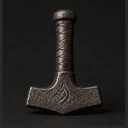
Thor's magical hammer, one of the most powerful weapons in Norse mythology. Capable of returning to its master after being thrown, it symbolizes the power and authority of the god of Thunder.
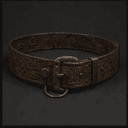
A magical accessory worn by Thor that doubles his strength. It is essential to his power and sets him apart among the Norse gods.
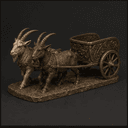
Thor's mythical vehicle across the skies, pulled by two goats named Tanngrisnir and Tanngnjóstr. The rumble of this chariot represents thunder in Norse mythology.
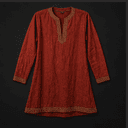
Thor's characteristic garment in iconographic depictions. It emphasizes his warrior nature and his connection to raw physical strength.
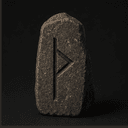
A Norse runic symbol associated with Thor and representing his protective power. It symbolizes strength against threats and giants.

The iconic vessel of the era in which Norse myths were passed down (9th–11th centuries). It represents the culture and expansion of the Scandinavian peoples who worshipped Thor.
📷 CC0 · Wikimedia Commons ↗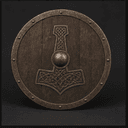
A symbol of protection and religious identity among Norse peoples. Thor's hammer was worn as an amulet or engraved on warriors' shields.
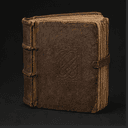
A 13th-century Icelandic collection compiling Norse mythological tales, including the adventures of Thor. This document is the primary written source for the legends surrounding this god.
School Curriculum
Vocabulary & Tags
Key Vocabulary
Daily Life
Morning
Thor begins his day in Asgard with feasts alongside the Aesir gods in the hall of Gladsheim. He then inspects Mjölnir, his magical hammer, and prepares to respond to cosmic threats — particularly the giants who seek to disrupt the balance of the nine worlds.
Afternoon
The afternoon is devoted to expeditions across the various worlds, traveling the paths between Asgard and Midgard. Thor performs great warrior feats and battles monstrous creatures, protecting humanity and maintaining cosmic order against chaos.
Evening
In the evening, Thor takes part in the grand banquets of Asgard, where gods and honorably fallen warriors gather together. He recounts the day's exploits, drinks mead and ale, and strengthens divine alliances around the communal tables.
Food
Thor's diet consists mainly of meat — boar, venison, and ram — along with mead and ale, the prestigious drinks of divine feasts. His legendary appetite reflects his superhuman strength and divine status.
Clothing
Thor wears the garments of a high-ranking warrior: a linen or wool tunic, his belt of strength (Megingjörð), iron gauntlets (Járngreipr), and sturdy boots. He is typically depicted with a thick red beard, a symbol of virility and power.
Housing
Thor dwells in Bilskirnir, his vast palace in Asgard, said to contain 540 halls capable of housing warriors. This dwelling reflects his status as a major god and his role as protector, built for great divine gatherings and communal feasting.
Historical Timeline
Period Vocabulary
Visual Style
Un style visuel inspiré de l'art viking médiéval, mêlant l'esthétique des manuscrits islandais anciens avec une énergie divine et tempétueuse. Les illustrations privilégient les contrastes dramatiques, l'éclairage électrique et une atmosphère guerrière teintée de magie nordique.
Sound Ambience
Une ambiance épique et majestueuse évoquant la puissance divine de Thor, dominée par les grondements du tonnerre, le fracas du marteau Mjölnir et l'atmosphère glaciale des terres nordiques mythologiques.
Liens externes & ressources
Références
Œuvres
Mjölnir (le Marteau magique)
mythologie intemporelle
Combats contre les géants du Feu et du Gel
mythologie intemporelle
Expédition au château de Thrym
mythologie intemporelle
Pêche du Serpent Jörmungandr
mythologie intemporelle
Combat final au Ragnarök
mythologie intemporelle
Protection des humains et du serment
mythologie intemporelle