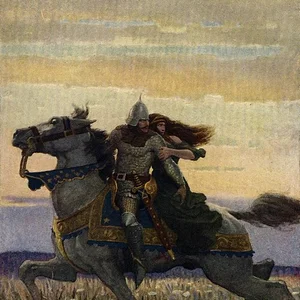

Lancelot du Lac is a legendary knight of the Round Table, son of King Ban of Benwick. Raised by the Lady of the Lake, he becomes the greatest warrior in Arthur's kingdom and the lover of Queen Guinevere. His story symbolizes the conflict between chivalric honor and romantic passion.
Frequently asked questions
Key Facts
- Central figure of the Arthurian romance cycle, created by Chrétien de Troyes in the 12th century
- Son of King Ban of Benwick, raised by the Lady of the Lake who gives him his surname
- Knight of the Round Table renowned for his martial prowess and his deeds in the quest for the Holy Grail
- Engages in a love affair with Queen Guinevere, triggering the downfall of Arthur's kingdom
- His story embodies the conflict between chivalric values and human passion
Works & Achievements
Lancelot takes part in the quest for the Holy Grail, one of the great adventures of the Knights of the Round Table. Though considered impure because of his love for Guinevere, he plays a crucial role in this spiritual quest, which symbolizes the search for the sacred.
Lancelot conquers and fortifies the castle of Joyous Gard, transforming it into an impregnable stronghold. The castle becomes a symbol of his power and a refuge for his forbidden love with Queen Guinevere.
Lancelot performs countless feats of arms as a Knight of the Round Table, winning decisive victories and embodying the ideal of the perfect knight. His military prowess makes him the most feared warrior in the kingdom.
Lancelot's love affair with Guinevere becomes one of the great themes of medieval literature. This transgressive passion brings about the fall of Arthur's kingdom and illustrates the irreconcilable conflict between chivalric honor and courtly love.
A vast prose romance tracing the full life of Lancelot du Lac, from his childhood with the Lady of the Lake to his final days. It is one of the most important works in Arthurian literature.
Lancelot carries out several daring rescues of Queen Guinevere, most notably saving her from the stake where she had been condemned to die. These heroic acts embody the strength of his love and his unwavering devotion to her.
Lancelot defends Arthur's kingdom against external invasions and internal threats, fighting enemies such as Mordred. His military victories preserve the stability of the kingdom until its ultimate destruction.
Anecdotes
Lancelot does not appear in the earliest Arthurian sources: he is absent from Geoffrey of Monmouth's *Historia Regum Britanniae* (c. 1138). It is the French poet **Chrétien de Troyes** who introduces him as a central character in *Le Chevalier de la Charrette* (c. 1177-1181), inventing from scratch his story and his passion for **Guinevere**.
In Chrétien de Troyes' romance, Lancelot agrees to ride in a cart of shame—a vehicle reserved for criminals—to find the abducted Queen Guinevere. This gesture, sacrificing his knightly honor for love, is one of the first literary examples of courtly love pushed to the point of voluntary humiliation.
The prose cycle of the **Lancelot-Grail** (also called the *Vulgate*, c. 1215-1235) devotes thousands of pages to Lancelot and is one of the longest works of the Middle Ages. It is in this cycle that the idea is developed that his moral fault—adultery with Guinevere—prevents him from achieving the quest for the **Grail**, reserved for his sinless son, **Galahad**.
The name 'of the Lake' refers to his upbringing by the **Lady of the Lake**, a fairy who takes him beneath the waters after the death of his father, King Ban. This supernatural figure recalls the Celtic origins of the Arthurian cycle, where the boundaries between the human world and the fairy world are porous and decisive for the heroes' destinies.
Primary Sources
The one appointed to drive the knight was Meleagant, son of King Bademagus. And the knight climbed into the shameful cart, for in those days the cart served as a pillory.
And when the king saw Lancelot, he began to weep most tenderly and said: 'Lancelot, I can no longer help you; you have betrayed your faith and your oaths and the loyalty you had sworn to me.'
And the Lady of the Lake raised him in her palace and taught him all the arts of arms and everything he needed to become a worthy knight.
Lancelot, who through his carnal sin had lost the vision of the Holy Grail, could not reach the end of his quest as the others did.
Key Places
According to Arthurian legend, Lancelot is raised by the Lady of the Lake in a magical lake after his father's death. This place symbolizes his chivalric upbringing and extraordinary powers.
Capital of King Arthur's kingdom, where Lancelot shines as a knight of the Round Table. It is the heart of the royal court where he performs his greatest feats of arms and where his love for Queen Guinevere begins.
Lancelot's kingdom and birthplace, where he is the son of King Ban. Though separated from it in childhood, this land represents his royal and dynastic origins.
The secret castle of love where Lancelot retreats with Queen Guinevere, symbolizing the refuge of their forbidden passion, far from the eyes of the Arthurian court.
A Cornish fortress tied to Arthurian legend, where Lancelot takes part in various adventures and knightly quests of the Arthurian cycle.
Typical Objects

A bladed weapon symbolizing Lancelot's martial prowess, renowned as the greatest fighter of the Round Table. The sword is the instrument of his military exploits and his quest for chivalric glory.

The protective equipment typical of knights in the late Middle Ages, reflecting Lancelot's noble and warrior status. His shining armor is frequently described in the tales as a symbol of his martial valor.

The essential mount of the medieval knight, indispensable for combat and quests. Lancelot's horse, his faithful companion, is a key element of his chivalric identity.

The symbolic piece of furniture in Camelot's great hall where King Arthur's knights, including Lancelot, are seated. This table, with no seat of honor, represents the equality of the knights and the ideal of Arthurian brotherhood.

The distinctive heraldic insignia of the knight Lancelot, displayed on his armor and shield. These symbols proclaim his noble lineage and his status as champion of the realm.

A wondrous object given by the fairy who raised him, symbolizing the magical protection and supernatural powers tied to his upbringing. This ring reinforces the legendary and enchanted nature of his story.

A representation of how Lancelot's deeds were passed down through the literary texts of the 12th and 13th centuries, most notably the Lancelot-Grail prose cycle. These manuscripts immortalize his adventures and his love for Guinevere.

The seat of King Arthur's power and the setting of Lancelot's life at court. These great castles symbolize the chivalric order and the feudal world of the Middle Ages in which the Arthurian legend is rooted.
School Curriculum
Vocabulary & Tags
Key Vocabulary
Tags
Mythologie
Daily Life
Morning
Lancelot rises at dawn to attend morning mass in the castle chapel, as required by the codes of courtly etiquette. After devotions, he heads to the stables to inspect his destrier and prepare his knightly equipment, assisted by his squires who help him don his armor.
Afternoon
The afternoon is devoted to martial training: sword and lance combat against fellow knights, jousting, or participation in tournaments organized by the court. These sessions are interspersed with time at King Arthur's court, where Lancelot takes part in councils and the festivities of the Round Table.
Evening
The evening is spent in the great hall of the castle at the lordly banquet, where Lancelot holds a place of honor. The meal is followed by courtly conversation with the ladies of the court, troubadour music, and tales of chivalric deeds before retiring for the night.
Food
As a high-ranking knight, Lancelot's diet consists mainly of roasted meats (game, poultry, mutton), white bread, fruit, and wine. These refined foods reflect his status as a privileged warrior, standing in stark contrast to the peasant diet of grains and pottage.
Clothing
In combat, Lancelot wears a full plate armor of steel, decorated with his coat of arms. At court, he dresses in sumptuous tunics of fine wool or silk, belted with an ornate girdle, paired with fitted hose and the pointed shoes fashionable in late medieval courtly dress.
Housing
Lancelot resides at Camelot Castle, the heart of Arthurian power, occupying apartments befitting a knight of his rank. He has spacious chambers, access to the armory and stables — all reflecting his eminent standing within the royal court.
Historical Timeline
Period Vocabulary
Visual Style
Un style s'inspirant des manuscrits enluminés médiévaux du XIIe-XIIIe siècle, mêlant l'esthétique gothique des enluminures à une atmosphère magique et romantique. Les couleurs riches et les détails ornementaux évoquent à la fois la splendeur de la chevalerie arthurienne et le mystère de la légende du Lac.
Sound Ambience
Une ambiance sonore médiévale mêlant la grandeur des châteaux arthuriens aux tensions intimes d'une passion interdite, où les bruits de chevalerie se fondent dans une atmosphère de romance clandestine et de conflits moraux.
Liens externes & ressources
Références
Œuvres
La quête du Graal
XIIe-XIIIe siècles
La conquête du château de Joyeuse Garde
XIIe-XIIIe siècles
Les exploits à la Table Ronde
XIIe-XIIIe siècles
L'amour avec la reine Guenièvre
XIIe-XIIIe siècles
Le cycle de Lancelot-Graal (Lancelot en prose)
XIIIe siècle
Le sauvetage de la reine Guenièvre
XIIe-XIIIe siècles
La défense du royaume contre les envahisseurs
XIIe-XIIIe siècles