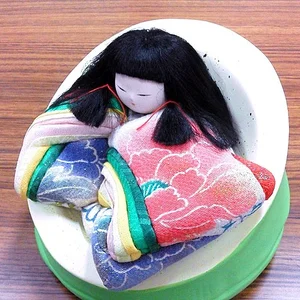

Legendary princess from Japanese folklore and heroine of The Tale of the Bamboo Cutter (Taketori monogatari), one of the oldest works in Japanese literature. Found as a child inside a glowing bamboo stalk and raised by a peasant couple, she grows into a woman of extraordinary beauty before returning to the Moon, her true home.
Frequently asked questions
Key Facts
- Discovered as a child inside a shimmering bamboo stalk by a woodcutter
- Her exceptional beauty draws Japan's most distinguished suitors, each of whom she sets an impossible task
- Revelation of her true identity: she is a princess sent from the Moon, temporarily exiled on Earth
- Returns to the Moon with her celestial family despite the love of the Emperor of Japan, who tries to keep her
- Central character of the Taketori monogatari, written around the 10th century
Works & Achievements
The founding text of Japanese literature, in which Kaguya-hime is the central heroine. The tale recounts her discovery inside a bamboo stalk and her transformation into a woman of legendary beauty, laying the foundations of medieval Japanese mythology.
The legendary trials imposed by Kaguya-hime on the noblemen who wish to marry her, testing their courage and wisdom. These tasks embody the values of Heian aristocracy and remain a major element of classical Japanese narrative tradition.
The mythological climax of the tale, in which Kaguya-hime returns to her true lunar origins. This ascent symbolizes transcendence and impermanence — central themes of the Buddhist philosophy that shaped the Heian period.
The legendary magical object that Kaguya-hime leaves behind in Japan before her return to the Moon, representing a link between the earthly world and the celestial realm. This motif embodies the quest for eternity in medieval Japanese literature.
Kaguya-hime established the archetype of the heroic and mysterious female character in Heian court literature. Her story profoundly shaped the development of the monogatari genre and the conception of femininity in classical Japanese culture.
Anecdotes
The Taketori Monogatari (The Tale of the Bamboo Cutter) is the oldest novel in Japanese literature, written around the 10th century during the Heian period. It tells the story of Kaguya-hime, a princess discovered inside a glowing bamboo stalk by a poor woodcutter. The tale influenced all of medieval Japanese literature and remains a foundational work studied to this day.
According to the original tale, Kaguya-hime receives five noble suitors who attempt to win her heart with lavish gifts. The princess sets them each an impossible task to complete, demonstrating her intelligence and her power to refuse marriage — a revolutionary stance for the Heian period, when women had very few rights.
The Taketori Monogatari is one of the earliest works of Japanese literature to place a female heroine at the center of the narrative. Kaguya-hime is no mere damsel in distress, but a strong character who controls her own fate all the way to her return to the Moon, her true home.
The motif of the glowing bamboo stalk containing Kaguya-hime symbolizes the irruption of the divine or supernatural into everyday Japanese life. This poetic image has inspired countless artistic adaptations, from Noh theater to modern cinema, reflecting the enduring place this tale has held in Japanese culture for over a thousand years.
The original tale includes an episode in which the Mikado (the Emperor of Japan) seeks to meet Kaguya-hime and keep her by his side. This reflects the historical reality of the Heian period, when imperial power was paramount, while also showing that even the highest earthly authority cannot hold Kaguya-hime back from her lunar destiny.
Primary Sources
Long ago there lived an old man known as the Bamboo Cutter. One day, as he was cutting bamboo in a forest, he came upon a stalk that glowed with an extraordinary light. Upon splitting it open, he found inside a tiny girl, no taller than three inches, of wondrous beauty.
Tales of beings descended from the Moon and of celestial princesses appear in the oral traditions of the people, passed down from generation to generation.
Stories of supernatural beauties and beings descended from the heavens formed part of the literary repertoire of the Heian period.
Key Places
The legendary region where Kaguya-hime was said to have been discovered inside a bamboo stalk by the bamboo cutter. This place symbolizes the princess's mysterious origins and remains a pilgrimage site associated with the tale.
The imperial capital of Japan during the Heian period, when The Tale of the Bamboo Cutter was written. This cultural center is where the legend of Kaguya-hime took shape and went on to influence Japanese literature.
The seat of imperial power where noble courtiers attempt to win Kaguya-hime's hand in the story. This place represents the aristocratic court and the earthly ambitions surrounding the princess.
The sacred mountain mentioned in The Tale of the Bamboo Cutter as the starting point for the rituals and trials imposed on Kaguya-hime's suitors. A symbol of Japanese spirituality deeply tied to the myth.
Kaguya-hime's final destination and true homeland according to the legend. She returns to the Moon at the end of the tale, revealing the divine, celestial nature she had kept hidden from the very beginning.
Typical Objects
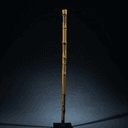
The central symbol of the tale — it is inside a glowing bamboo stalk that Kaguya-hime is discovered as a child. Bamboo represents the link between the earthly and celestial worlds, and remains the founding element of her story.
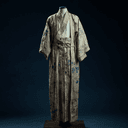
The sumptuous garment worn by Kaguya-hime during her life on earth. Silk, a prestigious textile in the Heian period, symbolizes her exceptional beauty and her elevated status in aristocratic society.

A typical grooming object of the Heian period, the mirror reflects Kaguya-hime's legendary beauty and represents the vanity of the suitors who court her.

The tale's greatest cosmic symbol, the Moon is Kaguya-hime's true home and the final destination of her celestial return, embodying her supernatural essence.
📷 CC BY-SA 3.0 · Wikimedia Commons ↗
A personification of the trade and tools of the peasant who discovers Kaguya-hime. The bamboo cutter and his tools represent the ordinary rural world set in contrast with the miraculous.

An aristocratic accessory of the Heian period, the fan was a refined everyday object for women of the court, symbolizing the elegance and sophistication of imperial court culture.

Tools associated with the literary culture of 10th-century Japan, they evoke the composition of the Taketori Monogatari itself — one of the earliest prose narratives written in Japanese.
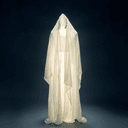
Symbolizing Kaguya-hime's supernatural nature, these luminous garments mark her miraculous appearance and divine essence, setting her apart from the mortal world.
School Curriculum
Vocabulary & Tags
Key Vocabulary
Daily Life
Morning
Kaguya-hime wakes up in the humble peasant home of her adoptive parents. She prepares herself with cold water and helps with the morning household chores, including preparing the main meal of rice and seasonal vegetables.
Afternoon
The afternoon is devoted to domestic work: spinning, weaving, and tending the surrounding crops. Gradually, as her beauty becomes legendary, she receives visits from nobles and suitors who attempt to win her over with gifts and trials.
Evening
At the end of the day, Kaguya-hime retreats to her inner chambers, where she composes poetry and gazes at the moon. She shares simple meals with her adoptive parents and engages in quiet conversation that reflects her sensitive, melancholic nature.
Food
Her diet consists mainly of rice, miso, locally grown vegetables (squash, beans), and occasionally dried fish. Tea and water are the common drinks, while seasonal fruits round out the simple meals of a peasant household.
Clothing
She initially wears the plain garments of a peasant woman of the Heian period, then gradually adopts the refined kimono offered by her noble suitors. Her long black hair, a symbol of beauty, is adorned with simple accessories before being dressed with luxurious jade and silk ornaments.
Housing
She lives in a simple thatched-roof wooden farmhouse, typical of the 10th century. The dwelling grows larger and more beautiful with the riches brought by her suitors, yet retains its modest structure, nestled within a rural Japanese landscape surrounded by bamboo groves.
Historical Timeline
Period Vocabulary
Visual Style
Un style inspiré de l'art de la période Heian japonaise, fusionnant l'ukiyo-e et la peinture de cour traditionnelle avec une ambiance lunaire et onirique. Les illustrations combinanderaient des motifs de bambou délicats, des tissus soyeux sophistiqués et une atmosphère de beauté surhumaine baignée de clair de lune.
Sound Ambience
Une ambiance sonore envoûtante mêlant la quiétude d'une forêt de bambou avec des instruments traditionnels japonais et des éléments célestes, évoquant la nature surnaturelle de Kaguya-hime et son retour à la Lune.
Liens externes & ressources
Références
Œuvres
Taketori monogatari (Le Conte du Coupeur de Bambou)
Xe siècle environ
Les Cinq Épreuves impossibles
Époque de Heian (VIIIe-XIIe siècles)
Le Retour à la Lune
Époque de Heian (VIIIe-XIIe siècles)
L'Élixir d'immortalité lunaire
Époque de Heian (VIIIe-XIIe siècles)
L'Influence littéraire sur le monogatari
À partir du Xe siècle