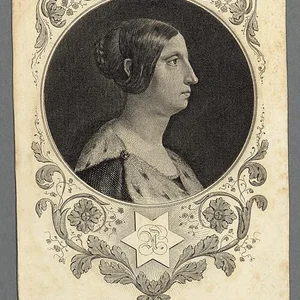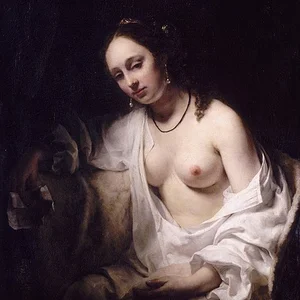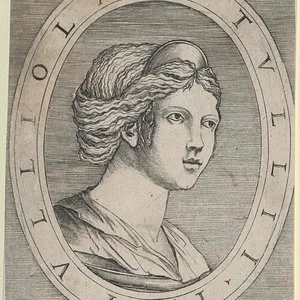

Tullia was the only and beloved daughter of the great Roman orator Cicero and Terentia. Her premature death plunged her father into deep grief, as his correspondence attests. She embodies the condition of the elite Roman woman at the end of the Republic.
Tullia(78 av. J.-C. — 44 av. J.-C.)
Tullia Ciceronis
Rome antique
6 min read
Frequently asked questions
Key Facts
- Born around 79-78 BC, the only daughter of Cicero and Terentia
- Married three times, notably to Publius Cornelius Dolabella
- Died in 45 BC shortly after childbirth, causing Cicero immense grief
- Cicero considered raising a shrine (fanum) to her memory, a project that was never realized
Works & Achievements
Her three marriages (Piso, Crassipes, Dolabella) also served her father's political strategies in the Rome of the late Republic.
Cicero praised his daughter's wit and education: a rare case of an elite woman lauded for her intellectual qualities.
A philosophical treatise Cicero composed to overcome his grief after Tullia's death, now lost but often cited in antiquity.
Written about her death, it is one of the most famous letters of consolation from antiquity, preserved in Cicero's correspondence.
Cicero wished to raise a shrine to his daughter in order to deify her: a unique testimony of a planned private cult devoted to a mortal.
For historians, her figure embodies the condition of the aristocratic matron and the strength of family bonds at the end of the Republic.
Anecdotes
Cicero adored his daughter and tenderly nicknamed her "Tulliola
(little Tullia) and *deliciae meae* (my delight) in his letters. These words of affection
rare in the correspondence of a great Roman man
reveal a father-daughter bond that was exceptionally warm for the time.
Tullia was betrothed very young, around 67 BC, to Gaius Calpurnius Piso Frugi, whom she married in 63 — the year her father was consul and foiled the Catiline conspiracy. Piso remained loyal to Cicero and worked for his recall from exile, before dying prematurely in 57.
In 50 BC, while Cicero was governing the distant province of Cilicia, Tullia married Publius Cornelius Dolabella, a young supporter of Caesar. The situation was delicate: her new husband belonged to the political camp opposed to her father's, on the eve of the civil war.
When Tullia died in February 45 BC, Cicero sank into immense grief. He withdrew to his solitary villa at Astura, read everything the philosophers had written about mourning, and composed for himself a *Consolatio*, a treatise now lost.
Cicero wanted to make his daughter a deity: he planned to raise a *fanum*, a shrine, in her honor, and feverishly searched for gardens along the Tiber on which to build it. This plan for a private cult, unique of its kind, was never carried out.
Primary Sources
I have arranged a match for our little Tullia with Gaius Piso, son of Lucius, Frugi.
In this solitude I speak to no one; in the morning I hide myself in a thick and wild forest, and I do not emerge until evening.
On my return from Asia, as I was sailing from Aegina towards Megara, I began to contemplate the regions around me. Behind me lay Aegina, before me Megara, on my right the Piraeus, on my left Corinth: cities once so flourishing, which now lie overthrown and in ruins before our eyes. And we, frail mortals, grow indignant if one of us dies!
I want a shrine to be built for her, and that is something no one can wrest from me.
Key Places
Capital of the Republic where Tullia was born and where Cicero's family owned its domus, at the heart of Roman political life.
Cicero's favorite country residence, in the hills southeast of Rome, where Tullia died in February 45 BC.
Cicero's secluded villa on the coast of Latium, where he withdrew to mourn his daughter and sought gardens in which to build her a shrine.
The home town of Cicero's family, from which the Tullii Cicerones took their name and their ancestral estates.
Typical Objects

The distinctive long dress of the Roman matron, a mark of a married woman of good birth. As a senator's daughter and a wife, Tullia wore it as a sign of her rank.

A large draped cloak that the matron threw over her stola to go out, sometimes covering her head as a sign of modesty.

Woolen bands braided into the upswept hair, reserved for respectable matrons and a symbol of their honorability.

The tabellae and the stilus were used for writing. Tullia was educated and could read and write, as revealed by the family letters of Cicero.

The sum Cicero paid out at his daughter's marriages; returning it after her divorce from Dolabella caused him real financial worries.

A grooming object of elite women, made of polished bronze and often richly decorated on the back.

Spinning wool (colus and fusus) embodied the ideal of domestic virtue expected of the Roman matron.
School Curriculum
Vocabulary & Tags
Key Vocabulary
Daily Life
Morning
Tullia rose at dawn with the household. As a matron, she supervised the awakening and work of the slaves, organized the home and ensured the smooth running of the domus while the men received their clients during the salutatio.
Afternoon
Afternoons were spent visiting female relatives and friends, reading and writing letters — Tullia could read and write — and sometimes a trip to the baths. She also supervised the spinning of wool, the ideal domestic virtue of the matron.
Evening
The main meal, the cena, was taken at the end of the day, reclining on couches in the triclinium. It was a time of family life and conversation, sometimes enhanced by readings or music.
Food
People ate bread, olives, cheese, fruit, vegetables and fish, seasoned with garum (fish sauce) and honey. Wine was diluted with water, and meat, which was rarer, was reserved mainly for banquets.
Clothing
Over a tunic of linen or wool, Tullia wore the stola, the long robe of married women, and then the palla to go out. Her upswept hair was bound with vittae, and she could wear gold jewelry, brooches and rings.
Housing
In Rome, the family lived in a domus organized around the atrium and the peristyle, decorated with frescoes and mosaics. In the countryside, she stayed in comfortable villas, such as the one at Tusculum where she died.
Historical Timeline
Period Vocabulary
Liens externes & ressources
Références
Œuvres
Mariages et alliances politiques
63–50 av. J.-C.
Une réputation d'intelligence et de culture
Ier siècle av. J.-C.
La « Consolatio » de Cicéron
45 av. J.-C.
La lettre de consolation de Servius Sulpicius
45 av. J.-C.
Le projet de « fanum »
45 av. J.-C.
Symbole de la femme romaine de l'élite
postérité