
Fulvia was a Roman aristocrat of the late Republic, famous for her exceptional political involvement for a woman of her time. Successively the wife of Clodius, Curio, and then Mark Antony, she led the armed resistance against Octavian during the Perusine War.
Frequently asked questions
Key Facts
- Born around 83 BC into a great family of the Roman nobility
- Wife of Publius Clodius Pulcher, tribune of the plebs, until his assassination in 52 BC
- Married to Mark Antony around 47-46 BC, she became an influential figure in Roman politics
- Organized and led the resistance against Octavian during the Perusine War (41-40 BC)
- Died in exile at Sicyon, in Greece, in 40 BC
Works & Achievements
Fulvia organized and supported the armed resistance against Octavian alongside Lucius Antonius, an exceptional act for a Roman woman.
She turned her husband's funeral into a political demonstration and testified at the trial of his murderer, Milo.
While Antony was away in the East, she defended his cause, supported his followers, and negotiated with the senators.
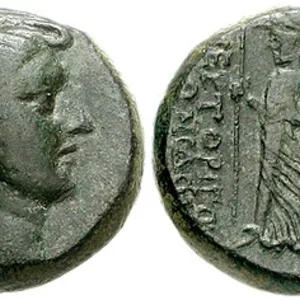
Her image as Victory circulated on coins, an unprecedented sign of a Roman woman's public visibility.
According to Cassius Dio, she girded on a sword and addressed the soldiers herself, taking on an unprecedented military role.
She took sides in the dispute over the settlement of veterans, defending the Italian cities threatened with confiscation.
Anecdotes
When her first husband, the tribune Clodius, was killed in 52 BC on the Appian Way, Fulvia displayed his bloodied body in the atrium of their home. Distraught, the crowd carried the corpse to the Forum and cremated it inside the Curia, the Senate building, which also went up in flames.
Fulvia is regarded as the first real Roman woman — not a goddess — to appear on coinage. Around 43–41 BC, her profile appeared in the guise of the winged Victory, and a city in Phrygia was even renamed “Fulvia” in her honor.
During the War of Perusia (41–40 BC), Fulvia gave military backing to Lucius Antonius, the brother of Mark Antony, against Octavian. Archaeologists have recovered lead sling bullets (glandes) from the site engraved with insults, several of which target Fulvia directly: proof that she was recognized as a genuine enemy commander.
According to the historian Cassius Dio, after the assassination of Cicero in 43 BC — the orator who had violently attacked both her and Mark Antony in his speeches — Fulvia is said to have pierced with her golden hairpins the tongue of the severed head displayed in the Forum. The episode, perhaps embellished, illustrates the cruelty of the proscriptions.
When Fulvia died in 40 BC, having taken refuge in Greece, Mark Antony and Octavian seized the chance to reconcile: they laid the blame for the civil war on her and sealed their peace with the Treaty of Brundisium.
Primary Sources
Fulvia cared nothing for spinning wool or keeping house, nor would she deign to rule over a husband without glory: she wanted to govern the one who governed and to command the one who commanded.
Fulvia girded on a sword, gave the watchword to the soldiers, and on many occasions harangued them herself.
Fulvia, who had nothing of the woman about her except her body, threw everything into confusion through war and discord.
Fulvia, wife of Antony, and Lucius, his brother, raised an army against Octavian and shut themselves up in Perusia, which was immediately besieged.
Antony lets himself be ruled by this greedy woman, to whom he must give account as to a demanding mistress.
Key Places
Capital of the Republic where Fulvia was born, lived, and conducted her political activities at the heart of the aristocracy's intrigues.
Political center of Rome where the crowd, after Clodius's funeral, set fire to the Senate building in 52 BC.
City in Etruria where Fulvia and Lucius Antonius were besieged by Octavian before surrendering in 40 BC.
Greek city where Fulvia, having fled Italy after the defeat at Perugia, briefly reunited with Mark Antony.
City in the Peloponnese where Fulvia, sick and abandoned, died in exile in 40 BC.
Typical Objects
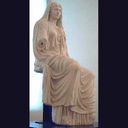
Long robe worn over the tunic, the distinctive mark of respectable Roman matrons that Fulvia wore as an aristocrat.
📷 Domaine public · Wikimedia Commons ↗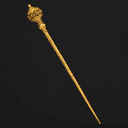
Hair accessories of wealthy Roman women; tradition holds that Fulvia is said to have used one against the tongue of Cicero's severed head.
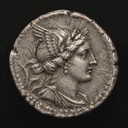
Small coins on which Fulvia's profile appears in the guise of Victory, an unprecedented honor for a Roman woman during her lifetime.

Projectiles engraved with inscriptions found at Perusia, several of which insulted Fulvia by name during the siege.
📷 CC BY 3.0 · Wikimedia Commons ↗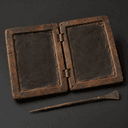
Writing surfaces used for the political correspondence she maintained while Mark Antony was away in the East.

Large draped shawl that matrons pulled over the head and shoulders to appear in public with dignity.
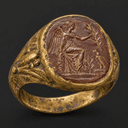
Engraved ring used to seal letters and documents, a sign of the authority she exercised over her husband's affairs.
School Curriculum
Vocabulary & Tags
Key Vocabulary
Daily Life
Morning
Like any well-off matron, Fulvia rose early. She received the clients and visitors who came to greet the family (the salutatio), gave orders to the household slaves, and oversaw the smooth running of the domus.
Afternoon
In the afternoon, she devoted herself to activities unusual for a woman: political correspondence, receiving her husband's allies, and following the intrigues of the Forum. Plutarch notes that she preferred ruling the powerful rather than spinning wool.
Evening
In the evening came the cena, the main meal, often shared with influential guests at banquets where alliances were forged. Reclining on the couches of the triclinium, the guests discussed politics between courses.
Food
The diet of wealthy Romans was varied: bread, olives, cheese, fruit, vegetables, fish, and meats, seasoned with garum, a fermented fish sauce. Wine, always diluted with water, accompanied meals.
Clothing
Fulvia wore the tunic, then the stola of married women, and the palla, a draped shawl for going out. Gold jewelry, ornate pins, and elaborate hairstyles displayed her aristocratic rank.
Housing
She lived in a vast domus in Rome, organized around the open-air atrium and its pool (the impluvium). Wall frescoes, floor mosaics, and ancestral masks (the imagines) recalled the family's prestige.
Historical Timeline
Period Vocabulary
Liens externes & ressources
Références
Œuvres
Direction de la guerre de Pérouse
41-40 av. J.-C.
Mobilisation politique après la mort de Clodius
52 av. J.-C.
Gestion des intérêts de Marc Antoine à Rome
44-41 av. J.-C.
Première Romaine figurée sur une monnaie
vers 43-41 av. J.-C.
Levée et harangue de troupes
41 av. J.-C.
Opposition aux distributions de terres d'Octave
41 av. J.-C.