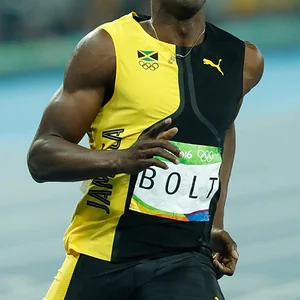

Jamaican sprinter widely regarded as the fastest man in history. The world-record holder in both the 100 m and the 200 m, he dominated his sport across three consecutive Olympic Games.
Usain Bolt(1986 — ?)
Usain Bolt
Jamaïque
6 min read
Frequently asked questions
Key Facts
- Born on August 21, 1986, in Sherwood Content (Jamaica)
- Triple Olympic champion at the 2008 Beijing Games (100 m, 200 m, 4×100 m relay)
- 100 m world record of 9.58 seconds set in Berlin in 2009
- 200 m world record of 19.19 seconds set in Berlin in 2009
- Eight Olympic gold medals (Beijing 2008, London 2012, Rio 2016)
Works & Achievements
Set at the Berlin World Championships and never beaten since: the fastest sprint in human history.
Still unbeaten, this record showcases his unique dominance over both blue-riband sprint distances.
The first sprinter to break the 100 m and 200 m world records at the same Games.
Three titles (100 m, 200 m, relay) across three consecutive Olympics, an unprecedented feat in athletics.
A record that places him among the greatest Olympic champions of all time.
The story of his life and career, where he reveals the behind-the-scenes of his feats and his preparation.
Anecdotes
In the 100 m final at the 2008 Beijing Olympics, Usain Bolt broke the world record in 9.69 s even though he had slowed down and spread his arms before the finish line. Experts estimated that he could have gone much faster if he had sprinted all the way through.
His nickname “Lightning Bolt” plays on his last name “Bolt,” which actually means “lightning bolt” in English. His famous pose, one arm stretched toward the sky like an archer, has become a gesture recognized all over the world.
As a child, Bolt mainly dreamed of becoming a cricket or football player, and it was his coach who steered him toward sprinting after seeing his exceptional speed. Very tall for a sprinter (1.95 m), he challenged the common belief that shorter athletes get off the blocks faster.
At the 2012 London Games and then the 2016 Rio Games, he achieved the “triple-triple” by winning the 100 m, the 200 m, and the 4×100 m relay at three consecutive Olympics. One Beijing relay medal was, however, later taken away from him because of a teammate's doping.
Bolt is known for his relaxed and playful attitude before races: he would joke around with the cameras and the crowd just seconds before world finals, which contrasted with the extreme tension of top-level athletics.
Primary Sources
Men's 100 m: 9.58 s, Usain Bolt (JAM), Berlin, 16 August 2009. World record still standing.
Men's 200 m: 19.19 s, Usain Bolt (JAM), Berlin, 20 August 2009.
In it, Bolt recounts his childhood in Sherwood Content, his relationship with sprinting, and how he prepared for the major championships.
Usain Bolt: eight Olympic gold medals in the 100 m, 200 m, and 4×100 m relay, won at the 2008, 2012, and 2016 Games.
Key Places
Rural village in northwestern Jamaica where Usain Bolt was born and grew up. It was here that he discovered running through play and school competitions.
Jamaica's main athletics stadium, where Bolt trained and won many races in front of his home crowd.
The Olympic stadium in Beijing where Bolt burst onto the world stage in 2008, breaking the 100 m and 200 m records.
The setting of the 2009 World Championships, where Bolt set his world records in the 100 m (9.58 s) and the 200 m (19.19 s).
The site of his triple titles at the 2012 Games and of his last major race at the 2017 World Championships.
Typical Objects

Ultralight athletic shoes fitted with metal spikes under the front of the foot to maximize grip on the track. Bolt wore models designed specifically for his long strides.

Adjustable pads fixed to the track against which the sprinter braces his feet to launch forward. Equipped with sensors, they detect false starts down to the thousandth of a second.

A small rigid tube that runners in the 4×100 m relay pass to one another within a marked zone. Bolt often ran the final leg, the Jamaican team's decisive weapon.

The supreme reward given to the winner of an event at the Olympic Games. Bolt amassed eight of them, becoming one of the greatest champions in the history of athletics.

An outfit in the green, gold and black colors of the Jamaican flag, worn by Bolt in international competition. It became a symbol of Jamaican dominance over world sprinting.

An automatic photo-finish timing system measuring times to the hundredth, and even the thousandth, of a second. It is what made Bolt's legendary records official.
School Curriculum
Vocabulary & Tags
Key Vocabulary
Tags
Daily Life
Morning
A top-level sprinter's day starts early with a muscle warm-up and an energy-rich breakfast. Bolt would go through stretching and warm-ups before the first training session.
Afternoon
The afternoon was devoted to technical work on the track: starts, accelerations and stride work, as well as strength training to build power. Recovery and care (massages, physiotherapy) played a major role.
Evening
The evening was for rest, relaxation and restorative sleep, essential for muscle recovery. Known for his cheerful temperament, Bolt also enjoyed music and the company of his loved ones.
Food
A sprint athlete follows a diet rich in proteins and carbohydrates for strength and energy. Bolt has said he ate large quantities of chicken nuggets during the Beijing Games, but his usual diet was overseen by nutritionists.
Clothing
In competition, he wore Jamaica's skintight green and gold jersey and ultralight spikes. In training, tracksuits and breathable technical clothing were the norm.
Housing
Coming from a modest rural Jamaican village, Bolt later lived in Kingston, close to his training center. His success allowed him to enjoy a comfortable lifestyle, split between Jamaica and his international travels.
Historical Timeline
Period Vocabulary
Liens externes & ressources
Références
Œuvres
Record du monde du 100 m (9,58 s)
2009
Record du monde du 200 m (19,19 s)
2009
Doublé olympique de Pékin
2008
« Triplé-triplé » olympique
2008-2016
Huit médailles d'or olympiques
2008-2016
Autobiographie « Faster than Lightning »
2013