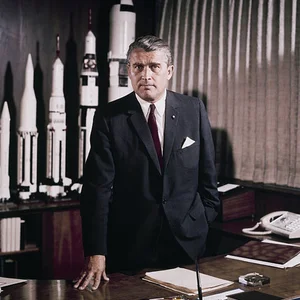

A German-American aerospace engineer, he designed the V-2 rocket for Nazi Germany before being recruited by the United States. He then led NASA's Saturn V program, which carried Apollo 11 to the Moon in 1969.
Wernher von Braun(1912 — 1977)
Wernher von Braun
États-Unis, Troisième Reich, république de Weimar, Empire allemand, Allemagne de l'Ouest
8 min read
Frequently asked questions
Famous Quotes
« Science has no homeland, but the scientist has one.»
« I consider the rocket to be a means to a higher end, and space exploration to be the noblest of all.»
Key Facts
- 1912: born in Wirsitz (German Empire, now Poland)
- 1942: first successful launch of the V-2 rocket at Peenemünde
- 1945: captured by the Americans under Operation Paperclip, he joins the American space program
- 1958: oversees the launch of Explorer 1, the first American satellite
- 1969: the Saturn V rocket he designed sends Apollo 11 to the Moon
Works & Achievements
The world's first ballistic missile to cross the boundary of space, designed as a weapon of war for Nazi Germany. It formed the technological foundation for all space exploration in the second half of the 20th century.
The first ballistic missile of the U.S. Army, developed by von Braun in Huntsville. A modified version, the Jupiter-C, launched Explorer 1 in 1958, and another variant carried Alan Shepard — the first American in space — in 1961.
Von Braun published in this major American magazine a series of illustrated articles accurately describing future space stations, lunar voyages, and missions to Mars, making him the first great popularizer of space exploration.
Von Braun collaborated with Walt Disney on three television documentaries about space exploration, watched by millions of Americans. These programs helped build public support for investment in the space program.
The most powerful launch vehicle ever built (110 m tall, 3,000 t), whose design von Braun oversaw from 1961 to 1967. It successfully propelled the Apollo missions to the Moon, including Apollo 11, which achieved the first crewed lunar landing in history.
Von Braun directed the Marshall Space Flight Center, which was responsible for developing the Saturn V launch vehicle and service module. His role was decisive in achieving Kennedy's goal of landing a man on the Moon before 1970.
Anecdotes
In March 1944, as the war was turning against Germany, the Gestapo arrested Wernher von Braun and two of his colleagues. They were accused of making defeatist remarks and of being more interested in space travel than in weapons. It was the German army itself — unable to do without his genius — that stepped in to secure his release after two weeks.
On May 2, 1945, as the war drew to a close, von Braun organized the surrender of his team to American soldiers rather than to the Soviets. He had secretly prepared trucks loaded with blueprints and technical documents, which he had hidden in an abandoned mine. His reasoning was straightforward: the United States would, in his view, offer better working conditions for continuing his research.
At a NASA banquet in the 1950s, von Braun was asked how he felt working for the Americans after having worked for Hitler. He reportedly replied with a quip that the V-2 rocket had worked perfectly — it had simply landed on the wrong planet. This line, which became famous, illustrates how he downplayed his own responsibility for the bombings that killed thousands of civilians.
The Saturn V rocket he designed for NASA was a machine of staggering power: weighing 3,000 tonnes at liftoff and standing 110 metres tall, it remains to this day the most powerful rocket ever put into service. Von Braun oversaw every detail of its design over many years. When Apollo 11 lifted off on July 16, 1969, he wept openly in the control room.
The shadow of his Nazi past never left von Braun. Satirist and songwriter Tom Lehrer dedicated an ironic song to him in 1965, with the lines: “Once the rockets are up, who cares where they come down? That’s not my department, says Wernher von Braun.” Historians have documented that he visited the underground Mittelwerk factory, where concentration camp prisoners from Camp Dora were forced to manufacture V-2 rockets under lethal conditions.
Primary Sources
We must remember that our rockets can reach the stars. But for now, they are landing on England. I am working for the future, even though I must work in the present.
We have the technical capability to send a man to the Moon and return him safely to Earth before the end of this decade, provided the nation is willing to commit the resources necessary to this national objective.
Within ten to fifteen years, Earth will have its first artificial satellite in orbit. Men will live and work in space, and a space station will serve as a stepping stone to the Moon and the planets.
The Saturn V is designed for a crewed lunar mission. Its liftoff thrust exceeds 3,400 tons-force, making it the most powerful launch vehicle ever built by humanity.
The A-4 rocket development program required years of fundamental research in liquid propulsion, aerodynamics, and gyroscopic guidance. The technical challenges were considerable, but the Peenemünde team overcame them one by one.
Key Places
Birthplace of Wernher von Braun on March 23, 1912, then part of the Prussian province of the German Empire. He grew up in an aristocratic and cultured family, developing a passion for astronomy at a very young age.
A top-secret facility on the island of Usedom where von Braun led the development of the V-2 rocket from 1937 to 1945. It was here that the first successful test launches took place and the modern rocket age was truly born.
An underground factory carved into the Harz mountains where V-2 rockets were mass-produced by prisoners from the Dora concentration camp. Around 20,000 forced laborers died there from exhaustion or mistreatment — a dark chapter that von Braun never fully acknowledged.
A city in the American South where von Braun lived and worked from 1950 to 1970. He led the development of the Redstone, Jupiter-C, and Saturn V rockets there, and became a beloved local figure.
The launch facility from which all major rockets of the American space program were fired. Von Braun watched the liftoffs of the Apollo missions from the control center, including Apollo 11 on July 16, 1969.
Typical Objects

An indispensable analog calculation tool for engineers of the era, von Braun used it to quickly perform trajectory and thrust calculations during rocket design, before the age of electronic computers.

Von Braun's technical masterpiece, this 14-meter rocket was the first to reach space and to be used as a ballistic weapon; it formed the technological foundation for all subsequent space exploration.

After his recruitment by the United States in 1945, von Braun participated in test flights and wore the standard attire of American military engineers — a symbol of his transformation from Nazi scientist to hero of the space race.

Near the end of the war, von Braun had several tons of technical documents hidden in a mine in the Austrian Alps to protect them from the destruction ordered by Hitler and hand them over to the Americans.

In the 1950s, von Braun published articles illustrated with detailed models of a future wheel-shaped space station, becoming one of the first popularizers of space exploration for the American general public.

A masterpiece of 20th-century engineering, this 110-meter, 3,000-ton launch vehicle — every component of which von Braun supervised — propelled twelve astronauts to the Moon between 1969 and 1972.
School Curriculum
Vocabulary & Tags
Key Vocabulary
Tags
Daily Life
Morning
At Peenemünde in the 1940s, von Braun arrived early in the morning at the design offices, where dozens of engineers worked on rocket blueprints. He took an active part in technical meetings, making corrections and asking sharp questions about propulsion and guidance calculations.
Afternoon
His afternoons were often devoted to tests at the proving ground or to conferences with military officials. At NASA in the 1960s, he moved from one meeting to the next with his engineering teams and traveled frequently between Huntsville and Cape Canaveral to oversee tests.
Evening
Von Braun was known for his sociability and his love of classical music, particularly Bach, and he played the piano. He often had colleagues over for dinner, discussing science as readily as philosophy or religion, for he was a deeply devout man.
Food
After settling in the United States he embraced American ways, enjoying Southern grilling, family barbecues, and convivial meals. Back in Germany, his aristocratic upbringing had given him a taste for refined cuisine, though wartime rationing had imposed frugality.
Clothing
During the war he wore the SS uniform (he had been a member since 1940) on official occasions, and a technician's coat for workshop duties. In the United States he consistently wore a suit and tie, projecting the image of the respectable scientific executive he wished to embody.
Housing
At Peenemünde, engineers and their families lived in company houses built on the research center's own grounds, forming a kind of isolated scientific village. In Huntsville, he lived in a comfortable suburban home with his wife Maria and their three children, leading a thoroughly American middle-class family life.
Historical Timeline
Period Vocabulary
Liens externes & ressources
Références
Œuvres
Fusée V-2 (Aggregat 4, A-4)
1942
Fusée Redstone
1953
Série d'articles dans Collier's Weekly
1952
Émissions télévisées avec Walt Disney ('Man in Space')
1955
Fusée Saturn V
1967
Programme Apollo (direction technique)
1961-1969