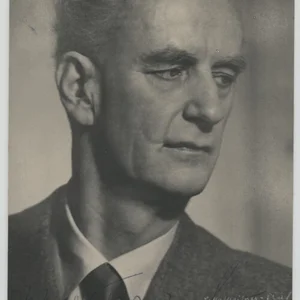

Wilhelm Furtwängler was a German conductor and composer, considered one of the greatest musical directors of the 20th century. He notably led the Berlin Philharmonic Orchestra and remains famous for his interpretations of Beethoven, Brahms, and Wagner. His career under the Third Reich still sparks debate about his relationship with the Nazi regime.
Wilhelm Furtwängler(1886 — 1954)
Wilhelm Furtwängler
Allemagne
6 min read
Frequently asked questions
Key Facts
- Born in 1886 in Berlin, died in 1954 in Baden-Baden
- Music director of the Berlin Philharmonic Orchestra from 1922 onward
- Remained in Germany during the Nazi regime, which led to a denazification trial from which he was acquitted in 1946
- Renowned for his interpretations of Beethoven's symphonies, particularly the Ninth
- Considered a master of Romantic conducting, favoring spontaneity and sweep over metronomic precision
Works & Achievements
Nearly thirty years at the helm of one of the world's greatest orchestras, shaping a sound and a style that became legendary.
Furtwängler is regarded as one of the greatest Beethoven interpreters; his Ninth and Fifth Symphonies are benchmarks.
A legendary studio version, often cited as one of the most profound ever recorded of this opera.
Reopening concert of the post-war festival, whose recording became an absolute reference in the discography.
A vast symphony of over an hour, a major work by Furtwängler the composer, in the German Romantic tradition.
An ambitious work revealing his aspiration as a composer in the lineage of Brahms and Bruckner.
A large-scale symphony reflecting his aspiration to extend the great Germanic symphonic form.
Anecdotes
During his concerts, Furtwängler gave entrances so imprecise and trembling that the musicians of the Berlin Philharmonic joked that they came in “when his baton reached the third button of his waistcoat.” Yet the resulting sound had a striking cohesion: he sought an organic sound, never a mechanical one.
In 1942, for Hitler's 53rd birthday, Furtwängler conducted Beethoven's Ninth Symphony, filmed by the Nazi cameras. A famous image shows him, the concert over, shaking the hand of Joseph Goebbels — a gesture that would haunt him all his life and fuel the accusation that he had served as a cultural endorsement of the regime.
Furtwängler used his prestige to protect Jewish musicians in his orchestra. He intervened notably on behalf of his secretary and several instrumentalists, and resigned dramatically from his official positions in 1934 after the banning of the opera *Mathis der Maler* by his friend Paul Hindemith.
At the end of the war, in 1945, Furtwängler fled to Switzerland to escape a possible arrest by the Gestapo. He was then subjected to a denazification trial and was not allowed to resume his career until 1947, after being cleared.
Furtwängler dreamed above all of being a composer, in the lineage of Bruckner and Brahms. He composed in particular vast symphonies, but his worldwide fame as a conductor always eclipsed, to his great regret, his work as a creator.
Primary Sources
In the end there is only one dividing line: the one that separates good music from bad music. As long as I am confronted with Hindemith the talentless noise-maker, I shall have nothing to worry about.
Great German music was created for free men; it can live only where freedom of the spirit prevails.
I knew that Germany was going through a terrible crisis; I felt responsible for German music, and it was my duty to have weathered that crisis together with my people.
He protected, saved, and helped a great many Jewish musicians; he was one of the few who had the courage to openly resist the Nazis in the realm of art.
Key Places
Furtwängler's birthplace and home of the Berlin Philharmonic Orchestra, which he conducted for decades. The centre of his artistic life and of the controversies surrounding him under Nazism.
From 1922, Furtwängler conducted the prestigious Gewandhaus Orchestra here, in a city deeply shaped by the legacy of Bach and Mendelssohn.
A shrine to the cult of Wagner, where Furtwängler conducted and where he reopened the festival after the war in 1951 with a memorable Ninth Symphony of Beethoven.
Furtwängler maintained close ties with the Vienna Philharmonic Orchestra, one of the greatest in the world, which he conducted regularly.
Furtwängler's refuge in 1945, where he escaped the collapse of the Reich and the Gestapo; here he composed and found a haven during those troubled years.
The region where Furtwängler died in 1954. A renowned spa town in south-western Germany.