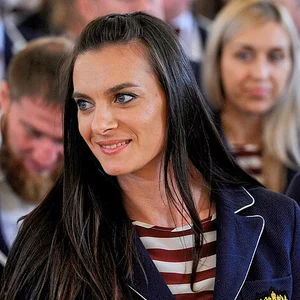

Russian pole vaulter born in 1982, Yelena Isinbayeva is considered the greatest athlete in the history of women's pole vault. A two-time Olympic champion and three-time world champion, she set 28 world records over the course of her career.
Yelena Isinbayeva(1982 — ?)
Yelena Isinbayeva
Russie
6 min read
Frequently asked questions
Famous Quotes
« I want to fly. That's why I do pole vault.»
« Every record is a new frontier to push past.»
Key Facts
- Born on June 3, 1982, in Volgograd, Russia
- Two-time Olympic champion: Athens 2004 and Beijing 2008
- Three-time world champion, both indoors and outdoors
- Set 28 world records between 2003 and 2009
- World record: 5.06 m set in 2009 in Zurich, still a historic benchmark
Works & Achievements
The most iconic performance of her career, this record marked the symbolic crossing of the 5-meter barrier and remains one of the most enduring athletic marks in sports history.
Isinbayeva is one of the rare athletes to have won consecutive Olympic gold medals in the same event, demonstrating absolute dominance over an entire decade.
Three world titles over a ten-year career stand as testament to exceptional longevity and consistency at the highest level of world athletics.
A unique streak in athletics history: Isinbayeva broke the world record 28 times, each time pushing the boundaries of what was possible in women's pole vault.
An autobiographical work in which Isinbayeva recounts her journey from gymnast to Olympic champion, offering an insider perspective on Soviet and then Russian athletic training.
Following her retirement from competition, Isinbayeva was elected to the International Olympic Committee, continuing to shape world sport as an athletes' representative.
Anecdotes
Yelena Isinbayeva began her sporting career as a gymnast, but at 15 she was too tall to continue competing. Her coach Evgeni Trofimov suggested she try pole vault, a discipline where her flexibility and muscular power would prove extraordinary.
At the 2004 Athens Olympics, Isinbayeva broke the world record on the day of the final itself, setting the bar at 4.91 m. She had a habit of 'ordering' her records in advance from her technical team, writing in a notebook the exact height she intended to clear.
Over the course of her career, Isinbayeva set 28 world records, the last of which — 5.06 m — came at the 2009 World Championships in Berlin, a record that stood for several years. Clearing the symbolic 5-metre barrier had been a goal she had publicly set for herself.
Despite the collective ban on Russian athletes at the 2016 Rio Olympics due to state-sponsored doping, Isinbayeva was named flag bearer for the Russian delegation at the opening ceremony, only to be ultimately excluded by the International Olympic Committee. She announced her retirement from sport shortly afterward, sending a wave of emotion through the athletics world.
Primary Sources
"I promised my fans that I would clear 5 metres. Today I did it. This is the most beautiful moment of my sporting life."
Isinbayeva, Yelena (RUS) — Women's pole vault: gold medal, world record set at 4.91 m in the Olympic final.
"Winning Olympic gold twice is something extraordinary. I want to keep pushing the boundaries of what is possible for women in this sport."
Yelena Isinbayeva claims the world title for the third time in Moscow with a vault of 4.89 m, cementing her status as the greatest pole vaulter of all time.
Key Places
Isinbayeva's hometown, formerly known as Stalingrad, where she grew up and began her athletic career. The central stadium in Volgograd is associated with her earliest training sessions.
The site of her first Olympic gold medal in 2004, where she set a world record of 4.91 m in front of tens of thousands of spectators.
The stage for her second Olympic title in 2008, where she set a world record of 5.05 m, cementing her absolute dominance in the discipline.
It was here, at the 2009 World Championships, that Isinbayeva set her definitive world record of 5.06 m — one of the most enduring records in athletics history.
The legendary stadium where Isinbayeva claimed her third world title in 2013 in front of a home crowd, in an atmosphere of extraordinary national pride.
Typical Objects

Isinbayeva's signature tool, custom-built to match her weight and height. She worked closely with engineers to fine-tune the pole's stiffness for each competition.

Light and rigid, these specialized shoes allowed her to build up speed on the track before her jump. She kept several pairs adapted to different weather conditions.

Isinbayeva meticulously recorded her record goals, physical sensations, and technical progress. This personal journal was a central tool in her mental preparation method.

The leotard in the white, blue, and red colors of the Russian flag — a symbol of the national pride Isinbayeva wore during her victories at major championships.

A collection of gold medals won in Athens (2004), Beijing (2008), and three times at the World Championships, representing a career unmatched in her discipline.

The permanent installations at athletics stadiums where Isinbayeva trained daily in Volgograd and at the National Training Center in Sochi.
School Curriculum
Vocabulary & Tags
Key Vocabulary
Daily Life
Morning
During training periods, Isinbayeva's alarm went off around 7 a.m. She would start with a light 30-minute jog to get her blood flowing, followed by a stretching and joint mobility session — essential for the flexibility demanded by her discipline.
Afternoon
Afternoons were devoted to intensive technical training: approach run work, pole plant, the ascent, and bar clearance. Sessions lasted three to four hours at the national training center, supervised by her coach Yevgeny Trofimov.
Evening
Evenings focused on muscle recovery: alternating cold and hot baths, therapeutic massages, and video analysis of her jumps to identify technical corrections to work on the following day.
Food
Isinbayeva followed a diet developed by Russian sports nutritionists: high in protein (white meat, fish, eggs), complex carbohydrates (rice, pasta, cereals) for training energy, and low in saturated fats. She placed great importance on hydration and vitamin supplements.
Clothing
During training, she wore lightweight technical gear (thermal tights, breathable t-shirt) in the colors of the Russian national team. In competition, her leotard in white, blue, and red was custom-made to minimize air resistance during the jump.
Housing
Isinbayeva lived primarily in Volgograd, her hometown, in an apartment she had purchased with her first prize money. She also spent time at national training centers in Sochi and during training camps abroad.
Historical Timeline
Period Vocabulary
Visual Style
Photographie sportive dynamique en contraste élevé, mettant en valeur la silhouette gracieuse et puissante d'une perchiste à l'apogée de son saut dans un stade olympique.
Sound Ambience
Ambiance d'un stade d'athlétisme lors d'une finale de saut à la perche : bruits de course, flexion de la perche, foule en tension puis explosion de joie.
Liens externes & ressources
Références
Œuvres
Record du monde à 5,06 m — Championnats du monde de Berlin
2009
Double titre olympique — Athènes 2004 et Pékin 2008
2004-2008
Triple titre mondial IAAF — Paris 2003, Osaka 2007, Moscou 2013
2003-2013
28 records du monde consécutifs
2003-2009
Autobiographie « Je veux voler »
2009
Engagement au CIO — Membre élue
2016