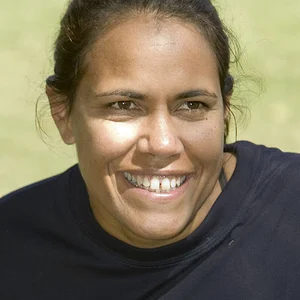

An Australian athlete of Aboriginal descent, Cathy Freeman became Olympic champion in the 400 metres at the Sydney 2000 Olympic Games. She is an iconic figure of reconciliation between Australians and Aboriginal peoples.
Cathy Freeman(1973 — ?)
Cathy Freeman
Australie
8 min read
Frequently asked questions
Key Facts
- Born on 16 February 1973 in Mackay, Queensland, Australia, of Aboriginal descent (Kuku Yalanji nation)
- World champion in the 400 metres at the 1996 World Athletics Championships in Atlanta
- Olympic champion in the 400 metres at the Sydney 2000 Olympic Games, before a crowd of 110,000 spectators
- Had the honour of lighting the Olympic flame during the opening ceremony of the Sydney 2000 Games
- After her victory, ran her lap of honour carrying both the Australian flag and the Aboriginal flag
Works & Achievements
Freeman won the 400 m at the Commonwealth Games in Victoria (1994) and then in Kuala Lumpur (1998), establishing herself as the finest female quarter-miler in the Commonwealth.
Her first world title launched Freeman onto the international stage and made her the first Indigenous Australian athlete to win a world athletics championship.
A silver medal at the Atlanta Olympics confirmed Freeman among the world's best and fuelled hopes of a title on home soil in Sydney.
The crowning moment of Freeman's career: victory in 49.11 seconds in front of her home crowd, in a stadium that fell silent then erupted with joy — one of the most iconic images in modern Olympic history.
A charitable organisation established after Freeman's retirement from sport to fund access to education for Indigenous Australian children in remote and rural communities.
A symbolic act of profound historical significance: by carrying the Olympic flame, Freeman embodied the spirit of reconciliation between Australia and its Indigenous peoples before a global audience of billions.
Anecdotes
At the opening ceremony of the 2000 Sydney Olympic Games, Cathy Freeman was chosen to light the Olympic cauldron — a moment of immense symbolic significance. She walked through a pool of water surrounded by flames, becoming the face of an Australia seeking reconciliation with its First Nations peoples before the entire world.
After winning gold at the 1994 Victoria Commonwealth Games, Freeman completed her lap of honour carrying both the Australian flag and the Aboriginal flag. The head of the Australian delegation reprimanded her for what he called an 'inappropriate' gesture, but Freeman fully embraced her dual identity, turning the controversy into an act of political resistance.
During the 400 metres final at the Sydney Olympics on 25 September 2000, a stadium of 112,000 people held its breath. Freeman, wearing a green and gold hooded bodysuit, crossed the finish line in 49.11 seconds, then sat for a moment on the track, overwhelmed with emotion, before setting off on an unforgettable lap of the stadium carrying both flags.
Freeman grew up in a family marked by poverty and the trauma of the 'Stolen Generations' — Aboriginal children forcibly removed from their families by the Australian government. Her maternal grandmother, Alice, had herself been a victim of this policy. This painful family history fuelled her activism and gave her sporting achievements a significance far greater than any athletic record.
In 1997, Freeman won the 400 metres world title in Athens, becoming the first Aboriginal Australian athlete to be a world track champion. She dedicated her victory to her half-sister Anne-Marie, who had died in 1990 from complications related to cerebral palsy, and whose memory stayed with her throughout her entire career.
Primary Sources
"I represented all of Australia that night. It was bigger than me, bigger than sport. I carried the hope of reconciliation of an entire people."
"I am Australian and I am Aboriginal. I don't see why I should have to choose one over the other. Both flags represent me."
"Winning that gold medal at home, in front of my people, was living the dream. But that dream belonged to all Australians, and I hope it brought us closer together."
"Sport gave me a voice. I use that voice to say that Aboriginal peoples deserve dignity, recognition and justice."
Key Places
A coastal city in Queensland where Cathy Freeman was born in 1973. It was in this region, shaped by the presence of Aboriginal communities, that she grew up and developed her passion for running.
A 110,000-seat venue where Freeman lit the cauldron during the opening ceremony and won gold in the 400m on 25 September 2000. This place remains forever associated with one of the most moving moments in Olympic history.
The host city of the 1994 Commonwealth Games, where Freeman, after her victory in the 400m, simultaneously raised both the Australian flag and the Aboriginal flag, sparking a national controversy.
The venue for the 1997 World Athletics Championships, where Freeman became the first Aboriginal Australian to win a world track title, claiming gold in the women's 400m.
A tropical Queensland region home to the Indigenous communities supported by the Cathy Freeman Foundation, established in 2003, which works to improve access to education for Aboriginal children.
Typical Objects

Revolutionary hooded suit worn by Freeman during the Sydney 2000 Olympic final, designed to reduce air resistance. This suit became an iconic symbol and has since been displayed at the Olympic Museum in Lausanne.

Black, red, and yellow flag created in 1971 by Harold Thomas, which Freeman began waving after her victories in 1994. It represents her connection to her heritage and her fight for the recognition of First Nations peoples.

Running shoes with metal spikes used on synthetic tracks, an essential tool for the middle-distance sprinter. Freeman wore Nike models throughout her professional career.

Medal won at the Sydney 2000 Games, made of gilded silver with a core of Australian native gold. It stands as a symbol of athletic achievement and the struggle for reconciliation.

The enormous circular structure that Freeman walked through to light the flame during the opening ceremony. This monumental object embodies the moment when sport and Aboriginal politics converged before 4 billion television viewers.

Electronic timing equipment accurate to one hundredth of a second, used in athletics competitions. Freeman's 49.11 seconds at Sydney remains one of the most celebrated performances in the history of women's athletics.
School Curriculum
Vocabulary & Tags
Key Vocabulary
Tags
Daily Life
Morning
During her competitive years, Freeman rose early for interval training sessions on the track, typically between 6 and 8 a.m. She began with muscle activation exercises and dynamic stretching before running sets of 200 to 400 metres under her coach's guidance.
Afternoon
Afternoons were dedicated to weight training, active recovery (swimming, physiotherapy), and video analysis of her performances. Her training sessions could total four to five hours per day during intensive preparation periods ahead of major competitions.
Evening
Evenings were marked by rest, recovery care, and staying in touch with family and loved ones. Freeman long maintained a strong connection with her Aboriginal community in Queensland, drawing strength from it between international competition tours.
Food
A high-performance athlete's diet rich in complex carbohydrates, lean proteins, and vegetables, tailored to the intense energy demands of middle-distance running. Freeman placed great importance on hydration and nutritional recovery after exertion.
Clothing
In training, lightweight compression gear, spiked shoes on the track or running shoes on roads. In competition, her full-length green and gold hooded bodysuit became her trademark. Outside of sport, she favoured a relaxed Australian casual style.
Housing
Freeman divided her life between Brisbane and Sydney during the competition season, making use of Australia's top-level sporting facilities. She always maintained ties with Queensland, her home region, and the Aboriginal communities she actively engaged with after her retirement.
Historical Timeline
Period Vocabulary
Visual Style
Le style visuel de Cathy Freeman associe l'esthétique dynamique du sport de haut niveau des années 2000 — combinaison aérodynamique verte et or, piste rouge du stade — aux couleurs profondes de la terre australienne et aux motifs de l'art aborigène à pointillés.
Sound Ambience
L'ambiance sonore de Cathy Freeman mêle le rugissement d'un stade olympique en délire, le claquement des pointes sur la piste rouge et les résonances du didgeridoo et des clapping sticks, instruments traditionnels aborigènes symboles de son identité culturelle.
Liens externes & ressources
Références
Œuvres
Victoire aux Jeux du Commonwealth — 400 m
1994 et 1998
Titre de championne du monde — 400 m, Athènes
1997
Médaille d'argent olympique — 400 m, Atlanta
1996
Médaille d'or olympique — 400 m, Sydney
25 septembre 2000
Création de la Cathy Freeman Foundation
2003
Allumage de la vasque olympique de Sydney
15 septembre 2000