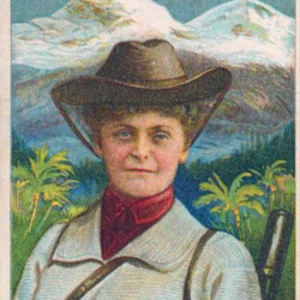

American mountaineer and educator (1850–1935), pioneer of women's mountaineering. In 1908 she climbed Huascarán in Peru, a summit of nearly 6,800 meters, setting an altitude record for the Western Hemisphere. A women's rights activist, she planted a suffragist flag at the top of a Peruvian mountain.
Annie Smith Peck(1850 — 1935)
Annie Peck
États-Unis
9 min read
Frequently asked questions
Key Facts
- 1850: born in Providence, Rhode Island, United States
- 1895: first woman to climb the Matterhorn in Switzerland (wearing trousers, scandalizing public opinion)
- 1908: ascent of North Huascarán (Peru), then the highest summit reached in the Western Hemisphere
- 1911: planted a suffragist flag "Votes for Women" at the summit of Coropuna (Peru)
- 1935: died in New York at the age of 84
Works & Achievements
A detailed account of her expeditions in the Andes, including the ascent of Huascarán in 1908. The work blends adventure, geography, and an implicit advocacy for women's equality.
A travel guide to South America aimed at the general English-speaking public, based on her many expeditions. It helped bring the Andes to the attention of American and European readers.
Written at age 82 following a flight over the South American continent, this book illustrates Peck's ability to embrace new technologies and continue exploring until the very end of her life.
A series of articles and lectures recounting the ascent of the Matterhorn, which launched Peck's public career and her image as a pioneer of women's mountaineering on the international stage.
The first documented ascent of the north summit of Huascarán by a woman, setting what was at the time the altitude record for the Western Hemisphere and receiving worldwide press coverage.
Anecdotes
In 1895, Annie Peck climbed the Matterhorn in Switzerland, one of the most feared peaks in the Alps. What scandalized public opinion as much as the feat itself was her outfit: she wore knickerbockers instead of the long traditional skirt expected of women. Newspapers published caricatures mocking her, but Peck refused to give in, arguing that a skirt was dangerous and impractical at high altitude.
On September 2, 1908, after several unsuccessful attempts spread over more than a decade, Annie Peck reached the north summit of Huascarán in Peru at approximately 6,654 meters above sea level. She was 58 years old — an age at which most climbers of the era had long since hung up their crampons. Her rival Fanny Bullock Workman challenged her measurements by funding a French geodetic expedition to verify them — a sign that women were now competing for sporting records just as fiercely as men.
In 1911, Annie Peck climbed the Coropuna volcano in Peru and planted a small pennant at the summit, at over 6,000 meters altitude, bearing the inscription “Votes for Women.” This symbolic gesture made headlines around the world and permanently linked her name to the suffragist cause. She was 61 years old and continued climbing to defend her convictions as much as to break records.
Annie Peck was above all an intellectual: trained as a Latinist and Hellenist, she was one of the first women to earn a degree from the University of Michigan (1878) and to study at the American School of Classical Studies in Athens. She taught Latin at Purdue University before devoting herself to mountaineering. This double life — rigorous professor and high-altitude adventurer — made her unique in a world where women were expected to choose between scholarship and daring.
At age 82, Annie Peck made an airplane journey over South America to write her last book, 'Flying Over South America' (1932). She remained active until the end of her life, giving lectures and writing articles even as her health declined. She died in New York in 1935, aged 84, leaving a legacy that inspired generations of mountaineers and women's rights advocates.
Primary Sources
We had conquered Huascarán. After years of effort, failure, and hardship, the summit was ours. The panorama from that altitude defied all description — a sea of peaks and glaciers stretching to the horizon.
Seen from the air, the great Andean cordillera appeared as the wrinkled backbone of the continent, its peaks gleaming white against the blue sky — familiar yet possessed of a new magnificence.
The Matterhorn demands not only physical strength, but the most absolute composure. I wore knickerbockers and I make no apology for it; safety in the mountains allows no room for false modesty.
What I have achieved in the heights of the Andes, I have done as a woman. I plant this flag for all those who will come after me — so that no summit may be too high for our ambition.
Key Places
Annie Peck's birthplace, where she was born on October 19, 1850, into a cultured and progressive family. Her education in this city opened the doors to higher learning at a time when such opportunities remained rare for women.
Peck climbed this iconic mountain in 1895, becoming one of the first women to do so. Her outfit — loose-fitting trousers — caused a scandal and launched her international fame.
The highest peak in Peru (6,768 m at the south summit), whose north summit Peck reached in 1908 at the age of 58. The climb earned her the altitude record for the Western Hemisphere at the time.
An Andean volcano (6,425 m) atop which Peck planted a suffragist "Votes for Women" flag in 1911, permanently linking her mountaineering feats to her political commitment to women's rights.
Home to the University of Michigan, where Annie Peck earned her degree in 1878, among the first women admitted to this pioneering coeducational institution.
The city where Annie Peck spent much of her adult life, lecturing, writing her books, and advocating for women's rights. She died there on July 18, 1935.
Typical Objects

An essential tool for mountaineers, the ice axe served both as a support on icy slopes and as a brake in case of a slide. Annie Peck carried one on all her major Andean ascents.

Metal frames fixed under boots to make progress on ice and hard snow. Peck used them on her high-altitude expeditions in Peru, on particularly dangerous glaciers.

Roped parties of the era used natural-fiber ropes, far less reliable than modern nylon ropes. Peck depended on hers for her life on difficult passages, together with her Peruvian guides.

Loose trousers gathered below the knee, adopted by Peck in place of the skirts imposed on women. This clothing choice, dictated by mountain safety, became a symbol of her fight for women's emancipation.

An instrument measuring atmospheric pressure to estimate altitude. Peck used it to document her records — data that became the subject of public controversy with her rival Fanny Bullock Workman.

Heavy and cumbersome at the time, the camera was taken on expeditions to document ascents and illustrate lectures and books. Peck's summit photographs served as undeniable proof of her achievements.

A small embroidered flag bearing the slogan of the women's suffrage movement, planted by Peck at the summit of Coropuna in 1911. This symbolic gesture at over 6,000 meters made the front pages of many American and European newspapers.
School Curriculum
Vocabulary & Tags
Key Vocabulary
Tags
Daily Life
Morning
On expeditions in the Andes, Annie Peck rose before dawn in temperatures that were often below freezing to prepare equipment alongside her Peruvian guides. She meticulously checked ropes, ice axes, and crampons before tackling the icy slopes. Between expeditions, she wrote her articles and prepared her lectures from the moment the sun rose.
Afternoon
Ascents were concentrated in the morning to avoid avalanches caused by warming snow at altitude. Base camp afternoons were devoted to recording scientific observations, taking barometric measurements, and photographing the surrounding landscapes. Back in the city, she gave lectures at geographical clubs or university associations.
Evening
In the evenings on expedition, huddled in her tent beneath the icy winds of the Andean heights, Peck wrote in her journal by the light of an oil lamp. In the city, she attended dinners hosted by literary or feminist societies, passionately advocating for equal rights. She read voraciously — Latin and Greek classics, as well as travel literature and scientific journals.
Food
On high-altitude expeditions, Annie Peck relied on simplified rations: dried meat, hardtack, chocolate, and hot tea, in keeping with the practices of mountaineers of her era. In Andean villages, she ate local dishes — potatoes, quinoa, and corn soup — and appreciated the hospitality of the Peruvian locals. She was known for her dietary frugality, convinced that keeping the body light made for easier ascents.
Clothing
On the slopes, Annie Peck wore knickerbockers (baggy breeches fastened just below the knee), a thick wool shirt, a waterproof coat, and a wide-brimmed hat — an outfit considered scandalous for a woman of her time but perfectly suited to the rigors of the mountains. She wore wool leggings and sturdy hobnailed boots. In society, she conformed to late Victorian fashion with long, high-collared dresses.
Housing
During her Andean expeditions, Peck slept in cotton tents mounted on wooden frames, pitched on glacier slopes at several thousand meters above sea level. Between expeditions, she lived in modest furnished apartments in New York or in the university towns where she taught. She had no fixed home and considered temporary lodgings perfectly suited to her lifestyle as an adventurer perpetually on the move.
Historical Timeline
Period Vocabulary
Liens externes & ressources
Références
Œuvres
A Search for the Apex of America
1911
The South American Tour
1913
Flying Over South America
1932
Ascension du Cervin — articles de presse
1895
Record d'altitude au Huascarán (sommet nord)
1908