Imaginary interview with Agnez Mo
by Charactorium · Agnez Mo (1986 — ?) · Performing Arts · Economics · Music · 6 min read
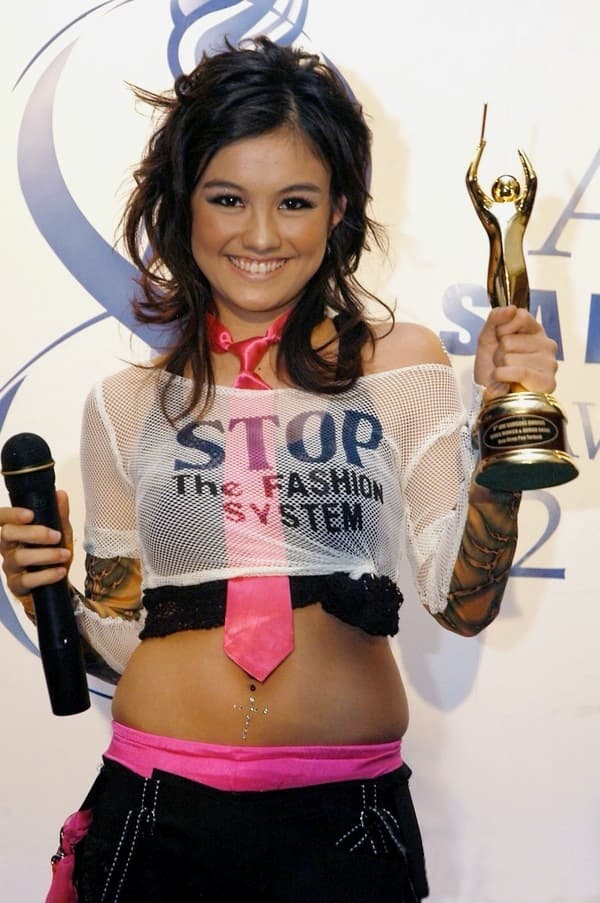
Imaginary meeting in Los Angeles, in a studio where sheets of lyrics scribbled in English still lie around and, pinned to the wall, an old poster of a concert at Istora Senayan. Between two choreography rehearsals, Agnez Mo — born Agnes Monica Muljoto in Jakarta — agrees to trace back the thread, from the TV set where she sang as a child to the American charts. She speaks quickly, with the discipline of someone who has been working since the age of six.
—Do you remember the moment it all began, on those Indonesian TV sets?
I was six years old. In Jakarta, they put a microphone in my hands in front of a camera, on a children's show, and I've never really let it go since. At seven, my first album was on the shelves. Other kids left school to play; I went from rehearsals to homework at night, to sets on weekends. As I once told the Jakarta Post, I started working very early, and it wasn't always easy — but my family supported me, and I learned the discipline of the profession before I even learned to write properly. They already called me the complete artist: singing, dancing, acting. For me it wasn't an achievement, it was just my way of growing up.
I learned the discipline of the profession before I even learned to write properly.
—How does one experience a childhood entirely paced by awards and tours?
Very young, I had trophies bigger than me — the AMI Awards, our Indonesian equivalent of the Grammys. It's exhilarating and it's tricky at the same time. A child who receives awards quickly learns that they are loved for what they produce, not just for who they are. With the album And the Story Goes... in 2003, as a teenager, I dominated the local charts, I filled venues in Jakarta. But in my head, I was doing my math homework in the dressing room. That double life — schoolgirl and national star — forged an endurance I've never lost. Even today, when I rehearse a choreography for hours, it's that disciplined little girl who holds the reins.
A child who receives awards quickly learns that they are loved for what they produce.
—What pushed you to leave everything behind to try your luck in America?
In 2010, I packed my bags for the United States. I was already a superstar in Indonesia, I could have stayed safe in my market, adored, comfortable. But something was itching: I wanted to know if a girl from Jakarta could hold her own where global pop is decided. Signing with Interscope Records in 2012 — the label of Lady Gaga, Eminem — wasn't just a line on a contract, it was a door I was forcing open. I rented an apartment in Los Angeles, I started almost from scratch: new working language, new codes, new producers. Starting over when you've already arrived somewhere is the most terrifying bet there is. And that's exactly why I did it.
Starting over when you've already arrived somewhere is the most terrifying bet there is.
—The single 'Coke Bottle' with Timbaland marks your real entry into the United States. How did that moment come about?
In 2013, I found myself in the studio with Timbaland, one of the greatest American producers, and T.I. on the mic. Coke Bottle was my first major English-language track, and it suddenly launched me into the American charts and international media. Working with Timbaland taught me that rhythm is sculpted like a material; he heard spaces where I only heard silence. I also collaborated with Rodney Jerkins around that time. These weren't just decorative meetings — it was a school. Each session confirmed to me that a Southeast Asian artist could sit at the same table as those giants, without complexes and without excuses.
He heard spaces where I only heard silence.
—Why did you drop the name Agnes Monica to become 'Agnez Mo'?
In 2014, I released my first fully English-language album, and I signed it Agnez Mo. Agnes Monica was the Indonesian child star, the little girl from the TV sets. Agnez Mo was the promise of an artist without borders. Changing your name isn't denying who you were — it's giving yourself a passport for who you want to become. The shortened, sharp name is pronounceable everywhere, in any mouth, in New York as in Seoul. It was a deliberate crossover move: I wanted my identity to fit in a single breath, to cross languages without stumbling. But under the new name, the same girl from Jakarta keeps singing.
Changing your name isn't denying who you were — it's giving yourself a passport for who you want to become.

—You stepped onto the stage of the MTV Europe Music Awards in Amsterdam in 2013. What did that moment represent?
Being nominated at the MTV EMA 2013 in Amsterdam, and appearing on Billboard the same year, was dizzying: few Indonesian artists had ever reached that level of visibility. But I didn't go up there just for myself. I've always believed that music has no boundaries, and if this door opened for me, it could open for other Asian artists behind me. As I told Billboard that year, I wasn't there to represent Indonesia alone — but every artist who dared to dream beyond their own borders. That's the real reward: not being an exception, but a precedent.
The real reward: not being an exception, but a precedent.
—You publicly take a stand on the representation of Asians in entertainment. Why this commitment?
When I arrived in Los Angeles, the question of ethnic diversity was just beginning to stir Western media. I could clearly see that an Asian face in this industry always had to justify itself twice as much. So I spoke up — about representation, about the place we are given or denied. I never saw myself as a professional activist, but I refused to stay silent and let people think we were merely tolerated. Soft power isn't decreed from above; it's earned artist by artist, song by song. Every time a girl from Jakarta or Manila gets played on American radio, a mental border retreats a little.
An Asian face in this industry always has to justify itself twice as much.
—The K-pop wave swept in after your first American steps. How do you situate your journey in relation to it?
When BTS and Blackpink conquered the world around 2017, the perception of Asian pop in the West suddenly shifted. Suddenly, what seemed exotic became desirable. But I had knocked on those doors a few years earlier, when no one was betting on a Southeast Asian artist. I'm not saying this to claim laurels — I'm saying it because pioneers often move in the dark. I believed in cultural globalization before it had a mainstream name in music. The Korean wave delighted me: it proved that the furrow I had begun to plow was leading somewhere.
Pioneers often move in the dark.

—You split your life between two continents. What does a typical day look like when you're recording in Los Angeles?
In Los Angeles, my day starts early, with sports — dance or fitness — because my stage performances are too choreographed to hold up without real endurance. Then I check my phone: my Indonesian fans are awake when I fall asleep, asleep when I work, so I grab the time difference to stay connected. Afternoon is studio or rehearsals with my dancers. Evening, when I'm not performing, I compose, write my lyrics in English, tailor my style to American pop codes. This double life has a price, but it also has its luxury: I never stop learning two worlds at once.
My fans are awake when I fall asleep; I grab the time difference to stay connected.
—What do you keep from Jakarta when you live in Los Angeles?
In my wallet, there are two allegiances: I obtained American citizenship, but my heart remains Indonesian. That dual passport is more than a piece of paper — it's my way of navigating between two industries without ever choosing to betray one. In Los Angeles, I wear streetwear, I live at the pace of the industry. But as soon as I return to Jakarta, I rush to find nasi goreng, rendang, the flavors that take me back to childhood. On stage, my costumes tell the same story: patterns from home sewn into the codes of international pop. You can learn a new language and new gestures without erasing the first melody you ever knew.
You can learn a new language without erasing the first melody you ever knew.
—What would you say to the six-year-old girl you were, if you could talk to her today?
I would tell her not to be afraid of distance. That child from Jakarta holding a microphone bigger than her hand could not imagine an apartment in Los Angeles, a contract with Interscope, sessions with Timbaland. But all of that was born from the same thing: discipline, and a stubborn curiosity that refuses borders. I would tell her that her double life will not be a tear, but a wealth; that she can dominate Istora Senayan and knock on the doors of New York without betraying herself. And above all, I would tell her that every door she forces will remain ajar for those who come after. That's what I wanted to leave behind, deep down.
Every door you force will remain ajar for those who come after.

This imaginary interview was generated by artificial intelligence from sources documented in Agnez Mo's profile. It dramatises what the figure might have said based on what we know about them, but does not constitute attested historical testimony. For primary sources and factual documentation, refer to the full profile.