Imaginary dialogue between Timbaland and Agnez Mo
by Charactorium · Agnez Mo (1986 — ?) · Performing Arts · Economics · Music · 5 min read
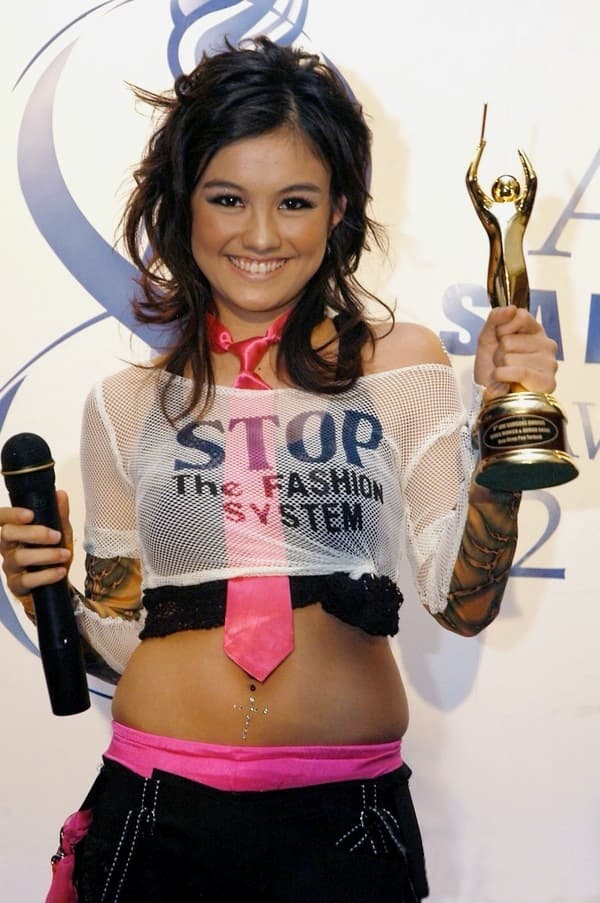
It's in a studio in Los Angeles, one evening in 2013, that Timbaland meets up with Agnez Mo between takes of Coke Bottle. The bass is still looping through the speakers, the booth's dim light carving out the consoles. The producer and the singer have known each other only a few months, but long enough to speak frankly. Timbaland sets down his headphones and wants to understand the path that brought this kid from Jakarta to his mixing board.
—Agnez, even before I met you, you'd been singing in Indonesia for years. I heard: six years old, on TV. Is that true?
It's true, Tim, and sometimes even I can hardly believe it. I was six when I first appeared on Indonesian television, and my first album came out at seven. I juggled school and sets, homework and rehearsals. You see me here, in your studio, talking production like an adult — but I learned the discipline of the business before I could write properly. It wasn't always easy, trust me. My family carried me, they held strong when the days were too long. When you ask me why I'm so demanding in sessions, that's the answer: I've never known anything but work.
I learned the discipline of the business before I could write properly.
—And that childhood in the spotlight — do you regret it, or would you do it again? I'm asking you almost like a father to a daughter.
I don't regret it, but I won't lie either: you grow up fast when you work at seven. I missed simple things other kids had — afternoons doing nothing, anonymity. In Indonesia, by my teens, they were already calling me a national icon. That's heavy for small shoulders. But you know what, Tim? That rigor they instilled in me so early is exactly what allowed me to end up here, in this studio, with you. Without that schooling, I would never have dared to cross an ocean. So yes, I'd do it again — but I'd make sure to keep a little bit of childhood somewhere.
You grow up fast when you work at seven.
—Let's talk about us. When we started working on Coke Bottle, you had just landed in the US. Do you remember that first session?
How could I forget? I was wound up tight, Tim. You are the producer everyone dreams of working with, and I came from Jakarta with my accent and my doubts. When you brought me into the booth for Coke Bottle, with T.I. on the track, I knew I was no longer in the regional league — I was in the American big leagues. That single was my official gateway to the US market. I had moved to Los Angeles, signed with Interscope, bet everything on it. And seeing you nod after my take, that little sign from you, was worth all the awards I had won back home.
I came from Jakarta with my accent and my doubts.
—Signing with Interscope, working with Rodney Jerkins and then me — for a Southeast Asian artist, that's still rare. Did you grasp the gamble?
Every day, Tim. That contract with Interscope — to me it's not just a piece of paper, it's the culmination of years of telling myself it was possible. Artists from our region who make it here, you can count on one hand. So working with you, with Rodney Jerkins — these are names I listened to since my teenage years on the other side of the world. The gamble was leaving everything behind — my established fame in Indonesia, my comfort — to start from zero, to become a nobody in Los Angeles. Many told me I was crazy to risk it. But I would rather fail trying than rule a market too small for my dreams.
I would rather fail trying than rule a market too small for my dreams.
—You often say you don't represent just Indonesia. When you sing in my studio, who or what are you thinking of?
I think of everyone who, like me, comes from a place people overlook when they talk about global pop. I'm not here just to represent Indonesia, Tim — I'm here for all the artists who dared to dream beyond their borders. Southeast Asia can compete at the highest level, I'm living proof. When I chart on Billboard, when I'm nominated at the MTV Europe Music Awards, it's not just my victory. It's a signal to a kid in Manila, in Bangkok, in Jakarta, who thinks they too have the right. Music has no boundaries — and if my door opens, I hope it opens others behind me.
I'm here for all those who dared to dream beyond their borders.

—You also champion the place of Asians in American entertainment. Is that a fight that costs you, or carries you?
Both, honestly. It carries me because I know why I do it, but it costs because you're constantly reminded of your difference. Here, in this industry, I've sometimes been looked at as a curiosity before being listened to as an artist. So I speak up, I speak out about Asian representation in entertainment, because if I stay silent, who will? You see, Tim, you opened doors for so many sounds, so many new voices. I'm trying to do the same for an entire region that wasn't expected in the charts. I believe culture can travel farther than an army — that's my way of serving my country.
I was looked at as a curiosity before being listened to as an artist.
—One thing puzzles me: back home you're Agnes Monica, here you become Agnez Mo. Why change your name for this market?
Because a name, Tim, is either a door or a wall. Agnes Monica is the little girl from Indonesian TV, the one my whole country has known for twenty years. But to get to your studio, to take the big leap into the world, I needed an identity that crosses borders without dragging all that past behind it. Agnez Mo is shorter, it snaps, it sticks in any language. It's not denying where I come from — on the contrary, I carry my roots everywhere. It's simply accepting that to conquer a new market, you sometimes have to reinvent yourself. Crossover isn't betrayal: it's translating who you are so others can understand you.
A name is a door or a wall.

—And this fully English album you're preparing — is it a break from your Indonesian, or a continuation?
A continuation, absolutely. Singing in English isn't erasing the Indonesian that built me — it's adding another string to my bow. My first fully English album will be me, the same artist, with a new language to reach an audience I couldn't before. You know, in Indonesia, they sometimes call me the 'total artist': I sing, dance, act, compose. I don't abandon that versatility by changing languages. I translate it. What I want, Tim, is to prove that you can come from over there and stand tall here, without denying your roots. English is the vehicle; my story remains Indonesian through and through.
English is the vehicle; my story remains Indonesian through and through.
—You now live between two cities. When you leave this studio at night, where do you go in your head — L.A. or Jakarta?
In both at once, and that's the strangest and most beautiful part. I have an apartment here in Los Angeles, at the heart of everything happening in music. And I have my family home in Jakarta, the one that smells like my home cooking. In the morning, I train, I dance, then I check my phone and it's already evening in Indonesia — my fans are waiting, time zone or not. I live with a passport in each pocket, literally. Some days it's exhausting, this double life. But when I go back to Jakarta and I have a nasi goreng, a rendang, I remember exactly where I come from. Los Angeles makes me grow; Jakarta keeps me whole.
Los Angeles makes me grow; Jakarta keeps me whole.
—Last question, lighter: between takes, you told me about your home cooking. What do you miss most here?
The table, Tim, the real table at home. Here, between studio sessions and rehearsals with my dancers, we eat fast, we eat healthy, because the stage demands athletic endurance. But nothing replaces a steaming soto or a slow-cooked rendang the way my family makes it. It's not just about taste, you understand — it's a piece of Jakarta I can hold in my hands, even thousands of miles away. When I go back, the first thing I do isn't sleep, it's eat. That's my way of reconnecting with who I really am, before heading off to conquer your world of bass and studios.
A piece of Jakarta I can hold in my hands.

This imaginary interview was generated by artificial intelligence from sources documented in Agnez Mo's profile. It dramatises what the figure might have said based on what we know about them, but does not constitute attested historical testimony. For primary sources and factual documentation, refer to the full profile.