Imaginary interview with Faith Ringgold
by Charactorium · Faith Ringgold (1930 — 2024) · Visual Arts · Society · 6 min read
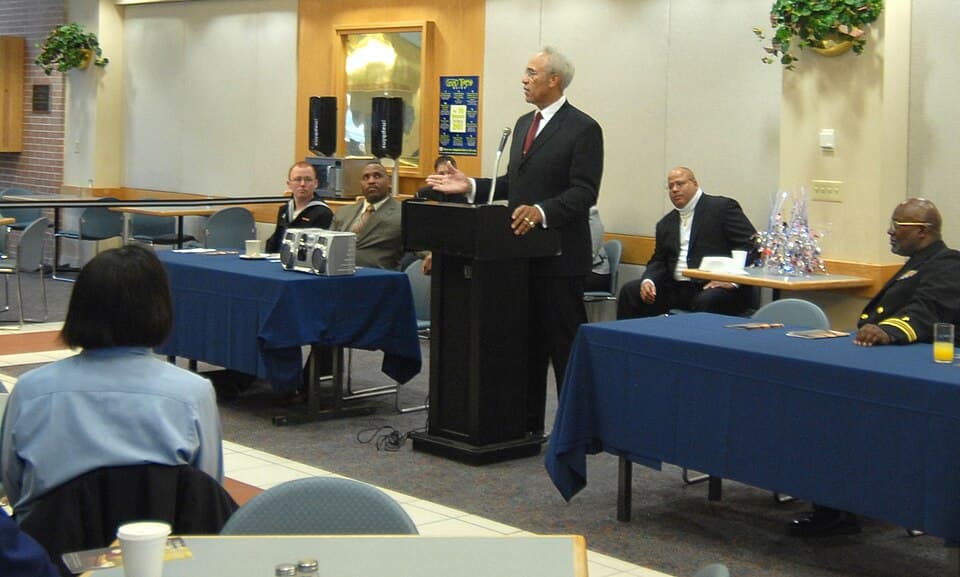
Englewood, New Jersey, a late winter afternoon. In a studio where painted quilts hang and spools of thread in every color lie about, Faith Ringgold, past ninety, welcomes us with a needle in her hand. Behind her, a panel of wax fabric on the wall hints at a story still unfinished.
—How did fabric enter your life long before painting?
I was an asthmatic child in Harlem, and there were whole days when I was forbidden to run outside. So my mother would sit me next to her. She was a fashion designer, her hands knew fabric better than anyone, and she put a needle and thread between my fingers the way others give a pencil. I remember the smell of new fabric swatches, the sharp sound of scissors cutting cotton. I didn't know it yet, but I was already learning my craft. Much later, when I quilted my first narrative quilts, it wasn't new: it was a gesture my fingers had memorized as a child, in a Harlem room, against asthma and boredom.
My mother put a needle between my fingers the way others give a pencil.
—Do you remember the masks you made with her?
In the 1970s, my mother, Willi Posey, and I sewed soft sculptures together, fabric masks we called soft sculptures. We were inspired by African arts, those faces that museums locked in display cases like curiosities, which we wanted to make alive, wearable, proud. It was a four-handed work: she cut, I painted the features, we stuffed them together. There was something very ancient in it, a woman-to-woman transmission, from the South where my family came from to that New York apartment. Those masks said: we have roots, and they are beautiful. Sewing at her side was mending a thread cut by slavery and exile.
—What drove you to invent what you call the story quilt?
I wanted my canvases to speak, literally. Painting alone seemed mute to me, and heavy frames were expensive and closed gallery doors. So around 1980, I surrounded my painted canvas with strips of quilted fabric and sewed the text directly onto the work. That's the story quilt: painting, fabric, and narrative in one object. It was reconnecting with the quilting of my grandmothers, that art that Black women practiced for generations without it ever being called art. As I wrote in my memoirs, 'I wanted to tell my story, or rather a part of it, and the story of my ancestors, through art.' The quilt gave me back my voice.
Painting alone seemed mute to me.
—Tell us about the little girl who flies over Harlem in Tar Beach.
Tar Beach, in 1988, is the tarred roof of our building, that 'beach' of the poor where we went up to breathe on summer nights. I placed Cassie Louise Lightfoot there, a little girl who, lying on a blanket, decides she owns everything her gaze flies over. In the book I made from it, she says: 'I can fly, yes, fly. Me, Cassie Louise Lightfoot, I flew over the highway, the buildings, the George Washington Bridge, in the starry sky.' Flying, for me, is never fleeing: it's claiming. A Black child soaring over Harlem and saying 'this is mine' — that's a gentle revolution, stitched in cotton.
Flying, for me, is never fleeing: it's claiming.
—Why do you so strongly want your stories to reach children?
When Tar Beach became a picture book in 1991, and received a Caldecott Honor, I understood I could speak to the young without talking down to them. A child who sees a Harlem girl like her flying in an award-winning book thinks that she, too, has the right to dream big. Big museums take years to open; a picture book goes straight into a bedroom, onto a lap, at bedtime. I spent my evenings writing these stories for young people, alongside the texts I sewed into my quilts. It's the same work: giving Black children heroes and dreams their size, before the world teaches them to look down.
—What were you seeking by protesting outside the Whitney and MoMA?
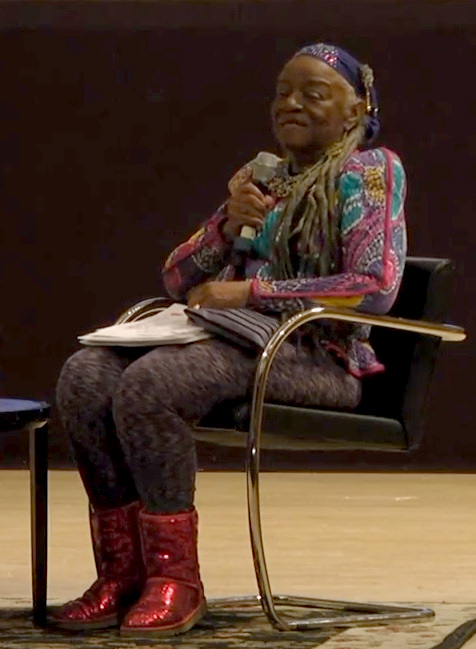
In the 1970s, I stood with others outside the Whitney Museum, then MoMA, to ask a simple question: where are the Black artists? where are the women? They mounted 'American' exhibitions without a single face like mine. Protesting was refusing that polite invisibility. I also co-founded, in 1971, the collective 'Where We At' Black Women Artists, because it wasn't enough to protest: we had to organize, show ourselves to each other, open our own doors. They called me an agitator. But a museum that hangs a country's history and erases half its inhabitants lies on its walls. I wanted it to tell the truth, or to own its lie in front of us.
A museum that erases half its inhabitants lies on its walls.
—You were arrested for allegedly desecrating the flag. How do you feel about that?
The American flag appears constantly in my work, but subverted, turned against the lie. In The Flag Is Bleeding, in 1967, I made it bleed: beneath its stars and stripes hides the racial violence this country refuses to see. I was accused of 'desecrating' the emblem, even briefly arrested. Desecrating? I only showed what the fabric covered. A flag is not sacred if the bodies it claims to protect fall in the streets. I painted it so that an American, looking at it, would finally ask what blood its colors are made of. It was my right, and I would do it again.
—Do you remember the day you were denied your painting degree?
Oh, I remember it very well. It was in 1963, at the City College of New York. I wanted a degree in painting, simply. They told me a woman could not enroll directly in that program, that I first had to get a teaching degree. As if art were men's business and women were only allowed to teach others. I swallowed the obstacle, I taught, I kept painting. But that humiliation never left me: it fueled my feminism as surely as segregation fueled my revolt. They wanted to bar a door; I made it the engine of a whole life as an artist.
They wanted to bar a door; I made it the engine of a whole life.
—How did that obstacle shape your view of women's place?
It taught me that talent isn't enough when the rules are written against you. I saw immensely gifted women fade for lack of an open door. So I made the lightness of my quilts a weapon: my fabric works, foldable, fit in a suitcase. Where galleries ignored me, I carried my work myself, on the train, into people's homes, into schools. No need for heavy frames or a director's permission. When Title IX in 1972 began demanding equality in education, I felt my anger from 1963 join a larger movement. A woman artist doesn't ask for permission: she makes herself indispensable.
—What truth do you seek to tell in a canvas like American People Series #20: Die?
Die, in 1967, is the America I saw out the window: a race riot, white and black bodies thrown against each other, terrified children in blood. I didn't paint an allegory; I painted what those years produced. This was after the March on Washington, after the Civil Rights Act, and yet violence persisted. That canvas is now at MoMA, the very museum I protested in front of — the irony is not lost on me. As I said during the Black Arts Movement, 'Art can change the world. That's why I paint: to tell the truth about what it means to be a Black woman in America.' A canvas doesn't have to console; it must bear witness.
A canvas doesn't have to console; it must bear witness.
—After so many battles, what do you hope to leave for those who will view your works long after you?
If I could imagine being read a century from now, I'd want them to understand this: I sewed beauty onto pain, without ever lying about either. My story quilts, from the Black Arts Movement to my latest children's stories, all say the same thing — a Black woman of America has the right to tell her own story, in her own language, with her mother's needle and the colors of her anger. I painted the truth of being Black and a woman in this country, and I wanted a little girl, one day, to stand before one of my quilts and think: I too can fly. If she thinks that, then I will have won.
I sewed beauty onto pain, without lying about either.
This imaginary interview was generated by artificial intelligence from sources documented in Faith Ringgold's profile. It dramatises what the figure might have said based on what we know about them, but does not constitute attested historical testimony. For primary sources and factual documentation, refer to the full profile.