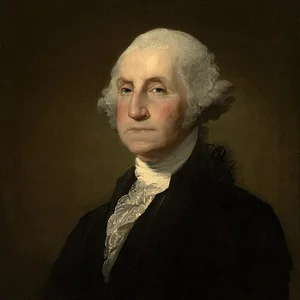

Commander-in-Chief of the Continental Army during the American War of Independence, George Washington became the first President of the United States (1789–1797). A Virginia planter and slaveholder, he embodies the contradictions of the young Republic — torn between ideals of liberty and the reality of slavery.
George Washington(1732 — 1799)
George Washington
États-Unis
8 min read
Frequently asked questions
Famous Quotes
« Liberty, once lost, is lost forever.»
« It is impossible to rightly govern the world without God and the Bible.»
Key Facts
- 1732: Born in Virginia into a planter family
- 1775–1783: Commands the Continental forces against the British Army
- 1783: Final victory and independence recognized by the Treaty of Paris
- 1789: Elected first President of the United States under the new Constitution
- 1799: Dies at Mount Vernon, leaving behind a consolidated republican nation
Works & Achievements
Washington's political testament, published as an open letter, in which he warned against political parties, regional factions, and permanent foreign alliances. This founding text had a lasting influence on American foreign policy and its isolationist stance well into the 20th century.
For eight years, Washington led a heterogeneous army — often poorly equipped and unpaid — against the professional forces of the British. His strategic talent and ability to hold the troops together proved decisive in securing the American victory.
Washington presided over the Philadelphia debates that resulted in the drafting of the U.S. Constitution, still in force today. His moral authority legitimized a revolutionary document that established, for the first time, a federal republican government.
As the first President of the United States, Washington set the fundamental precedents of the office: the Cabinet, diplomatic protocol, and the relationship with Congress. His refusal to seek a third term established the norm of democratic transition of power, followed until 1940.
Washington transformed his tobacco plantation into a diversified operation producing wheat, whiskey, dried fish, and manufactured goods. He introduced modern farming methods inspired by Enlightenment thinking and corresponded with European agronomists.
Anecdotes
On the night of December 25, 1776, Washington led his exhausted troops across the icy Delaware River to launch a surprise attack on Hessian soldiers at Trenton. This unexpected victory, after months of defeats, restored hope to an army on the verge of collapse. Without this bold gamble, the American Revolution might have crumbled.
Washington owned more than 300 enslaved people at Mount Vernon, including a cook named Hercules and a valet named Christopher Sheels. Aware of the contradiction between his republican ideals and his practice of slavery, he arranged in his will to free his personal enslaved people after his wife Martha's death — something few of the Founding Fathers were willing to do.
Elected twice by unanimous vote of the Electoral College, Washington declined a third term in 1796, thereby establishing the tradition of the peaceful transfer of presidential power. Napoleon Bonaparte himself, upon hearing of this decision, reportedly declared him 'the greatest man in the world.'
Washington suffered from severe dental problems throughout his life and wore dentures made not from wood, as popular myth claims, but from hippopotamus ivory, bone, and human teeth — some reportedly pulled from his own enslaved people. His dental pain directly influenced the grave expression seen in his official portraits.
Primary Sources
I retire from the great theatre of public action... If my services have been of any value to the country, I am happy to have had the opportunity to render them.
Beware of permanent alliances with the foreign world... Europe has a set of primary interests which to us have none, or a very remote relation.
I do hereby direct that all the slaves which I hold in my own right shall receive their freedom and emancipation upon the decease of my beloved wife.
Today I inspected the fields on the east side of the farm. The corn is growing well but the servants need to be more closely supervised in the north plot.
The fall of Cornwallis is an event of such importance that I hope it will help bring an end to a war that has caused so much suffering on both sides.
Key Places
An 8,000-acre family plantation on the banks of the Potomac River, where Washington spent most of his adult life and died in 1799. The estate, worked by more than 300 enslaved people, embodies the fundamental contradiction between the ideals of freedom he proclaimed and the slaveholding reality of the South.
Winter encampment of the Continental Army in 1777–1778, a symbol of American resilience during the darkest days of the war. Washington held his troops together through extreme cold, hunger, and disease that ravaged the camp, maintaining both discipline and morale.
Site of British General Cornwallis's surrender in October 1781, marking the last major battle of the Revolutionary War. Washington coordinated with Rochambeau and Lafayette to execute the decisive siege that forced the British to negotiate peace.
The building where the Declaration of Independence was signed (1776) and where Washington presided over the Constitutional Convention (1787). This red-brick landmark is the institutional birthplace of American democracy.
The site of Washington's inauguration as the first President of the United States on April 30, 1789. New York served as the nation's first federal capital before the seat of government moved to Philadelphia and later to Washington, D.C.
Typical Objects

Washington wore a gold-hilted sword during military ceremonies, a symbol of his supreme command. In 1783, he symbolically surrendered it to Congress to mark the subordination of military power to civilian authority.

An essential tool for observing enemy positions from high ground, Washington used a spyglass during his field reconnaissance. It embodies the role of careful tactician he played throughout the war.

As the owner of a large tobacco and later wheat plantation, Washington was deeply passionate about modern agricultural techniques. At Mount Vernon, he introduced an improved plow and experimented with crop rotation.

In keeping with the etiquette of the Virginia gentry and European courts, Washington wore a white powdered wig and an embroidered silk or velvet suit on official occasions. These garments signaled his social standing and political legitimacy.

Suffering significant tooth loss as early as his forties, Washington wore several sets of dentures made from hippopotamus ivory and bone, held in place by painful metal springs. They account for the tight, closed-lipped expression seen in his official portraits.

Washington took his oath of office on a Masonic Bible at his presidential inauguration in 1789, a symbolic gesture uniting Protestant faith with Enlightenment ideals. Episcopal Protestant religion structured the social and moral calendar of life at Mount Vernon.
School Curriculum
Vocabulary & Tags
Key Vocabulary
Tags
Daily Life
Morning
Washington rose before dawn, around 5 a.m., and rode on horseback around his plantation to inspect the crops and the tasks assigned to the enslaved workers. He ate a frugal breakfast of corn cakes, honey, and tea, then drafted his correspondence before his correspondents had even risen.
Afternoon
The afternoon was devoted to managing the plantation: meetings with his overseers, reviewing accounts, and dispatching commercial correspondence to English markets for tobacco and later wheat. During the war, these hours were filled with war councils, drafting orders, and receiving envoys.
Evening
Dinners at Mount Vernon often brought together a dozen guests in an elegant dining room; Washington enjoyed Madeira, punch, and generously laden tables, in keeping with the hospitality traditions of the Virginia gentry. The evening ended early, around 9 p.m., as Washington was a disciplined early riser.
Food
The food at Mount Vernon was plentiful and varied: game hunted in the surrounding forests, fish caught from the Potomac (notably herring), pigs raised on the farm, cornbread, vegetables from the kitchen garden, and fruit from the orchard. Washington drank in moderation but appreciated the whiskey distilled on his own estate, which housed one of the largest distilleries in Virginia.
Clothing
In daily life, Washington wore practical work clothes in wool or linen, suited to his horseback farming inspections. On formal occasions — diplomatic receptions, sessions of Congress, military ceremonies — he wore a coat of midnight blue velvet or fine broadcloth, white silk stockings, silver shoe buckles, and a powdered wig.
Housing
Mount Vernon was a white-painted wooden mansion that Washington expanded and embellished throughout his life, eventually reaching 21 rooms and an 85-meter neoclassical façade overlooking the Potomac. The main house was surrounded by functional outbuildings — kitchen, forge, distillery, enslaved workers' quarters — forming a self-contained village typical of the great Southern plantations.
Historical Timeline
Period Vocabulary
Visual Style
Style portrait colonial américain du XVIIIe siècle, inspiré de Gilbert Stuart, avec des tonalités terreuses chaudes, une lumière dramatique à la bougie et une composition néoclassique austère évoquant la vertu républicaine.
Sound Ambience
Ambiance sonore d'une grande plantation virginienne du XVIIIe siècle, mêlant travail agricole, vie domestique et lointains échos militaires de la guerre d'Indépendance.
Liens externes & ressources
Références
Œuvres
Discours d'adieu présidentiel (Farewell Address)
1796
Commandement de l'armée continentale (1775-1783)
1775-1783
Présidence de la Convention constitutionnelle
1787
Deux mandats présidentiels
1789-1797
Développement agricole de Mount Vernon
1759-1799