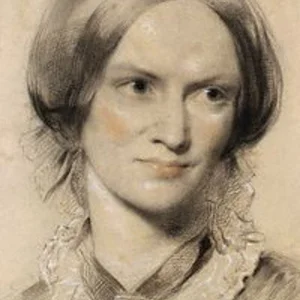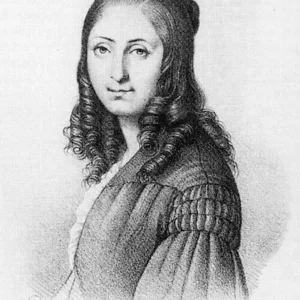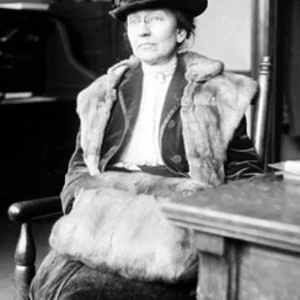

American social reformer, co-founder with Jane Addams of Hull House in Chicago in 1889. An activist in the Arts and Crafts movement and workers' rights, she worked for popular education and improving the living conditions of immigrants.
Ellen Gates Starr(1859 — 1940)
Ellen Gates Starr
États-Unis
8 min read
Frequently asked questions
Key Facts
- Visited Toynbee Hall in London with Jane Addams in 1889
- Co-founded Hull House in Chicago in 1889, one of the first American settlement houses
- Promoted the Arts and Crafts movement and learned bookbinding in London in the 1890s
- Engaged in labor strikes and unionism in the early 20th century
- Converted to Catholicism in 1920 and ended her life in a convent
Works & Achievements
Co-founded with Jane Addams the first American settlement house, a revolutionary institution combining housing, education, political advocacy, and social services. Hull House became a national and international model for urban reform and remains operational to this day.
Created a teaching program in artisan bookbinding inspired by the Arts and Crafts movement. Ellen trained dozens of young workers and immigrants in the art of the book, believing that creative work was key to emancipation.
Organized free lectures, exhibitions, and classes accessible to immigrant families. Ellen championed the revolutionary idea that culture is not a bourgeois privilege but a fundamental human need.
Active involvement in labor movements, notably during the 1894 Pullman Strike. Ellen used Hull House as a platform to defend workers' rights and challenge economic inequalities.
Ellen regularly wrote for progressive journals, articulating her vision of accessible art and an America founded on social justice rather than profit.
Developed projects in civic education, English language learning, and cultural awareness to facilitate immigrant integration while respecting their heritages.
Anecdotes
Ellen Gates Starr and Jane Addams founded Hull House in 1889 in the working-class neighborhood of Chicago, a building that Jane had just inherited. It was not an orphanage or a traditional charitable refuge, but a "neighborhood house" where the reformers lived alongside immigrants to better understand their problems. It was the first settlement house in the United States and quickly became a center for learning, political debate, and solidarity.
Passionate about the Arts and Crafts movement of the British William Morris, Ellen taught artistic bookbinding at Hull House starting in the 1890s. She believed that creative manual work could transform the souls of workers crushed by industry. She created a bookbinding workshop where young immigrants learned to bind books by hand, rediscovering the pride of the artisan craft.
During the great Pullman Strike of 1894 in Chicago, Ellen fought alongside the striking workers against inhumane working conditions. Her controversial actions led conservative newspapers to accuse her of socialism, but she considered the struggle for workers' rights a moral and religious duty.
In 1920, at over 60 years old, Ellen converted to Catholicism, astonishing her contemporaries. This conversion marked a turning point in her life: she gradually withdrew from her activities at Hull House to live more quietly. Nevertheless, she remained committed to her principles of social justice until her death in 1940.
Ellen organized lectures, concerts, and art exhibitions at Hull House so that immigrant families could access culture. She firmly believed that beauty and artistic education were rights, not privileges reserved for the rich. These initiatives made Hull House much more than a social center: it was a cultural hub of working-class Chicago.
Primary Sources
We had planned to make our work there only the first application of a growing social theory, but at the moment we could state our aim as that of promoting a higher civic and social life in the industrial quarter of the city.
The teaching of design, the practice of handicraft, the study of the history of art—all these are not luxuries but necessities for a full human life, even for those who labor with their hands.
Our young people have discovered that to make something beautiful with their own hands is to reclaim their dignity as human beings, not mere factory workers.
The settlement house is not charity—it is solidarity. We live here not to pity the poor, but to share their struggle and build together a more just society.
Key Places
Founded by Ellen and Jane Addams in 1889, Hull House became the beating heart of the social reform movement in Chicago. It was here that Ellen organized her art workshops, education classes, and workers' meetings. This building is the living symbol of her conviction that a more just society can be built through proximity, education, and solidarity.
A small town in Wisconsin where Ellen was born in 1859 into a middle-class Protestant family. This rural Midwest setting shaped her independent character and work ethic.
The industrial and working-class heart where Ellen devoted her life to reforms. It was in the crowded streets and factories that her vision of a new America was born, where workers and reformers worked together.
A learning space where Ellen taught the art of hand bookbinding to young immigrants. It was an educational laboratory where she proved that beauty and utility could transform a working-class life.
A small town in upstate New York where Ellen retired after 1920, following her conversion to Catholicism. She spent her final years in relative solitude, but kept alive her faith in justice.