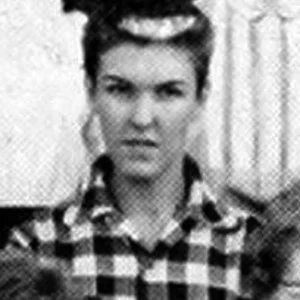

Valerie Solanas (1936-1988) was an American writer and radical feminist activist. The author of the provocative pamphlet SCUM Manifesto (1967), she remains famous for attempting to assassinate the artist Andy Warhol in 1968.
Valerie Solanas(1936 — 1988)
Valerie Solanas
États-Unis
6 min read
Frequently asked questions
Key Facts
- Born on April 9, 1936, in Ventnor City (New Jersey)
- Publishes the SCUM Manifesto in 1967, a radical feminist pamphlet
- Shoots and seriously wounds Andy Warhol on June 3, 1968, at the Factory
- Convicted and then committed to a psychiatric hospital after the attack
- Dies on April 25, 1988, in San Francisco, destitute
Works & Achievements
A satirical play featuring a panhandler and prostitute, entrusted to Warhol and then lost for decades. Solanas's first major text.
A radical feminist pamphlet, scathing and provocative, calling for the overthrow of patriarchal society. Solanas's most famous and most debated work.
A small role in an Andy Warhol film, marking her time within the artistic circle of the Factory.
A text published in Cavalier magazine in which she sets out, in an ironic tone, her life on the margins and her ideas about money and women's independence.
Anecdotes
On June 3, 1968, Valerie Solanas walked into the Factory, Andy Warhol's New York studio, and fired three revolver shots at the artist. Warhol, seriously wounded in the chest, survived after hours of surgery, but he would bear the after-effects for the rest of his life and had to wear a surgical corset.
A few hours after the shooting, Solanas turned herself in to a traffic officer in Times Square, handing him her weapon and declaring: “The police are looking for me.” She would explain her act by saying that Warhol had “too much control” over her life.
In 1967, she wrote and self-published the SCUM Manifesto, a pamphlet she sold herself on the streets of Greenwich Village: one dollar for women, two dollars for men. The text, of extreme verbal violence against patriarchal society, would become a famous and controversial document of radical feminism.
Solanas entrusted her only play, Up Your Ass, to Andy Warhol so that he could produce it. The artist lost the manuscript, and this quarrel over the missing text would feed Solanas's resentment toward him. The manuscript would not be found until well after her death, in a lighting trunk at the Factory.
Diagnosed as a paranoid schizophrenic, Solanas was committed to a psychiatric institution and then imprisoned after the shooting. The final years of her life were spent in great poverty; she died alone in 1988 in a San Francisco hotel room, her body not discovered until several days later.
Primary Sources
Life in this society being, at best, an utter bore and no aspect of society being at all relevant to women, there remains to civic-minded, responsible, thrill-seeking women only to overthrow the government.
SCUM is impatient; SCUM is not consoled by the thought that future generations will thrive; SCUM wants to grab some thrilling living for itself.
The police are looking for me. He had too much control over my life.
Key Places
Seaside town where Valerie Solanas was born in 1936 and where she had a difficult childhood.
Institution where she studied and earned a bachelor's degree in psychology in the late 1950s.
Bohemian Manhattan neighborhood where Solanas lived in poverty and sold her SCUM Manifesto on the street.
Andy Warhol's studio where Solanas shot the artist on June 3, 1968. A central hub of New York's artistic counterculture.
Poor neighborhood where Solanas spent her final years and died alone in a hotel room in 1988.
Typical Objects

A cheaply printed pamphlet that Solanas sold herself on the street. It is the object through which her radical ideas spread before any official edition.

The writer's working tool, on which she typed her texts in cheap hotel rooms. It symbolizes her determination to live by her pen.

The handgun with which Solanas shot Andy Warhol on June 3, 1968. The object of the news story that made her sadly famous.

The typescript of her only play, entrusted to Warhol and then lost. Its disappearance fueled the conflict between the two figures.

The printed and commercially released version of the SCUM Manifesto in 1968. It secured the text's legacy far beyond the Greenwich Village circle.

Solanas, homeless for long stretches, carried her writings in a plain bag. It illustrates her life of wandering and precarity.
School Curriculum
Vocabulary & Tags
Key Vocabulary
Tags
Daily Life
Morning
Solanas's mornings, in 1960s New York, often begin in a modest hotel room or a temporary apartment. She frequently wakes up with no certainty of being able to pay for the next night.
Afternoon
In the afternoon, she writes or reworks her texts on the typewriter, then walks through Greenwich Village. She begs for a little money and sells copies of her manifesto to passersby.
Evening
In the evening, she frequents the cafés and underground spots where artists, writers, and outsiders cross paths. It is in this milieu that she meets Andy Warhol's circle.
Food
Her diet is irregular and depends on her meager resources: cheap meals in cafeterias, sandwiches, whatever the money begged or earned day by day allows. Hunger is part of her precarious daily life.
Clothing
Solanas dresses simply, in worn and practical clothes suited to her wandering life. Far from the polished look of the Factory's “superstars,” she cultivates a disheveled appearance.
Housing
She has no stable home: cheap hotels, rooms rented by the week, sometimes homeless. This instability marks her entire adult life, from New York to San Francisco.
Historical Timeline
Period Vocabulary
Liens externes & ressources
Références
Œuvres
Up Your Ass (pièce de théâtre)
1965
SCUM Manifesto
1967
A Young Girl's Primer (article de magazine)
1966