Imaginary interview with George Sudarshan
by Charactorium · George Sudarshan (1931 — 2018) · Sciences · 5 min read
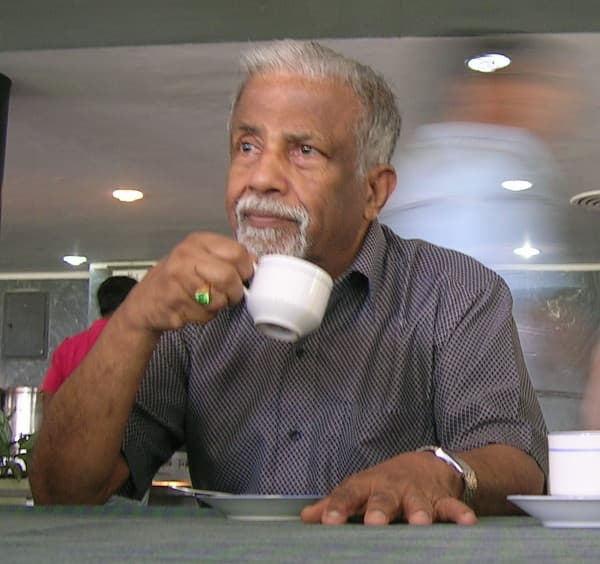
Austin, Texas, a late-career afternoon. The office blackboard is still covered with half-erased equations, a notebook of calculations open near a cold cup of coffee. George Sudarshan greets us with quiet courtesy, the Kerala accent intact despite the American decades.
—How was the theory that, they say, slipped through your fingers born?
It was at Rochester, in 1957. I was Robert Marshak's PhD student, still a young man hunched over his notebook, and we were looking for the correct mathematical form of the weak interaction — that discreet force governing certain radioactive decays. We understood that it must be written as a vector minus an axial vector, what came to be called the V−A structure. The idea rested on chirality invariance: imagine a left hand that obstinately refuses to become right. When I saw the equations hold together, I knew we had touched one of the pillars of what would become the Standard Model. Marshak and I were certain we had found something right, clean, necessary.
We had touched one of the pillars of what would become the Standard Model.
—How do you feel when this discovery is attributed to names other than yours?
A few months after our work, Feynman and Gell-Mann published the same V−A structure, and the world remembered their names rather than ours. I won't lie to you: this wound has never fully healed. Our founding paper, Chirality Invariance and the Universal Fermi Interaction, appeared in Physical Review in 1958; it is there, dated, verifiable, engraved in the archives. A theorist lives on paper and pencil, but also on recognition. I learned that science sometimes remembers the loudest voices rather than the first. One can be right first and remain in the shadow of the second; that is a lesson in humility that no equation teaches you.
One can be right first and remain in the shadow of the second.
—Nominated nine times for the Nobel without ever winning it: how does one live with such anticipation?
I am told my name has circulated at least nine times before the Stockholm committee. Nine times the door half-opened, nine times closed again. The hardest part is not the absence of a medal — a blackboard asks for no reward — but the idea that a part of your work walks the world under another name. In 1963, I had introduced the diagonal representation, that way of translating light between its classical and quantum language, using coherent states. Today it is part of every quantum optician's toolbox. Waiting means learning to watch your own work live without you, like a father seeing a child leave who no longer bears his name.
—In 2005, the Nobel Prize in quantum optics rewarded Roy Glauber. What did you feel that year?
In 2005, when the prize went to Roy Glauber for quantum optics, several physicists protested publicly, because the representation in question also bears my name — one often speaks of Sudarshan-Glauber coherent states. I took up my pen, not out of vanity, but because silence would have been a second injustice. I wrote my disappointment, calmly, as a man who has spent his life seeking the exact formulation of things. Physics demands precision; the history of physics deserves as much. I bear no grudge toward Glauber himself — our works respond to each other — but toward that way scholarly memory has of simplifying what was, in truth, a work of many hands.
Silence would have been a second injustice.
—You showed that observing a system can prevent it from evolving. Where did this surprising idea come to you?
In 1977, with Baidyanath Misra, we demonstrated something that looks like a magic trick: if you observe an unstable atom relentlessly, you can prevent it from decaying. We called it the quantum Zeno effect, as a nod to the old Zeno of Elea and his paradoxes about frozen motion. Our English-speaking friends saw an echo of a kitchen proverb: a watched pot never boils. That is exactly it, but transported to the heart of matter. We published it in the Journal of Mathematical Physics, establishing that in the limit of continuous observation, the system's evolution freezes entirely. Measurement, in quantum physics, is never an innocent gesture.
A watched pot never boils — transpose that to the heart of matter.
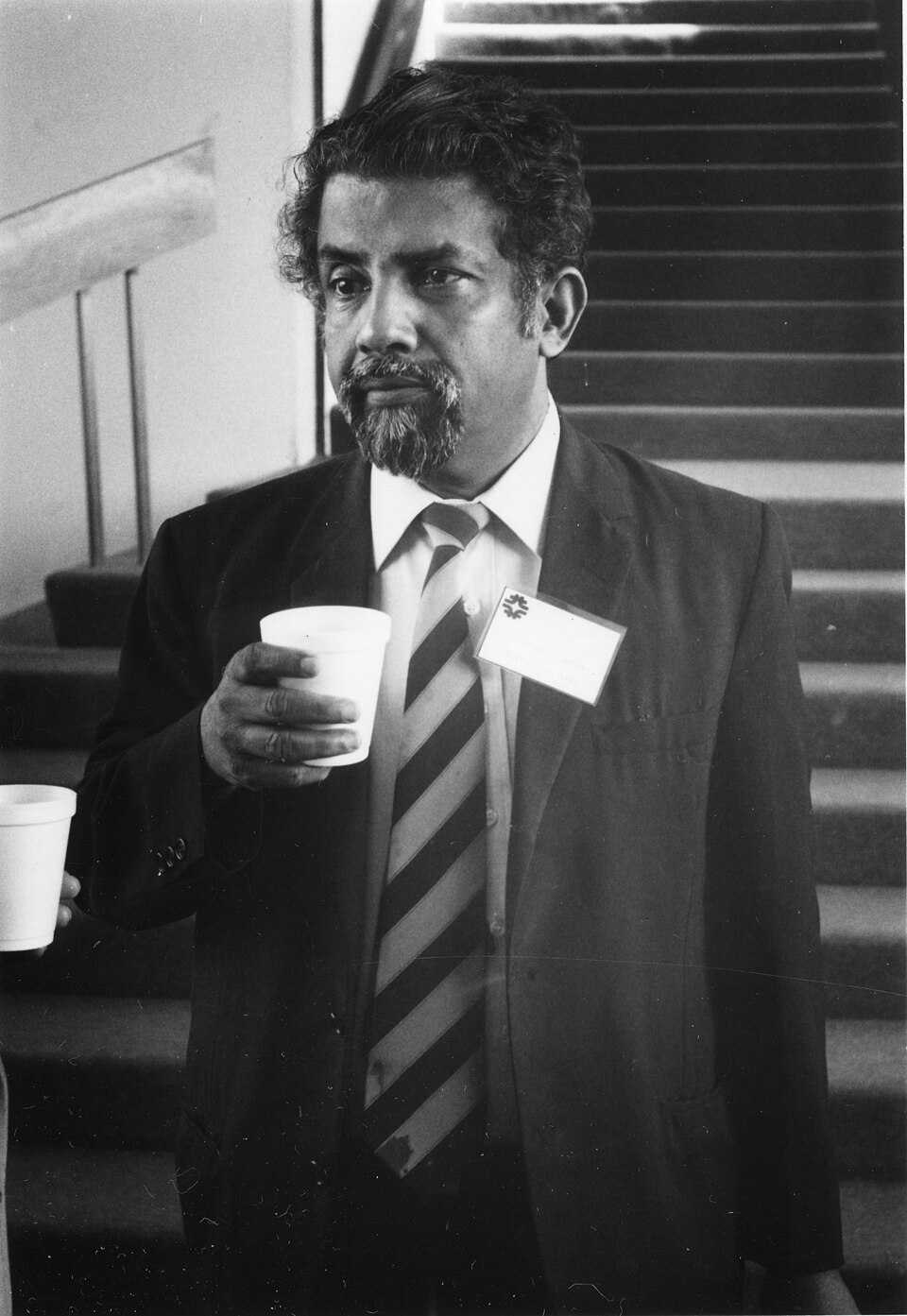
—Why summon an ancient Greek philosopher to name a modern physics result?
Because an idea has no age. Zeno of Elea imagined an arrow that, at each frozen instant, seems motionless, and concluded that movement was impossible. We, twenty-four centuries later, show that observation instant by instant can actually immobilize a quantum system. The Greek paradox ceased to be a logical game and became an equation verifiable in the laboratory. I have always thought that physics is a long conversation with the Ancients; we often merely respond to them with new tools. Naming our effect after Zeno was not coquetry; it was acknowledging a debt. The deepest questions cross the centuries; only the blackboard and chalk on which we try to answer them change.
—You were born in a village in Kerala. What remains of that origin in the physicist you became?
I was born in 1931 in Pallam, a small village in Kerala, into a Christian family in southern India. From that corner of the earth — rice, vegetables, spices — I kept the taste even in my Austin kitchens, a vegetarian faithful to my youth. I grew up in a country that gained independence in 1947, a teenager in a nation learning to stand on its own. People sometimes think an Indian physicist must forget his roots to speak the universal language of equations. That is false. My village and my calculation tables belong to the same man. Science never asked me to renounce where I came from; it only gave me another way to question the world.
—You willingly link quantum physics and the philosophy of Vedānta. How do these two worlds speak to each other within you?
In the evening, when the day's calculations were done, I would sometimes open a text of the Vedānta, that great current of Indian thought that meditates on the nature of consciousness and reality. I do not claim that quantum mechanics demonstrates Indian metaphysics — that would be an intellectual laziness I refuse. But both ask the same troubling question: what role does the observer play in what he observes? Our Zeno effect brought me back to it constantly. I enjoyed discussing, in Austin, the links between consciousness and reality, not to confuse religion and science, but because a curious mind does not have to choose between the blackboard and the sacred text. Both seek, each in its own way, what holds the world together.
A curious mind does not have to choose between the blackboard and the sacred text.
—What does a theorist's day concretely look like, far from the great abstract equations?
My day began with reading articles and coffee, before heading to my office on the Austin campus. The morning was a long face-to-face with the notebook of calculations, pencil in hand, filling pages with reasoning before any of it dared become a publication. Theoretical physics is done like that: paper, a pencil, and a lot of patience. The afternoon belonged to my PhD students and the blackboard, that surface covered with chalk where ideas are debated in the open. We erase, we start over, we discuss until a line holds up. The theorist's craft, in the end, amounts to little: a piece of chalk, an admitted mistake, and a student who contradicts you with enough courage.
A piece of chalk, an admitted mistake, and a student who contradicts you with enough courage.
—You co-authored a book rewriting classical mechanics. Why reopen a chapter thought to be closed?
In 1974, with N. Mukunda, I published Classical Dynamics: A Modern Perspective. Many were surprised: why revisit classical mechanics, that old lady of three centuries, when everyone was rushing toward the quantum? Because one understands the new well only by rewriting the old with the tools of the day — here, geometry and the language of symmetries. A symmetry, you see, is a transformation that leaves the laws unchanged, and that is where the deep meaning of things hides. This book was also an act of transmission: I wanted my students to inherit a rethought mechanics, not a catalog of recipes. Teaching, for me, has never been distinct from searching; it is the same chalk that serves both.
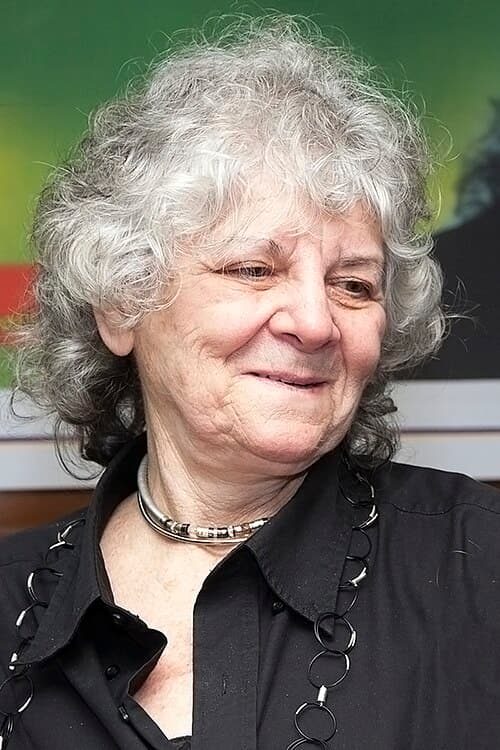
This imaginary interview was generated by artificial intelligence from sources documented in George Sudarshan's profile. It dramatises what the figure might have said based on what we know about them, but does not constitute attested historical testimony. For primary sources and factual documentation, refer to the full profile.