Imaginary interview with Harriet Beecher Stowe
by Charactorium · Harriet Beecher Stowe (1811 — 1896) · Literature · Society · 6 min read
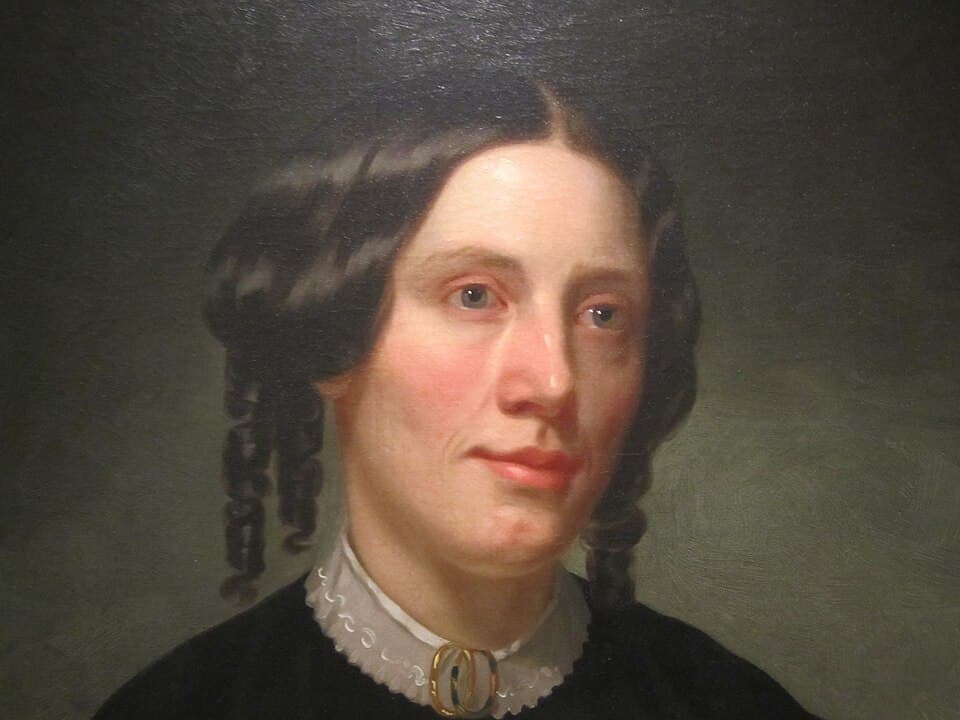
Hartford, Connecticut, an autumn afternoon at Nook Farm. In the parlor of her Victorian house, a small woman with lively eyes sets down her pen and agrees to look back on a life spent writing between chores, from slaveholding Kentucky to the drawing rooms of New England. She speaks softly, but every word carries weight.
—Where and under what conditions did you write the novel that would make you famous?
In Brunswick, Maine, in the winter of 1851. My husband was teaching at Bowdoin College, we had seven children around me, and I had neither a study nor leisure. I wrote on the kitchen table, pen in one hand, the other sometimes stirring a pot, pages piling up between the bread to knead and the diapers to change. People often ask how such a busy woman found the time. I answer that I didn't find it: I stole it. The scenes came to me like visions; I had to throw them onto paper before they faded. I wasn't composing a book coldly; I was transcribing what I saw and what I felt, because I couldn't do otherwise.
I didn't have time to write: I stole it between the bread to knead and the diapers to change.
—How would you describe an ordinary day during that period in Brunswick?
It began with family prayer and morning chores, a legacy of my upbringing as a minister's daughter. The children demanded, the fire demanded, the garden demanded. Only in the afternoon, when a bit of silence fell over the house, did I sit down with my pen and inkwell and let the sentences flow. In the evening, we gathered to read, discuss theology, and debate the great moral questions of the time, slavery foremost. I didn't write in an ivory tower; I wrote in the midst of domestic life, and perhaps that is why my characters smell of the kitchen, of illness, of the separation of a mother and her child. These things I didn't invent: I lived them differently every day.
—Do you remember the moment when slavery ceased to be an idea and became a reality before your eyes?
Cincinnati, in Ohio, where we lived from 1832 to 1850. The city sat on the frontier: across the river began Kentucky, and with it slavery. We saw fugitives pass through, heard of the clandestine network, the Underground Railroad, leading them north. I knew black maids who trembled at being taken back; I saw with my own eyes what the Fugitive Slave Act meant in a family. It was there that the scene of Eliza fleeing with her child on the floating ice of the river was born, long before I wrote it. That woman jumping from block to block rather than give up her son—I didn't imagine her; I assembled her from everything the Ohio frontier had shown me.
Eliza fleeing on the ice—I didn't imagine her; I assembled her from what the frontier had shown me.
—Why was the 1850 Fugitive Slave Act so decisive for you?
Because it made each of us an accomplice. The Fugitive Slave Act of 1850 forced citizens of free states themselves to hand over fugitives, to help the slave catcher in his hunt. One could no longer tell oneself that slavery was the South's affair; it knocked at my door, in the North, and asked me to betray a man in the name of the law. I felt that to remain silent from then on was to consent. My sister-in-law wrote to me that in my place, if she could wield a pen like me, she would write something that would make the whole nation feel what a cursed thing slavery was. Those words never left me. Uncle Tom's Cabin was born as much from that law as from my anger.
—You were accused of inventing the horrors described in your novel. How did you respond?
That hurt me more than the insults. Claiming I had lied was to absolve slavery of its crimes. So, in 1853, I did what a minister's daughter knows how to do: I brought evidence. I published A Key to Uncle Tom's Cabin, a collection of original documents, testimonies, court records, and legal articles, showing that behind every episode of my novel stood a verified fact. If my Simon Legree was deemed too dark, I could cite worse from Southern newspapers. That book was not written with the heart but with the archive: I wanted no one to say the novelist had dreamed. Fiction had moved people; the documents, in turn, shut mouths.
They accused me of dreaming the horrors: I answered with the archive, document against calumny.
—What do you say to those who judge your novel too sentimental to be serious?
That sentiment was my weapon, and it shot better than many treatises. Lawyers and orators debated slavery as a matter of accounting or constitutional law; I wanted people to feel what a mother feels when her child is sold away. The purpose of my pages, I wrote in the preface itself, was to awaken sympathy and feeling in favor of a race that lived among us in chains. Do they reproach me for my tears? Those tears made people read about slavery who would never have opened a pamphlet. An open Bible and a stirred heart will always do more than a syllogism. I am not ashamed to have written to move: that is how conscience awakens.
—Is it true that President Lincoln greeted you as the woman who caused the war?
It is told, and I leave it to others to swear to the exact words. During our meeting in 1862 in Washington, it is reported that he greeted me by saying, 'So this is the little lady who wrote the book that started this great war.' The phrase is too beautiful to be entirely certain, and too flattering for me to boast of it. A book does not start a war; the cannons of 1861 had other fathers than my pen. But I am willing to believe that a novel could make thousands of readers feel, in their homes, what figures and speeches left cold. If I poured a drop into the torrent that led to emancipation, that is enough for my life.
A book does not start a war; but it can make a household feel what figures leave cold.
—How do you explain the enormous success of your novel?
It first appeared as a serial in an abolitionist newspaper, the National Era, in 1851 and 1852, chapter by chapter, so that readers awaited the next installment as one awaits news of a friend. When it came out as a book, I was told it sold 300,000 copies in a year, an unheard-of thing then. Then came the theaters: countless Tom shows brought the story to crowds who had never held the book, so that more people saw the play than read the page. I did not control that; the story slipped from my hands like a child growing up. Sometimes it frightened me, so much was it distorted; but that it circulated was what mattered.
—Where did you get such firm moral conviction? Tell us about your family.
I was born in Litchfield, Connecticut, in 1811, in a house of Congregationalist ministers where we breathed the Bible like air. My father preached, and we were a tribe of believers and reformers. My brother Henry Ward Beecher became one of the most listened-to preachers in America; my sister Catharine became a pioneer of girls' education when it was still thought a woman had no need of instruction. In our home, faith was not a Sunday ornament: it was a daily demand, an account to be rendered. Congregationalism taught us that each conscience answers directly for its actions before God. How, in such a house, could I have looked at slavery and remained silent? I was raised not to be able to.
—How did this faith shape your way of writing against slavery?
It is the very soil of my book. I did not attack slavery in the name of a political doctrine, but in the name of a soul that is worth as much as any other before the Creator. In the evenings, in our family, we did not merely read Scripture: we debated what it required of us here and now. It is from those evenings that my Uncle Tom came, that man whose body is possessed but never his faith. When asked where I found such a story, I said, and I still think, that God showed it to me. I do not claim genius; I only claim to have written what my Christian conscience no longer allowed me to keep to myself.
I did not attack slavery in the name of a doctrine, but in the name of a soul that is worth as much as any other.

This imaginary interview was generated by artificial intelligence from sources documented in Harriet Beecher Stowe's profile. It dramatises what the figure might have said based on what we know about them, but does not constitute attested historical testimony. For primary sources and factual documentation, refer to the full profile.