Kids interview Katharine Burr Blodgett
by Charactorium · Katharine Burr Blodgett (1898 — 1979) · Sciences · Technology · 5 min read
That morning, two young visitors of twelve pushed open the door of a laboratory in Schenectady. A gray-haired lady greeted them with a smile, a small trough full of water placed before her. Her name was Katharine Burr Blodgett, and she had agreed to answer all their questions.
—What was it like growing up without ever knowing your father?
You know, my child, my father died a few weeks before I was born, in 1898. A burglar killed him. I never saw him, never heard him. But he was a lawyer, a specialist in patents for a large company. A patent is an official paper that protects an invention. So I grew up surrounded by that world: ideas, machines, inventors. It's a bit as if my absent father left me an invisible gift. He didn't tell me bedtime stories, but he passed on to me the taste for creating new things. All my life, I filed patents too. Eight, in all.
My absent father left me an invisible gift: the taste for creating.
—How old were you when you decided to become a scientist?
I was fifteen, my child. I was given a tour of the General Electric laboratories, here in Schenectady. Imagine a large room full of glass tubes, strange devices, and chemical smells. There, I met a scientist named Irving Langmuir. He was a chemist, studying surfaces. He saw that I asked a thousand questions, that nothing scared me. So he said a simple thing: “First go study, learn a lot, and then come back.” I followed his advice. And in 1918, I became the first woman scientist hired by this company. Advice can change a whole life.
Advice can change a whole life.
—Was it hard being the only girl among all those learned gentlemen?
Yes, a little, I won't lie to you. In my time, women were very rare in laboratories. In 1926, I went to England, to the famous Cavendish Laboratory at Cambridge, run by the great Ernest Rutherford. There I studied the behavior of tiny particles of electricity, electrons, in a vapor. And I became the very first woman to earn a doctorate in physics there. Imagine a room full of men in dark suits, and me, the only young woman in the middle. You had to work twice as hard to be taken seriously. But every door I opened stayed open for those after me.
Every door I opened stayed open for those after me.
—Were you afraid of failing and disappointing everyone?
Of course I was afraid, sometimes. When you're the first, you carry a weight on your shoulders. Two years earlier, in America, women had just obtained the right to vote, in 1920. The world was slowly changing. So if I failed, they would say, “You see, physics is not for girls.” That, I could not accept. But you know, fear didn't stop me from acting. I wrote everything in my notebooks, I repeated my experiments ten times if necessary. Patience, my child, is the secret weapon of researchers. You move forward in tiny steps, but you move forward.
Patience is the secret weapon of researchers.
—What is invisible glass? Does it really exist?
Yes, it exists, and I made it, in 1938! Listen carefully. Normal glass, when light hits it, reflects glare that is bothersome. My idea was to deposit on it a minuscule layer, so thin that it makes those reflections disappear. It's the principle of interference: two light waves that meet and cancel each other out, like two waves that flatten each other. To prove it, I placed two frames side by side. One shone, full of reflections. The other seemed completely empty, as if there were no glass at all! The newspapers called it “invisible glass.” It was used in eyeglasses and camera lenses.
One of the two frames seemed completely empty, as if there were no glass.
—How can you measure something as small as a molecule?
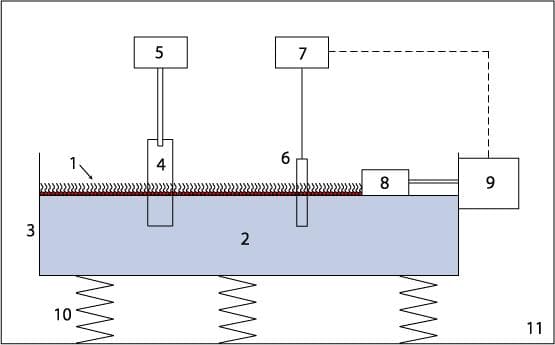
Ah, that's a great question! Imagine you want to measure a thickness a thousand times thinner than one of your hairs. No ruler can do that. So I invented a trick: the color gauge. I deposited layers of molecules one by one onto a plate, first spreading them on the water in a small trough. And depending on the number of layers, the surface changed color! Blue, red, gold told me exactly the thickness. It was like a ruler made of colors. Simple, but clever. I used a fatty substance, barium stearate. The beauty is that a scientist doesn't always need a complicated machine.
It was a ruler made of colors.
—And during the war, what did you do with your inventions?
War, my child, is a terrible time when even scientists are called to help. In 1942, I worked on two things. First, smoke screens: thick clouds created to hide soldiers from the enemy's eyes, like a man-made fog. Second, a method to prevent ice from forming on aircraft wings, because ice could cause them to crash. And my antireflective glass was used in submarine periscopes. A periscope is a long tube with mirrors that lets you see the surface when hidden underwater. Clear glass could save lives.
In times of war, even scientists are called to help.
—Did it make you sad to work for the war?
That's a serious question, and I'll answer you honestly. No, I didn't like war. No sensible person does. But when your country is in danger, you use what you know how to do. I knew how to make thin layers, understand glass and surfaces. So I put my knowledge at the service of those who were fighting. De-icing wings, for example, wasn't meant to hurt: it was meant to prevent planes from crashing. I preferred a thousand times to protect rather than destroy. An invention, you know, is neither good nor bad in itself. It all depends on the hand that uses it.
An invention is neither good nor bad: it all depends on the hand that uses it.
—In the evenings, after the lab, what did you do for fun?
Oh, plenty of things! A scientist is not just a scientist, you know. In the evening, I loved my garden in Schenectady: I grew my flowers and vegetables with great patience, the same as in the lab. I also took out my little telescope to look at the stars. Imagine the night sky, with no city lights to spoil it, just thousands of bright points. I played bridge with my friends, a card game, and I performed on stage with the town's theater troupe. And in summer, I dashed off to my cottage on Lake George. The water, the trees, the silence: that was my true rest.
A scientist is not just a scientist.
—Were you ever rewarded for all this work?
Yes, my child, even if recognition sometimes comes late. In 1951, I received the Garvan Medal, an award created specifically to reward women who have accomplished fine work in chemistry. I was very proud of it. But you know, my greatest reward is not a medal. It's knowing that my method of depositing layers one by one, which today is called Langmuir-Blodgett films, still serves researchers long after me. I worked forty-five years before retiring in 1963. If children like you are still interested in my invisible glass, then my work continues to live. And that is the most beautiful reward.
If children are still interested in my work, then it continues to live.
This imaginary interview was generated by artificial intelligence from sources documented in Katharine Burr Blodgett's profile. It dramatises what the figure might have said based on what we know about them, but does not constitute attested historical testimony. For primary sources and factual documentation, refer to the full profile.