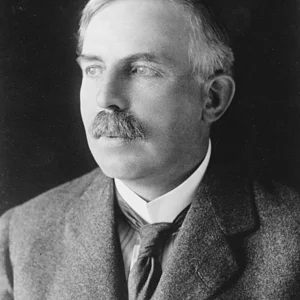

New Zealand-born physicist and chemist (1871–1937) who revolutionized our understanding of atomic structure. He discovered the atomic nucleus and elucidated the mechanisms of radioactivity, laying the foundations of modern nuclear physics.
Frequently asked questions
Famous Quotes
« If you can't explain something simply, you don't understand it well enough.»
« Science is not merely a collection of laws, a catalogue of facts; it is a creation of the human mind with its freely invented ideas and concepts.»
« In physics, you shouldn't worry too much about these difficulties.»
Key Facts
- 1909: Conducts the gold foil experiment, revealing the existence of the atomic nucleus
- 1911: Proposes a planetary model of the atom with a dense, positively charged central nucleus
- 1919: Achieves the first artificial nuclear transmutation (converting nitrogen into oxygen)
- 1908: Awarded the Nobel Prize in Chemistry for his research on radioactive decay
- 1920: Postulates the existence of the neutron, a particle later discovered by Chadwick in 1932
Works & Achievements
Rutherford identified two distinct types of radiation emitted by radioactive substances, which he named alpha and beta, laying the foundations for the classification of nuclear radiation.
Together with Frederick Soddy, he demonstrated that radioactivity results from the spontaneous transmutation of one element into another. This discovery overturned the dogma of the immutability of atoms.
The first comprehensive work on radioactivity, it became the global reference on the subject and was used in universities worldwide for decades.
By analysing the scattering of alpha particles on a gold foil, Rutherford proved that the mass of the atom is concentrated in a tiny, dense nucleus, establishing the planetary model of the atom.
Rutherford transformed nitrogen atoms into oxygen by bombarding them with alpha particles, thus fulfilling the ancient alchemists' dream of transmuting elements.
Rutherford put forward the hypothesis that a neutral particle existed within the atomic nucleus. This prediction was confirmed in 1932 by his student James Chadwick.
Anecdotes
During his famous 1909 experiment, Rutherford asked his assistants Hans Geiger and Ernest Marsden to bombard a thin gold foil with alpha particles. When some particles bounced back, he declared it was 'the most incredible event that has ever happened to me, as if you fired a 15-inch shell at a piece of tissue paper and it came back and hit you.'
Rutherford received the Nobel Prize in Chemistry in 1908, which greatly amused him as he considered himself first and foremost a physicist. He humorously remarked that of all the transmutations he had observed, the fastest was his own transformation from physicist to chemist.
In his Cambridge laboratory, Rutherford had a reputation for loudly singing 'Onward, Christian Soldiers' when his experiments were going well. His collaborators knew the results were promising when they heard his booming voice echoing through the corridors of the Cavendish Laboratory.
The son of a New Zealand farmer, Rutherford learned of his scholarship to study in England while digging up potatoes in the family field. He threw his spade into the air and exclaimed: 'That's the last potato I'll ever dig!' He was 24 years old at the time.
Rutherford led the Cavendish Laboratory in Cambridge with a benevolent but firm authority. He forbade his researchers from working in the evenings, believing that if one could not finish their work before 6 p.m., it meant they were not thinking hard enough during the day.
Primary Sources
Considering the evidence as a whole, it seems simplest to suppose that the atom contains a central charge distributed through a very small volume, and that the large single deflexions are due to the central charge as a whole.
The atoms of matter are not the permanent, indestructible units that Dalton imagined, but are themselves centres of energy, capable of undergoing transformation into other forms of matter.
From the results so far obtained it is difficult to avoid the conclusion that the long-range atoms arising from collision of α particles with nitrogen are not nitrogen atoms but probably atoms of hydrogen.
Radioactivity is shown to be accompanied by chemical changes in which new types of matter are being continuously produced. The radio-elements undergo spontaneous transformation.
Key Places
Prestigious physics laboratory at the University of Cambridge, which Rutherford directed from 1919 until his death. It was there that he trained a generation of nuclear physicists.
It was in this laboratory that Rutherford carried out his most celebrated experiments between 1907 and 1919, including the discovery of the atomic nucleus in 1911.
Rutherford worked there from 1898 to 1907 and conducted his pioneering research on radioactivity and atomic disintegration, which earned him the Nobel Prize.
Rutherford's birthplace in the South Island of New Zealand, where he grew up in a farming family before winning a scholarship to study in England.
Rutherford's place of burial, where his ashes were laid near the tombs of Isaac Newton and Lord Kelvin, in recognition of his exceptional contribution to science.
Typical Objects

Fluorescent screen used to detect alpha particles during the gold foil experiment. Each impact produced a tiny flash of light that researchers counted in the dark.

Metal foil a few thousandths of a millimetre thick, used as a target in the scattering experiment that revealed the existence of the atomic nucleus.

Measuring instrument used to detect and quantify electric charges and radioactive radiation. Rutherford used it daily in his research.

Radioactive sample emitting alpha particles, used as a projectile in scattering experiments. Radium was at the time a rare and precious substance.

Device invented by Hans Geiger in Rutherford's laboratory to detect and count individual radioactive particles. It became a fundamental tool of nuclear physics.

Rutherford regularly smoked a pipe in his office and sometimes in the laboratory, a common habit among academics of his era.
School Curriculum
Vocabulary & Tags
Key Vocabulary
Tags
Daily Life
Morning
Rutherford arrived at the Cavendish Laboratory early in the morning, often around 9 o'clock. He would begin by reading his mail and the latest scientific publications, then make his rounds of the experimental rooms to discuss the progress of ongoing work with his researchers.
Afternoon
The afternoon was devoted to his own experimental research or to meetings with his doctoral students. He also gave lectures at the university and attended physics seminars, where he enjoyed asking incisive questions.
Evening
In the evening, Rutherford would return home to have dinner with his wife Mary. He would then read in his home study, drafting articles or scientific correspondence. He insisted that his researchers leave the laboratory before nightfall.
Food
Rutherford appreciated a hearty, traditional British cuisine: roasted meats, boiled vegetables, puddings. He took afternoon tea, an indispensable custom of university life in Cambridge. He regularly dined in the hall of his college, Trinity College.
Clothing
Rutherford wore the typical attire of a British university professor of his era: a three-piece tweed suit, stiff-collared shirt, tie, and a bowler hat for outings. In the laboratory, he would sometimes put on a white coat.
Housing
In Cambridge, Rutherford lived in a comfortable house at Newnham Cottage, in a residential neighbourhood close to the university. The house had a study where he worked in the evenings and a garden he appreciated for moments of relaxation.
Historical Timeline
Period Vocabulary
Visual Style
Un style visuel mêlant l'esthétique des laboratoires édouardiens en bois sombre et laiton, avec des éclats lumineux dorés symbolisant les particules, dans une palette de tons sépia chauds et de bleus profonds.
Sound Ambience
L'atmosphère sonore d'un laboratoire de physique des années 1920 à Cambridge, avec le cliquetis caractéristique des compteurs Geiger, le bourdonnement des équipements électriques et les pas feutrés des chercheurs sur les dalles de pierre.
Liens externes & ressources
Références
Œuvres
Découverte des rayonnements alpha et bêta
1899
Théorie de la désintégration radioactive
1903
Radio-activity (ouvrage)
1904
Découverte du noyau atomique
1911
Première transmutation artificielle
1919
Prédiction du neutron
1920