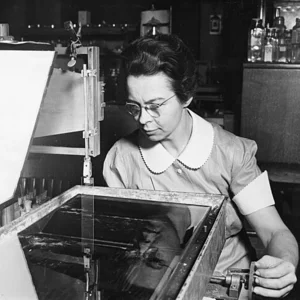

American physicist and inventor (1898-1979), the first woman to earn a doctorate in physics from the University of Cambridge and the first female scientist hired by General Electric. She is known for inventing non-reflective glass (“invisible” glass).
Katharine Burr Blodgett(1898 — 1979)
Katharine Burr Blodgett
États-Unis
6 min read
Frequently asked questions
Key Facts
- Born in 1898 in Schenectady (New York State), died in 1979.
- First woman to earn a doctorate in physics from the University of Cambridge in 1926.
- First female scientist hired by General Electric, where she collaborated with Irving Langmuir.
- Invented non-reflective glass (“invisible glass”) in 1938, used in optics, photography, and film.
- Developed Langmuir-Blodgett films and a color gauge to measure the thickness of thin films.
Works & Achievements
First woman to earn this degree at Cambridge, following research on the behavior of electrons in ionized mercury vapor.
A technique for stacking layers of molecules one by one with extreme precision; still used today in nanotechnology.
A simple and ingenious instrument for measuring thicknesses on the scale of a single molecule using reflected colors.
A major invention eliminating glare from glass; applied to camera lenses, eyeglasses, projectors, and periscopes.
Development of protective smoke screens and aircraft wing de-icing techniques during the Second World War.
A collection of patents filed over the course of her career at General Electric, reflecting her inventiveness in the field of surfaces and optics.
Anecdotes
Katharine's father, a patent lawyer for General Electric, was killed by a burglar a few weeks before her birth in 1898. The little girl thus grew up never knowing her father, but surrounded by the world of inventions and laboratories that would shape her entire life.
At 15, during a visit to the General Electric laboratories, she met the great chemist Irving Langmuir. Impressed by her curiosity, he advised her to further her scientific studies before coming back: she would follow his advice and, in 1918, become the first woman scientist hired by the company.
In 1926, she became the very first woman to earn a doctorate in physics from the University of Cambridge, working at the famous Cavendish Laboratory led by Ernest Rutherford. At a time when women were rare in the sciences, this was a resounding achievement.
In 1938, she developed an “invisible glass”: a glass coated with a layer so thin that it eliminated almost all reflections. To prove it, two frames were photographed side by side — one shimmering with distracting reflections, the other perfectly transparent, as if there were no glass at all. This invention equipped cameras, eyeglasses, and periscopes.
To measure layers a thousand times thinner than a hair, she invented a “color gauge”: by depositing layers of molecules one by one, the thickness could be read directly from the reflected colors, without any complicated device. It was a measuring ruler on the scale of molecules.
Primary Sources
Blodgett describes how to stack, one by one, layers of molecules a single molecule thick onto a solid surface in order to obtain films of perfect regularity. This marks the birth of what came to be called “Langmuir-Blodgett” films.
The article explains how a thin layer deposited on glass cancels reflections through light interference, making the glass almost invisible. This is the scientific basis of anti-reflective glass.
Blodgett and Langmuir detail the layer-by-layer fabrication of barium stearate films and their optical properties, notably the appearance of colors depending on thickness.
The patent protects the manufacturing process for the anti-reflective thin films applied to glass, the fruit of Blodgett's research at General Electric.
Key Places
Blodgett's birthplace and home to General Electric's large research laboratory, where she spent most of her career. She died there in 1979.
A prestigious women's college where Katharine earned her bachelor's degree in 1917, studying mathematics and physics.
She earned her master's degree in physics here in 1918, notably working on the adsorption of gases by charcoal (useful for gas masks).
A world-leading center of physics directed by Ernest Rutherford, where in 1926 Blodgett became the first woman to earn a doctorate in physics at Cambridge.
Typical Objects
A tray filled with water onto which a film of molecules just one layer thick is spread, then transferred onto a solid plate. It is the key tool that today partly bears her name.
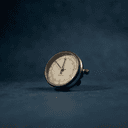
A measuring instrument invented by Blodgett to gauge the thickness of a film to within a few molecules, simply by comparing the reflected colors. A ruler at the molecular scale.

Glass coated with a thin layer that removes almost all reflections through interference. Used in lenses, eyeglasses, and optical instruments.
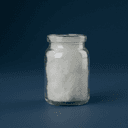
A greasy substance used by Blodgett to form her films of uniform molecular thickness. Its shifting colors served as a marker for measuring thickness.
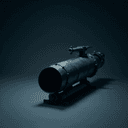
An optical instrument that allows a submerged submarine to see above the water. Blodgett's anti-reflective glass improved its clarity during the war.
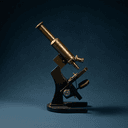
The researcher's everyday tool, used to observe the thin films and surfaces studied at General Electric. Its lenses also benefited from anti-reflective coatings.
School Curriculum
Vocabulary & Tags
Key Vocabulary
Tags
Daily Life
Morning
Living in Schenectady, Katharine went each morning to General Electric's research laboratory, just a few minutes from her home. She often began by setting up her delicate experiments on thin films, which demanded cleanliness and patience.
Afternoon
The afternoon was devoted to work in the laboratory: depositing films molecule by molecule, measuring their thickness, and discussing them with her mentor Irving Langmuir. She carefully recorded her results in her research notebooks.
Evening
In the evening, she enjoyed gardening, observing the stars with her amateur telescope, and playing bridge with her friends. A theater enthusiast, she also took part in the plays of the local Schenectady troupe.
Food
She ate like a middle-class American of her time: family meals, produce from her garden, and the common canned goods of the twentieth century. Coffee and simple dishes punctuated her working days.
Clothing
In the laboratory, she wore plain, practical attire, often a smock to protect her clothes from the chemicals. Outside, she adopted the elegant but understated dresses and suits of 1930s-to-1950s America.
Housing
She lived in a comfortable house in Schenectady, surrounded by a garden she tended with care. She also owned a cottage near Lake George, where she recharged during the summer.
Historical Timeline
Period Vocabulary
Liens externes & ressources
Références
Œuvres
Doctorat de physique de Cambridge
1926
Méthode des films monomoléculaires (films de Langmuir-Blodgett)
1935
Jauge de couleur (color gauge)
1935
Verre antireflet (« verre invisible »)
1938
Travaux de guerre (écrans de fumée et dégivrage)
1942
Huit brevets américains
1917-1963