Kids interview Lady Triệu
by Charactorium · Lady Triệu · Politics · Military · 5 min read
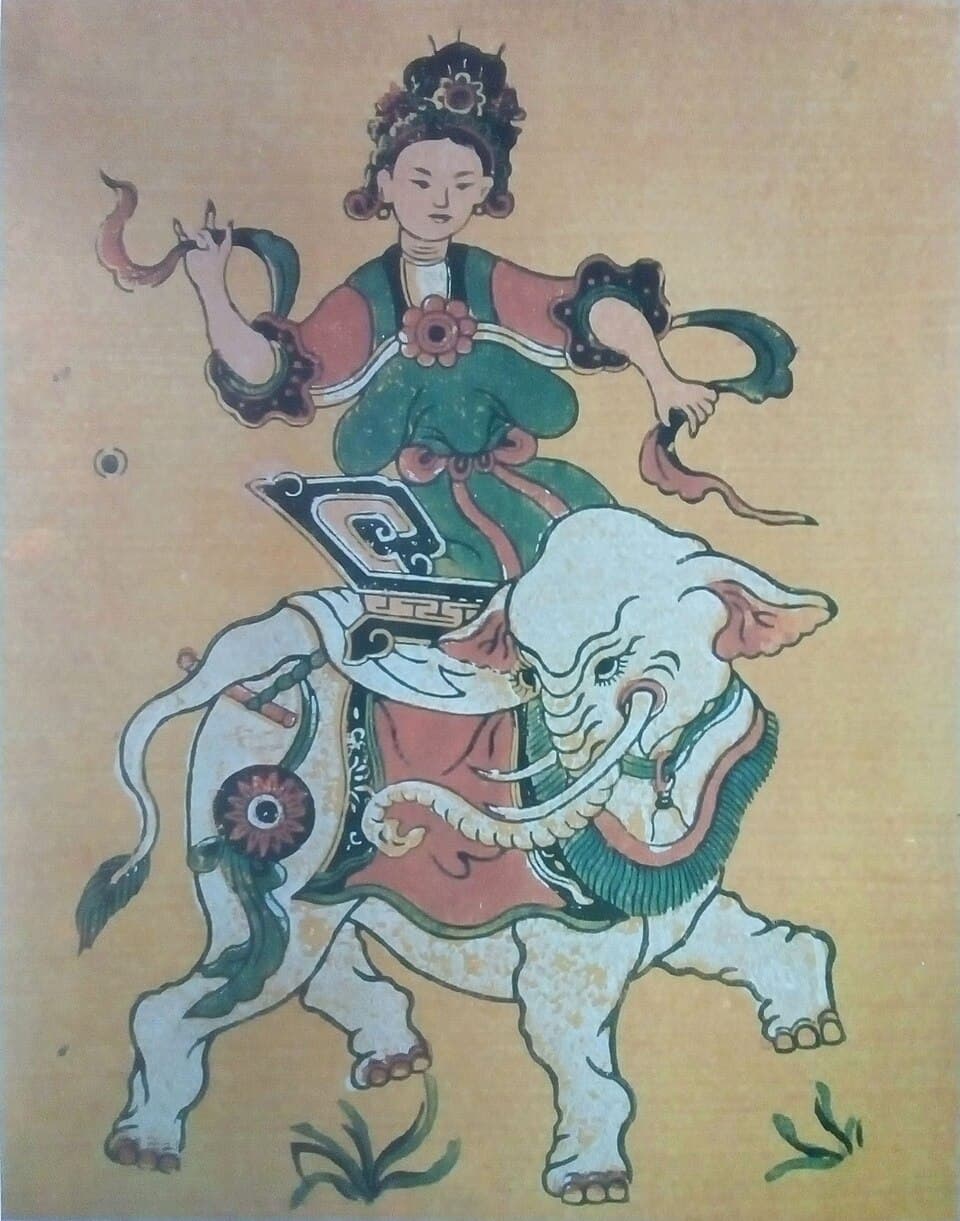
That morning, two twelve-year-old visitors stop in front of an old temple in Thanh Hóa. A woman in golden armor waits for them, calm, her voice deep. It is Lady Triệu, dead long ago, returned to tell them about her revolt.
—What was it like, going into battle on an elephant?
You ride very high, my child. From the elephant's back, you can see the whole valley of Cửu Chân, the rice fields, the dust of enemy soldiers. In Vietnamese, we call it a voi chiến, a war elephant. Imagine a living wall that moves and makes the ground tremble beneath your feet. The soldiers of the Wu, those Chinese from the north, were afraid just from that sound. I wore golden armor, shining like the sun. It wasn't to look pretty. It was so my fighters could spot me from afar and keep their courage. A leader, you see, must be seen.
A leader must be seen from afar, otherwise no one follows.
—What did the Chinese soldiers say about you?
Ah, that always made me smile! The scribes of the Wu wrote astonished things about me. They spoke of an immense woman, with a voice that carried like thunder. Imagine soldiers used to seeing men command, and suddenly a young woman charges at them on an elephant, in golden armor. It troubled them! In their world, a woman did not lead an army. But in our mountains, courage does not look at whether you are a girl or a boy. I think they exaggerated my height because they couldn't understand how a woman could hold them off for six whole months.
Courage does not look at whether you are a girl or a boy.
—How old were you when you decided to fight?
I was very young, barely older than you in a few years. My elder brother, Triệu Quốc Đạt, tried to reason with me. He thought it was too dangerous for a girl. So I answered him, and these words, all my people still repeat them: “I want to ride the storms, kill sharks in the seas, chase the invaders out of our country, free our people from slavery.” You understand? I didn't want a quiet little marriage while foreigners plundered our villages. I wanted something great, something immense. Like taming a storm with bare hands.
I want to ride the storms and chase the invaders from our country.
—It must have been hard to continue alone when your brother died?
Very hard, yes. We were preparing this uprising together, he and I. We call it a khởi nghĩa, a word that means to rise up against an unjust master. When my brother died, around the year 243, I had two paths before me. Cry and go home. Or take his place at the head of the fighters. Imagine you carry a fire in your hands: if you drop it, it goes out. I took the fire. Thousands of men followed me, a woman, which had almost never been seen. I turned grief into courage.
I turned grief into courage.
—What did you eat in the morning, in the mountains?
Rice, my child, always rice! Especially sticky rice, nếp, steamed, which stays in your stomach for a whole day of marching. With that, dried and fermented fish, some game when the hunters returned, and vegetables gathered in the forest. We wasted nothing. Imagine: we were hidden on the slopes of Cửu Chân, without markets, without big cities. Every grain of salt counted, we kept it preciously. I got up before the sun to check supplies and positions. An empty stomach doesn't fight long, you know.
An empty stomach doesn't fight long.
—How did you warn your soldiers quickly in the mountains?
Good question! We were scattered all over the forests, impossible to shout from one hill to another. So we used fire. Torches, signals lit on hilltops: a flame that lights up, and everyone understands to prepare. We also had bronze drums, trống đồng, old instruments of our ancestors. Their deep sound rolled through the valleys and set the rhythm for our charges. Imagine a dark night, with no light around, and suddenly a fire lights up there, then the beat of a drum. That was our way of speaking across the mountain.
A fire that lights up, a drum that beats: that's how we speak in the mountain.
—In the evening, around the fire, what did you do with your chiefs?
Evening was the most important moment. Around the campfire, I received the clan chiefs from all the villages. I had to convince them to stay united, because each had his pride and his quarrels. A revolt, you see, is not just a battle: it's a thousand little disputes to calm. We also prayed to the spirits of our ancestors to keep morale high. Imagine dozens of tired men, sitting in the dark, and a young woman listening to them one by one. In the morning, we trained for combat; in the evening, we mended hearts. Both count equally.
A revolt is a thousand little disputes to calm before the battle.
—How did the Chinese general finally manage to defeat you?
Not by force, my child. Governor Lục Dận was cunning. He knew my fighters greatly respected spirits and omens. So, tradition says, he invented tricks to scare them, to break their courage from within. That's terrible: to lose not because you are weaker, but because you doubt. Little by little, my troops found themselves surrounded, in the year 248. Imagine a hand slowly closing around you. We held out six months, all the same. Six months against an empire, with almost nothing. I am still proud of that.
I was not defeated by force, but by sowing doubt.
—Why didn't you rather surrender to stay alive?
Because surrendering, for me, was dying another way. On Mount Núi Tùng, my last refuge, all was lost. The enemies were climbing. I could have bowed my head, begged forgiveness, lived submissive the rest of my days. But all my life, I had said I wanted my people free. How could I live on my knees after that? I chose to die standing, free. You may find that hard to understand at your age, and that's normal. But there are things you carry stronger than your own life. My freedom was one of those.
I chose to die standing and free rather than live on my knees.
—How does it feel that people still come to see you in a temple?
It touches me more than you can imagine. At Phú Điền, near where I fought, they built me a temple, the đền Bà Triệu. “Bà Triệu” means Lady Triệu, or even Mother Triệu. Centuries after my death, the Lý and Trần kings gave me titles of guardian goddess. Me, a young mountain girl! Imagine you plant a seed and, a thousand years later, a huge tree still gives shade to a whole people. My revolt failed, yes. But my example was never defeated.
My revolt failed, but my example was never defeated.
—What would you like people to remember about you today?
Remember this, my child: they defeated me, but they never made me bend. Long after me, a man named Ngô Quyền finally freed our country, in 939, and I was placed among the nation's heroes. My people still say a saying linked to my name: Đánh Đông, dẹp Bắc, “fight in the east, pacify the north.” Imagine a flame thought extinguished, that reignites years later in the hearts of others. You don't need to be great or powerful to matter. You just need to refuse injustice, even if you are alone, even if you are young.
You don't need to be powerful to matter, just to refuse injustice.
This imaginary interview was generated by artificial intelligence from sources documented in Lady Triệu's profile. It dramatises what the figure might have said based on what we know about them, but does not constitute attested historical testimony. For primary sources and factual documentation, refer to the full profile.