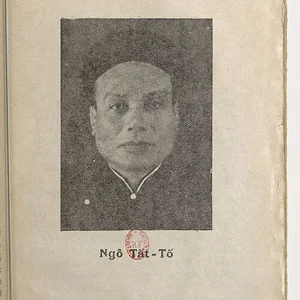

Ngô Quyền (898–944) was the first king of the Ngô dynasty in Vietnam. In 938, he led the Vietnamese resistance and crushed the Southern Han fleet at the Battle of Bạch Đằng, ending nearly a millennium of Chinese domination and ushering in an era of lasting independence [1].
Ngô Quyền(897 — 944)
Ngô Quyền
Vietnam
6 min read
Frequently asked questions
Key Facts
- April 17, 898: born into a family of hào trưởng (local notables) in Đường Lâm [1]
- 937: Kiều Công Tiễn assassinates his father-in-law Dương Đình Nghệ and seizes power [1]
- 938: Ngô Quyền kills Kiều Công Tiễn, then wins the Battle of Bạch Đằng against the Southern Han, killing prince Lưu Hoằng Tháo [1]
- 939: he proclaims himself king (Ngô Vương), founds the Ngô dynasty, and establishes his capital at Cổ Loa [1]
- 944: Ngô Quyền dies after six years of reign, at the age of 47 [1]
Works & Achievements
Defeat inflicted on the Southern Han fleet through the tactic of submerged stakes, ending nearly a millennium of Chinese domination over Vietnam.
Proclamation of Ngo Quyen as king (Ngo Vuong), the first sovereign of an autonomous Vietnamese state after the period of Chinese domination.
Symbolic choice of Co Loa, the former capital of Au Lac, over Dai La, to mark continuity with the pre-Chinese Vietnamese state.
Establishment of a hierarchy of one hundred dignitaries, court rites, and official dress codes, forming the foundation of the Ngo state.
Suppression of the usurping notable who had assassinated Duong Dinh Nghe, a necessary step toward unifying command before the confrontation with the Southern Han.
Anecdotes
Before the arrival of the Southern Han fleet, Ngô Quyền is said to have declared to his generals that Lưu Hoằng Tháo was merely an “inexperienced child” leading troops exhausted by a long sea voyage, and that the death of Kiều Công Tiễn deprived the enemy of any local support [1].
To prepare for the Battle of Bạch Đằng in 938, Ngô Quyền had wooden stakes carved into points and reinforced with iron planted in the riverbed, taking advantage of the large tidal range to conceal them underwater at high tide [1].
According to traditional accounts, Ngô Quyền sent light vessels to provoke the enemy fleet at high tide in order to lure it above the field of stakes, then feigned retreat; when the tide receded, the stakes tore through the hulls of the Southern Han ships, causing them to sink [1].
Prince Lưu Hoằng Tháo, son of the Southern Han ruler Lưu Cung, was captured and killed in this debacle, putting an end to the Southern Han attempt to reconquer the region [1].
In the *Bình Ngô đại cáo*, the scholar Nguyễn Trãi later summed up this episode with the line “Lưu Cung tham công nên thất bại” (Lưu Cung, out of a thirst for glory, was defeated), underscoring the Chinese ruler's miscalculated ambition [1].
Primary Sources
Mùa xuân, vua bắt đầu xưng vương, lập Dương thị làm hoàng hậu, đặt trăm quan, chế định triều nghi phẩm phục.
Vương giết Công Tiễn, phá Hoằng Tháo, tự lập làm vua, tôn Dương thị làm Hoàng hậu, đặt đủ 100 quan, dựng ra nghi lễ triều đình.
Công Tiễn bị Ngô Quyền vây, sức yếu bị thua mới cầu cứu nhà Nam Hán.
Lưu Cung tham công nên thất bại.
Key Places
Birth village of Ngo Quyen, born into a family of local notables who held the office of district chief.
Estuary where in 938 Ngo Quyen won the famous naval battle against the fleet of Southern Han, thanks to submerged stakes.
Former capital of Au Lac, chosen by Ngo Quyen to establish his court in 939, a symbolic break from Dai La.
Territory entrusted to Ngo Quyen by his father-in-law Duong Dinh Nghe, the base of his power before he ascended the throne.
Former Chinese administrative seat on the To Lich river, deliberately rejected by Ngo Quyen as a capital because of its colonial past.
Typical Objects

Wooden stakes carved into points and reinforced with iron, planted in the bed of the Bach Dang river to rip open enemy ships at low tide.

Fast vessels used to provoke the Southern Han fleet and lure it into the trap of the stakes.

Dress codes and official insignia instituted by Ngo Quyen to structure the new hierarchy of his court.

Royal title taken by Ngo Quyen in 939, marking the break with the status of military governor under Chinese tutelage.

Insignia of office inherited from the Chinese and then local administrations, passed from Khuc Thua Du to Duong Dinh Nghe before Ngo Quyen.
School Curriculum
Vocabulary & Tags
Key Vocabulary
Daily Life
Morning
As governor and later king, Ngo Quyen devoted his mornings to military and administrative affairs, receiving reports from the borders and provinces under his authority, particularly while preparing the defense against the Southern Han.
Afternoon
Afternoons were often taken up by war councils with his generals, such as when he laid out his strategy of iron-tipped stakes before the Battle of Bach Dang, or by managing relations with local notables who had rallied to his authority.
Evening
In the evening, the sovereign and his court observed the rites newly established at Co Loa, amid an atmosphere of political consolidation for a still-young power facing the ambitions of the Southern Han.
Food
Like the Vietnamese nobility of his time, his diet was based on rice, fish, and river produce, supplemented by goods supplied by the agricultural regions under his control.
Clothing
After his accession to the throne in 939, Ngo Quyen instituted official dress codes distinguishing the ranks of his court, while he himself likely wore sovereign's robes inspired by Chinese customs adapted to local use.
Housing
He resided at Co Loa, the capital he chose for its symbolic link to the ancient kingdom of Au Lac, rather than at Dai La, the former administrative seat marked by the Chinese presence.
Historical Timeline
Period Vocabulary
Liens externes & ressources
Références
Œuvres
Victoire de la bataille de Bach Dang
938
Fondation de la dynastie Ngo
939
Etablissement de la capitale a Co Loa
939
Organisation de l'administration royale
939
Elimination de Kieu Cong Tien
938