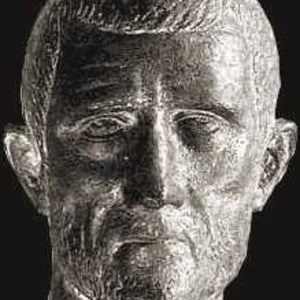

Flavius Aetius was a Roman general and statesman of the 5th century, the dominant figure of the waning Western Roman Empire. Nicknamed “the last of the Romans,” he is famous for stopping Attila and the Huns at the Catalaunian Plains in 451.
Aetius(390 — 454)
Aetius
Empire romain d'Occident, Rome antique
7 min read
Frequently asked questions
Key Facts
- Born around 391 in Durostorum (Moesia), he spent part of his youth as a hostage among the Goths and then among the Huns
- Became master of the soldiers (magister militum) and patrician, the true ruler of the Western Empire in the 430s–450s
- Won the Battle of the Catalaunian Plains in 451 against Attila, leading a Roman-Visigothic coalition
- Assassinated in 454 by Emperor Valentinian III himself, jealous of his power
Works & Achievements
His most famous achievement: halting Attila's invasion thanks to a Roman-barbarian coalition. This battle temporarily saved Gaul from Hunnic domination.
Aetius managed to unite Visigoths, Franks, Burgundians and Alans alongside Rome. This diplomatic feat demonstrates his mastery of the balance between peoples.
A military campaign that annihilated the first Burgundian kingdom with the support of the Huns. It lastingly reshaped the map of peoples in Gaul.
A series of campaigns through which Aetius restored Roman authority in Gaul. There he stabilized the borders and contained the peasant revolts of the Bagaudae.
A policy of establishing barbarian peoples as allies (foederati) in the service of Rome. It made it possible to maintain a defense despite the weakness of the Roman army.
For more than twenty years, Aetius was the strongman of the West, directing both the army and politics. He embodied the last great figure of Roman imperial authority.
Anecdotes
As a child, Aetius was sent as a hostage first to the Goths and then to the Huns. Far from being a humiliation, this stay taught him the language, customs, and military arts of these peoples. Later, he knew how to use this: he was personally acquainted with Attila and was able to recruit Hunnic warriors into his own armies.
In 451, facing Attila, Aetius pulled off a stroke of diplomatic genius: he assembled a coalition bringing together Romans, Visigoths, Franks, Burgundians, and Alans — peoples who were often enemies of one another. This unlikely alliance halted the Huns at the Catalaunian Plains, near present-day Châlons-en-Champagne.
His nickname, “the last of the Romans,” is said to have been given to him by the Byzantine historian Procopius. For many, his death marked the end of any organized defense of the Western Empire, which collapsed for good about twenty years later, in 476.
Aetius was assassinated in 454, struck down by the sword of Emperor Valentinian III himself, who was jealous of his power. According to an anecdote reported by the chroniclers, a courtier is said to have then told the emperor: “You have just cut off your right hand with your left.” A few months later, Valentinian was himself assassinated by former loyal followers of Aetius.
Before his great victory against Attila, Aetius had already fought the Huns... alongside them! In his early political career, he relied on Hunnic troops to assert himself at the court of Ravenna, showing just how blurred the boundaries between “Romans” and “Barbarians” had become in the 5th century.
Primary Sources
Aetius, then master of the soldiery, on whom rested the whole State of the West, a man of great prudence and experienced in wars, marched out to meet Attila with the help of the Goths and their allies.
The battle was fought on the Catalaunian Plains; it is said that one hundred and sixty thousand men were killed there on both sides, and that Attila fled with his own people.
Aetius was the last of the Romans, a man remarkable for his virtue, who had often triumphed over the invading Barbarians.
Aetius, the most illustrious of the patricians, was killed in the palace by the hand of Valentinian, and with him fell the State of the West, which has not been able to recover to this day.
Key Places
Town in Moesia where Aetius is said to have been born, in a Danube frontier region exposed to the peoples of the steppes. His father, Gaudentius, was a Roman officer of Scythian origin there.
Plain in Gaul where Aetius and his coalition halted Attila in 451, in one of the most famous battles of Late Antiquity. The exact location remains debated.
Capital of the Western Roman Empire in the 5th century and seat of the imperial court. It was here that Aetius wielded power, and here that he was assassinated by Valentinian III in 454.
The symbolic city of the Empire, still prestigious but vulnerable in the 5th century. Aetius worked to maintain Roman authority in Italy in the face of barbarian threats.
Capital of the first Burgundian kingdom, which Aetius destroyed in 436 with the help of Hunnic mercenaries. This bloody episode later inspired the Germanic legend of the Nibelungs.
A great city in northern Italy ravaged by Attila in 452 during his invasion of the peninsula. Its fall illustrates the pressure the Huns brought to bear on Italy despite Aetius's victory.
Typical Objects

Long cavalry sword adopted by the late Roman army, longer than the classic gladius. It was the weapon of choice for officers and cavalrymen like Aetius.

Conical helmet made of metal plates joined by ribs, typical of the late Roman army influenced by the peoples of the steppes. It protected the head in battle.

Powerful recurved bow used by Hunnic horsemen, formidable at long range. Aetius knew how to use it, having lived among the Huns.

Brooch made of precious metal used to fasten the cloak, a rank insignia reserved for high dignitaries and imperial officers. It marked the status of a man like the patrician Aetius.

Armor made of small metal scales sewn onto a backing, common among officers of Late Antiquity. It offered flexible protection on the battlefield.

Carved ivory tablet given by great figures upon their accession to honors, celebrating their prestige. These objects spread the image of the Empire's dignitaries.
School Curriculum
Vocabulary & Tags
Key Vocabulary
Daily Life
Morning
On campaign, Aetius rose early to inspect the camp, listen to the reports of his scouts, and hold council with his officers. At the court of Ravenna, his mornings were taken up with audiences and the affairs of the Empire.
Afternoon
The afternoon might be devoted to military training, cavalry drills, or the reception of barbarian ambassadors. Aetius, a skilled negotiator, spent a great deal of time weaving and maintaining alliances.
Evening
In the evening, a Roman general often shared a banquet with his officers and allies, an occasion to seal trust and discuss strategy. These meals were also moments of informal diplomacy.
Food
The diet of the late Roman elite was based on bread, wine, olive oil, vegetables, cheese, and meat. On campaign, Aetius no doubt shared more frugal fare, close to that of his soldiers: wheat, salt pork, and wine cut with water.
Clothing
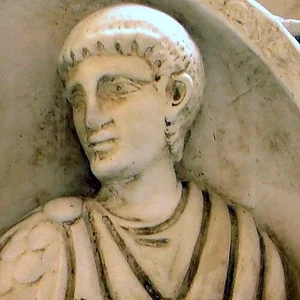
Aetius wore the dress of a high-ranking Roman officer: a tunic, a military cloak (*paludamentum*) fastened with a precious brooch, an ornate belt, and leather boots. In battle, he donned scale armor and a helmet.
Housing
In Ravenna, he resided in the vast residences of the aristocracy, near the imperial palace, with mosaics and inner courtyards. On campaign, he lived in a tent, at the heart of the fortified military camp.
Historical Timeline
Period Vocabulary
Liens externes & ressources
Références
Œuvres
Victoire des Champs Catalauniques
451
Constitution d'une coalition romano-barbare
451
Destruction du royaume burgonde de Worms
436
Pacification de la Gaule (campagnes contre les Bagaudes, Francs et Wisigoths)
430-440
Installation contrôlée des fédérés
années 440
Exercice du pouvoir comme patrice et maître de la milice
433-454