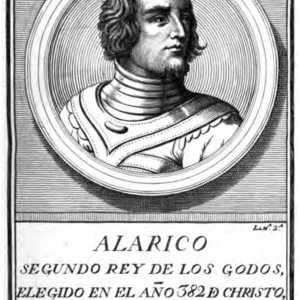

King of the Visigoths from 395 to 410, Alaric I is famous for leading the sack of Rome in 410, a symbolic event marking the beginning of the end of the Western Roman Empire.
Alaric I(370 — 410)
Alaric I
9 min read
Frequently asked questions
Key Facts
- 395: becomes king of the Visigoths following the death of Theodosius I
- 401–402: first incursions into Italy, repelled by Stilicho
- 408–410: three successive sieges of Rome
- 24 August 410: sack of Rome, the first since 390 BC
- 410: death of Alaric in Calabria during his march toward Africa
Works & Achievements
A major historical event and the first plundering of Rome since the Gauls (390 BC). An enormous symbolic trauma for the Roman world, it inspired Saint Augustine to write *The City of God* and is often cited as one of the harbingers of the fall of the Western Empire.
Alaric transformed the Visigoths from a scattered group of *foederati* into a unified people under a structured monarchy. His reign laid the institutional foundations for the future Visigothic Kingdom of Aquitaine (418) and later Toledo (507).
For fifteen years, Alaric pursued a complex policy, alternating military pressure with negotiation and playing East against West. These dealings offer invaluable insight into how Romano-barbarian diplomacy functioned in late Antiquity.
Alaric ravaged much of mainland Greece and the Peloponnese, sparing Athens after negotiation. These campaigns reveal his strategy of maximum pressure to extract official recognition from the Empire.
Alaric had the prefect Priscus Attalus proclaimed as a rival emperor in Rome in order to weaken Honorius. This episode demonstrates his political sophistication: he did not wish to destroy the Empire, but to secure a legitimate place within it for his people.
Anecdotes
Alaric I served in the Roman army before becoming Rome's enemy. He fought alongside the Romans at the Battle of the Frigidus in 394, under the command of Theodosius I. Despite his bravery, he was never granted the title of magister militum he demanded, which fueled his resentment toward the Empire.
The sack of Rome on August 24, 410 lasted only three days. Contrary to the legendary barbarian plundering, Alaric ordered that churches and those sheltering in Christian basilicas be spared. This detail astonished contemporaries and reflects the Arian Christian character of the Visigoths.
At his death in Cosenza in 410, his warriors diverted the course of the Busento river to bury him with his treasure in the dried riverbed, then restored the river to its normal flow. All the prisoners who had dug the tomb were killed so that the secret would be kept forever — and the tomb has never been found.
During the first siege of Rome in 408, Alaric did not take the city by force: he starved it into submission by blockading the Tiber. The desperate Roman Senate sent ambassadors to negotiate. Alaric demanded a colossal ransom — 5,000 pounds of gold, 30,000 pounds of silver, and thousands of furs and spices — and got what he wanted without fighting a single battle.
Alaric found himself caught in a power struggle between the two halves of the Empire. The shrewd general Stilicho, himself of Vandal origin, managed to corner him militarily on several occasions but never delivered the killing blow. Some historians believe Stilicho was keeping Alaric in reserve as a political counterweight — an ambiguity that would prove very costly for Rome.
Primary Sources
Orosius describes the sack of 410 as divine punishment but also as a relatively restrained event: “Alaric took Rome, but ordered that all who took refuge in holy places be spared.”
Augustine writes in direct response to the trauma of the sack of Rome: “What shall we say of the sack of Rome by the Barbarians? [...] The shrines of the martyrs and the apostles protected all who took refuge there, whether Christian or not.”
Zosimus, a Greek historian, gives a critical account from the Roman perspective of Alaric’s negotiations with the Empire and his various demands for land and military titles, presenting Alaric as an ambitious leader betrayed by the imperial courts.
The Latin poet Claudian, a contemporary of Alaric, portrays him as a formidable and dangerous enemy to the stability of the Empire, documenting his early campaigns in Greece and his initial incursions into Italy.
Procopius of Caesarea records the tradition of Alaric’s secret burial in the bed of the Busento river near Consentia: “The Visigoths diverted the course of the Busento [...] and buried their king along with a great portion of the spoils of Rome.”
Key Places
Symbolic capital of the Empire, besieged three times and finally sacked by Alaric in August 410. This event profoundly shook Roman civilization and inspired Saint Augustine to write *The City of God*.
Effective capital of the Western Empire since 402, residence of Emperor Honorius who always refused to negotiate seriously with Alaric. It was from Ravenna that Stilicho was executed in 408, freeing Alaric to advance on Rome.
City in Calabria where Alaric died in 410, shortly after the sack of Rome. Tradition holds that he was secretly buried in the diverted bed of the Busento river along with the spoils of Rome — a burial site that has never been located.
Site of the decisive battle of 378 in which the Visigoths crushed the Roman legions and killed Emperor Valens. This landmark event proved that a barbarian army could defeat Rome in open battle, paving the way for leaders like Alaric.
Near Asti, site of the battle of 402 in which Stilicho surprised the Visigoth camp during the Easter celebration and freed many Roman prisoners. Alaric was wounded there but not defeated — he negotiated his withdrawal and continued his struggle.
Major Roman city in the Balkans, the starting point of Alaric's campaigns in Greece (396–397). It was from this base that the Visigoth leader launched his raids toward Corinth, Athens, and the Peloponnese, forcing the Eastern Empire to come to terms with him.
Typical Objects

A long double-edged blade, inherited from both Germanic traditions and Roman military equipment. Alaric, a former Roman soldier, carried a weapon of this type — a symbol of his hybrid status between barbarian chieftain and Roman officer.

A Visigothic ornamental clasp inlaid with garnets and enamel, worn on the cloak to fasten it over the shoulder. Visigothic treasures uncovered through archaeology reveal a highly sophisticated goldsmithing tradition among the warrior elites.

A circular shield made of wood covered in leather, fitted with a central metal boss (umbo). The standard defensive weapon of Visigothic warriors during their battles against the Roman legions.

During the fall of Rome in 410, the Visigoths carried off a vast treasure: gold and silver vessels, candelabras, precious textiles, and according to tradition, part of the Temple treasure of Jerusalem that Titus had brought back in 70 AD.

The Visigothic peoples on the move traveled with their families and belongings in long columns of covered wagons. These convoys served both as their mobile camp and as a symbol of their condition as a people on the march, searching for a homeland.

A segmented helmet of Sassanid-Germanic type, composed of riveted metal panels, often adorned with golden decorations for chieftains. Associated with the Visigothic heavy cavalry that formed the main striking force of Alaric's army.
School Curriculum
Vocabulary & Tags
Key Vocabulary
Daily Life
Morning
Alaric rose at dawn in his commander's campaign tent, surrounded by his bodyguards (his *bucellarii*). He received reports from his military chiefs on the state of the troops, the progress of the columns, and news from spies embedded in Roman cities. The daily mobilization of an entire people on the move began at first light.
Afternoon
Afternoons were devoted to war councils with Visigoth clan chiefs, negotiations with Roman ambassadors who came bearing offers of truces or ransoms, and personal oversight of siege or march operations. Alaric regularly rode along the lines on horseback to maintain discipline and cohesion among his troops.
Evening
In the evenings, the Visigoths gathered around campfires. Arian priests led prayers — the Visigoths had been Christians of the Arian rite since their conversion in the 4th century. Bards sang the deeds of their ancestors in the Gothic tongue. Alaric held council with his trusted men, planning the next day's movements.
Food
The Visigothic diet was built around meat (smoked pork, game, mutton), barley or wheat bread, legumes, and dairy products. During the Italian campaigns, the Visigoths plundered local stores — grain from granaries, wine from cellars, livestock from farms. Chiefs like Alaric gained access to Roman cuisine during negotiations inside cities.
Clothing
Alaric wore a hybrid military outfit: Germanic wool *braies* (trousers), a linen tunic, and a wool cloak fastened with a gold-and-garnet fibula. Over that, a Roman coat of mail and a cavalry helmet (*spangenhelm*). Away from battle, a toga or Roman-style garment signaled his ambition to be recognized as an imperial dignitary.
Housing
On campaign, Alaric lived in large command tents at the heart of the Visigoth camp, ringed by his people's wagons arranged into a circular defensive enclosure. During winter quarters or the occupation of cities, he took up residence in Roman *domus* or requisitioned palaces. His entire people lived in perpetual motion — women, children, and the elderly carried in vast convoys of *carpentum* (covered wagons).
Historical Timeline
Period Vocabulary
Visual Style
Guerrier hybride romano-barbare de la fin de l'Antiquité : casque de cavalier doré, cotte de mailles, fibule en grenat. Esthétique des mosaïques ravennates et de l'orfèvrerie wisigothique, fonds ocre et or, lumière dramatique de torche.
Sound Ambience
Un paysage sonore de camp militaire en marche : cliquetis des armes, roulement des chariots wisigoths sur les voies romaines, chants guerriers en langue gothique et litanies chrétiennes ariennes au crépuscule.
Liens externes & ressources
Références
Œuvres
Sac de Rome (410)
24 août 410
Construction du royaume wisigoth comme entité politique
395–410
Négociations diplomatiques avec les deux Empires
395–410
Campagnes militaires en Grèce (396-397)
396–397
Élection de l'anti-empereur Attale (409)
409