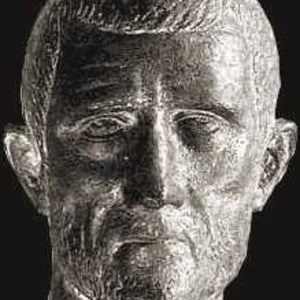

Antiochus III, known as the Great, was a Seleucid king who reigned from 223 to 187 BC. He restored the Seleucid Empire through vast campaigns into the East, but was defeated by Rome, which marked the rise of Roman power in the eastern Mediterranean.
Frequently asked questions
Key Facts
- Ascends the Seleucid throne in 223 BC
- Leads the “anabasis” (212-205 BC), a great expedition into the East that earns him the title “the Great”
- Welcomes Hannibal to his court after his flight from Carthage
- Defeated by the Romans at Thermopylae in 191 BC, then at Magnesia ad Sipylum in 190 BC
- Signs the Treaty of Apamea in 188 BC, ceding Asia Minor; dies in 187 BC
Works & Achievements
A vast military campaign that restored Seleucid authority from Media to the borders of India, earning Antiochus the title of “the Great.”
The annexation of Coele-Syria and Palestine at the expense of Ptolemaic Egypt, secured by the victory at Panion in 200 BC.
A reform of the Seleucid government, with the appointment of viceroys and the strengthening of the royal cult to unify an immense territory.
The suppression of the revolt of the governor Achaeus, besieged and captured at Sardis, which re-established Seleucid control over Anatolia.
The crossing into Thrace and the refounding of Lysimachia, a gesture of European ambition that aroused the alarm and hostility of Rome.
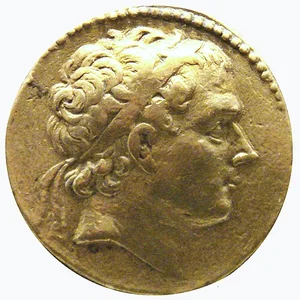
The massive minting of silver tetradrachms bearing his likeness in numerous workshops, spreading his image and financing his armies.
Anecdotes
To conclude peace with the Indian king Sophagasenos around 206 BC, Antiochos III obtained additional war elephants, bringing his elephant cavalry back up to about 150 beasts. This great expedition to the East, which took him as far as the edges of India, earned him the prestigious nickname *Megas*, the Great.
In 209 BC, before the rebel city of Bactra, Antiochos won a battle against the Greco-Bactrian king Euthydemus, but was wounded in the mouth and lost several teeth during a cavalry skirmish. Despite his victory, he recognized Euthydemus's kingship rather than bog himself down in an endless siege.
After his defeat by Rome, Antiochos welcomed to his court the famous Carthaginian general Hannibal, sworn enemy of the Romans, who became his military adviser. Legend has it that Hannibal, on seeing the king's vast and motley army, made an ironic remark: all that gold and luxury would be more than enough “for the Romans,” meaning that they would make rich plunder of it.
At the Battle of Magnesia in 190 BC, Antiochos's huge army, tens of thousands strong and equipped with scythed chariots, was crushed by the far less numerous Roman legions of Scipio. His own scythed chariots, panicked by the arrows, turned on his own troops and spread chaos.
Antiochos III died in 187 BC in a manner humiliating for a great king: short of money to pay the heavy tribute imposed by Rome, he attempted to plunder the temple of Bel at Elymais, in Persia. The inhabitants, enraged by this sacrilege, attacked and killed him along with his escort.
Primary Sources
Euthydemus argued that it was not just to deprive him of his kingdom, for he himself had not revolted against the king, but on the contrary had destroyed the descendants of other rebels. Antiochus, persuaded by these reasons, agreed to conclude a treaty and to grant him the royal title.
The scythed chariots, which Antiochus had positioned in front, far from harming the enemy, threw his own ranks into confusion, for the horses, frightened by the missiles, rushed unchecked against his own troops.
Antiochus shall evacuate all the cities and territories lying on this side of the Taurus, pay fifteen thousand Euboean talents of silver, and surrender his elephants and warships.
Hannibal, seeing the king's army resplendent with gold and silver, and asked by Antiochus whether he thought all this would be enough against the Romans, replied that he believed it quite enough for the Romans, greedy as they were.
Key Places
Western capital of the Seleucid Empire, founded by Seleucus I, the seat of Antiochus III's power. One of the greatest cities of the Hellenistic world.
Capital of the Greco-Bactrian kingdom, which Antiochus besieged before recognizing the kingship of Euthydemus around 206 BC. A major stage of his great eastern expedition.
A city near Gaza where Antiochus suffered a heavy defeat in 217 BC against Ptolemy IV of Egypt. The battle pitted tens of thousands of men and elephants against each other.
A plain in Asia Minor where the Seleucid army was annihilated by the Roman legions in 190 BC. This defeat sealed the end of Antiochus's expansion.
A pass in central Greece where Antiochus was defeated by the Romans in 191 BC, forcing him to abandon Greece. The legendary site of ancient Greek resistance.
A region of Persia where Antiochus III was killed in 187 BC while attempting to plunder a temple to pay the tribute owed to Rome. The site of his violent death.
Typical Objects

A band of white cloth tied around the head, the emblem of kingship among the rulers descended from Alexander's empire. Antiochus wears it on his coinage as a symbol of legitimacy.

A trained battle animal mounted with a tower for archers, used in large numbers by the Seleucids. Antiochus brought back about 150 of them from his eastern expedition.

A war chariot fitted with curved blades on its axles to mow down enemy ranks. At Magnesia, these chariots turned against the Seleucid army.

A long pike of five to seven metres wielded by the foot soldiers of the Macedonian phalanx, the core of the Seleucid army. Held with both hands, it formed a wall of points.

A large silver coin struck with the diademed effigy of Antiochus III, used to pay soldiers and to spread the king's image. The reverse often shows Apollo seated on the omphalos.

Heavy armour covering the rider and sometimes his horse, worn by the elite Seleucid cavalry. Antiochus himself charged at the head of his horsemen.
School Curriculum
Vocabulary & Tags
Key Vocabulary
Daily Life
Morning
The king begins his day surrounded by his “friends” (philoi) and his bodyguards, receiving reports from messengers who have come from the empire's distant provinces. On campaign, he inspects the troops and reviews the phalanx and the elephants at dawn.
Afternoon
The afternoon is devoted to audiences: Antiochus dispenses justice, receives Greek, Persian, and Roman ambassadors, and settles administrative matters with his satraps. He dictates orders and letters to his secretaries to govern a territory stretching from the Aegean Sea to Central Asia.
Evening
In the evening, the king presides over a banquet (symposion) in the Greek style, bringing together noble guests, advisors, and sometimes foreign envoys such as Hannibal. Wine diluted with water, music, and political and strategic discussions set the rhythm of the night.
Food
The royal diet blends Greek and Eastern traditions: wheat bread, roasted meats (mutton, game), fish, fruit, honey, and spices from the East. Greek wine, served diluted with water, accompanies meals and court banquets.
Clothing
Antiochus wears the purple chlamys (cloak) of the Macedonian kings and the white diadem, the emblem of Hellenistic royalty. In war, he dons the bronze or iron cuirass and the plumed helmet of the shock cavalryman.
Housing
The king resides in the palaces of Antioch, Seleucia, or the provincial capitals, vast complexes adorned with colonnades, mosaics, and gardens. On campaign, he lives in a richly decorated royal tent, a true mobile center of power.
Historical Timeline
Period Vocabulary
Liens externes & ressources
Références
Œuvres
Grande anabase orientale
212-205 av. J.-C.
Conquête de la Cœlé-Syrie (Ve guerre de Syrie)
202-200 av. J.-C.
Réorganisation administrative de l'empire
vers 220-205 av. J.-C.
Restauration de l'autorité en Asie Mineure
vers 216-213 av. J.-C.
Expansion en Thrace et en Europe
196 av. J.-C.
Politique monétaire à grande échelle
223-187 av. J.-C.