Imaginary interview with Nanny of the Maroons
by Charactorium · Nanny of the Maroons · Politics · Military · 6 min read
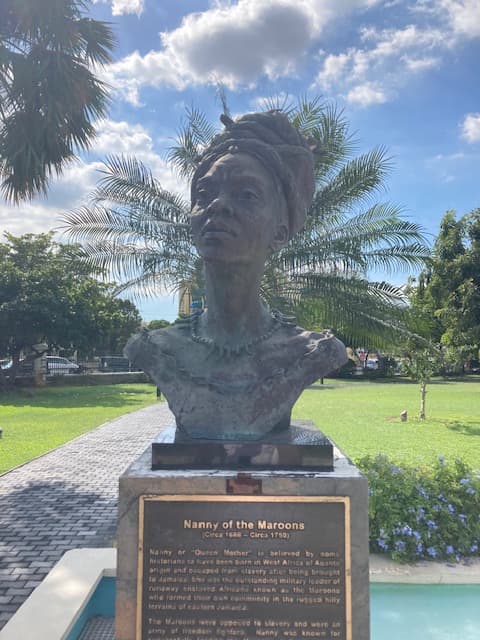
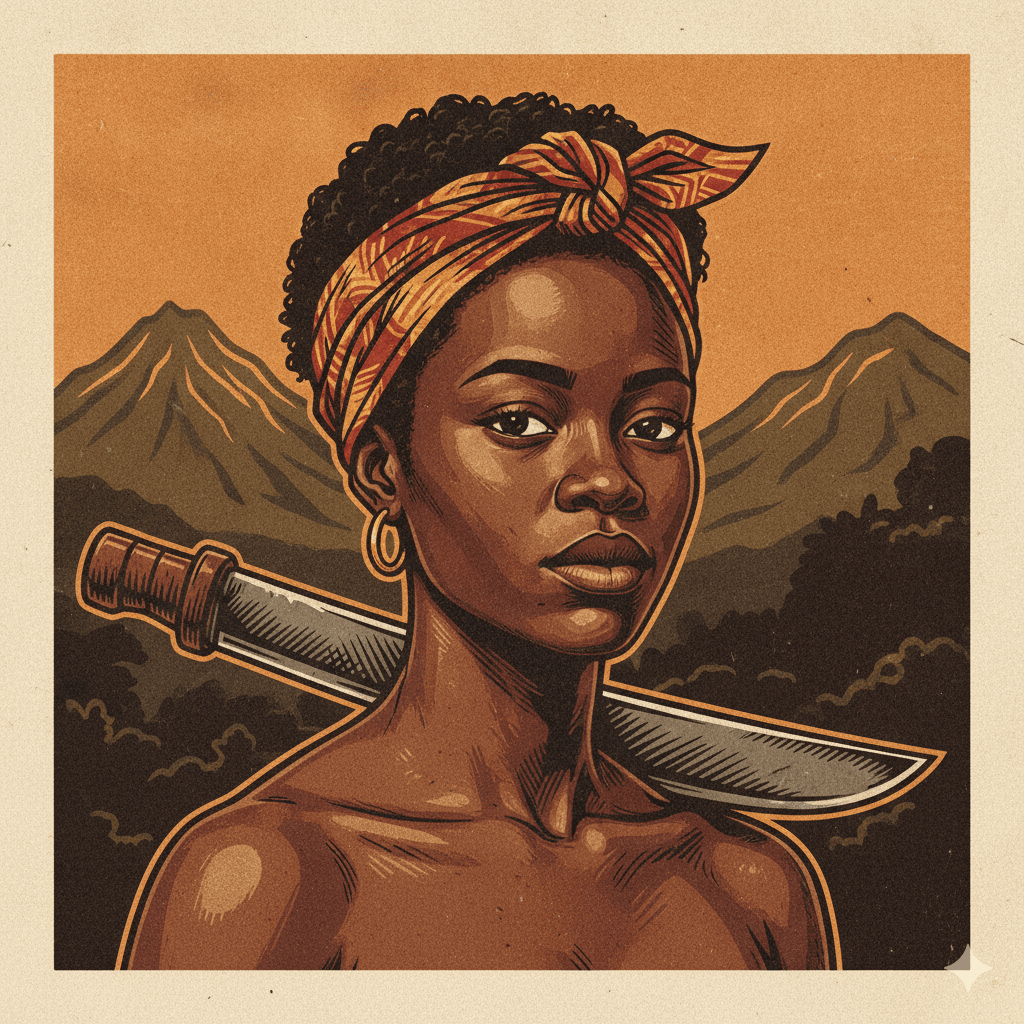
Dawn mist over the gorges of the Rio Grande, more than nine hundred meters above the world of plantations. A horn echoes in the distance, long then short, and a silhouette draped in ochre patterns beckons us up the last rocks. Here is Nanny, leader of the Windward Maroons, who agrees to talk as long as the sun has not crossed the ridge.
—Where exactly are we, and why did you choose to build here rather than elsewhere?
You are in my home, in the heights where the air cuts the breath of King George's soldiers before they even fire. I placed my village in the river gorges, where the mountain closes like two hands on a grain of corn. Do you hear that horn, the abeng? A sentinel has just told the whole valley that strangers are climbing. The English exhaust themselves climbing single file, one by one, on trails where my people wait for them, invisible in the ferns. Below, they count their cannons; here, I count my precipices. From the Blue Mountains, I see death coming three days before it arrives, and that's already three days of life stolen from the master.
Below, they count their cannons; here, I count my precipices.
—They say a boiling cauldron stood at the entrance to your village. What should we believe?
The English speak of a great cauldron placed on the path, boiling without fire and swallowing their soldiers. I leave you their fear as they left it to me. What I know is that a man who believes the mountain is bewitched stumbles faster than a man sure of his boots. We had traps under the leaves, pits, balanced rocks that a single arm could roll. The rest, the tales have thickened like a soup. Since 1720, they have launched expedition after expedition, and each time they come back down with fewer men and more stories. Let them keep their legends of the pot: they stand guard in my place when my warriors sleep.
Let them keep their legends of the pot: they stand guard in my place.
—Your own soldiers say that bullets cannot harm you. How do you live with such a reputation?
They say I catch musket balls and send them back to the one who spat them. Believe what you will; my warriors believe it, and that is where the true powder lies. A fighter who walks behind a woman no lead can reach walks without trembling. I am what they call an obeah woman: I know the spirits, I speak to the ancestors who remained on the Ashanti coast, I hold my calabash of plants when a wounded man delirious with fever. My strength is not in the blade alone; it is in the gaze my people cast upon me. You cannot command these men by the fear of the whip — that, they have fled. You command them by faith.
A fighter who walks behind a woman no lead can reach walks without trembling.
—What happens here when the sun sets?
In the evening, I am no longer only the warrior. I sit at the center of the village for the palaver: two men argue over a goat, a woman demands justice, and I must decide without breaking what holds us together. Then come the drums. We dance the kumina, we call the dead by their Akan names, and legs tired from guard duty find a reason to keep going. I visit the wounded with my herbs from the Blue Mountains, those leaves the forest gives to those who know how to ask. A people who have fled the hell of plantations do not bond with orders; they bond with songs, fire, and the shared memory of where we come from.
A people who have fled hell do not bond with orders, but with songs and fire.
—You are credited with freeing hundreds of slaves. How does one become such a liberator?
They say I snatched nearly eight hundred souls from plantations in a few years. I did not count; I only opened the mountain to those who still knew how to run. A man arrives here broken, his back striped, his eyes lowered from the habit of the whip. My work begins there: to give him back a name, a place, a blade. Some become farmers in our hidden gardens in the highlands, others learn ambush and the silence of the forest. Since 1728, the English have put a price on my head — proof that they finally understand what a fugitive turned soldier costs them. Every slave I free is not just a mouth saved: it is one less gun aimed at my people and one more arm to defend them.
My work begins there: to give back a name, a place, a blade to one the whip had bent.
—How do you restore the will to fight in these traumatized men?
You do not heal fear by shouting at it. The fugitive who climbs up to me has learned that lifting his head means death. So I feed him first — yams, sweet potatoes, wild boar caught in our snares — for a full belly begins to hope. Then I put him on the abeng, to blow the code of short and long sounds, and the day his horn warns the whole village of danger, he understands that he matters. I give him a machete, that short blade that clears as much as it cuts, and I let him clear his own field before I let him fight. A man who owns a piece of land and a tool never lies down in chains again. That is my strategy: make a slave a free man before making him a warrior.
A man who owns a piece of land and a tool never lies down in chains again.
—In 1739, peace was signed with the English. How did you receive that treaty?
Governor Trelawny finally extended the hand he had not been able to cut off. The Treaty of 1739 recognizes our autonomy, our lands, our right to govern ourselves — something no empire had ever granted to fugitive Africans. A victory, yes. But I do not drink the rum of celebration without tasting it long. To sign with the master is to acknowledge that he still exists; it is also to accept clauses my mouth does not like to utter. I have seen too many truces be only a slower way to chain us. So I shake the hand, but I keep the other on the blade, and I tell my people: the freedom written on their paper is worth nothing if our horns still know how to sound.
The freedom written on their paper is worth nothing if our horns still know how to sound.
—A year later, a grant of five hundred acres bears your name. What does this land mean to you?
In 1740, the English put down on one of their deeds the name of a woman, 'Nanny', and give her five hundred acres they call New Nanny Town. Think of it: they who hunted me like game engrave my name in their registers, as if they had finally admitted that I exist. This land is not alms; it is war booty paid in years of blood. It is where my people will plant their yams without lifting their heads at the slightest noise, where Moore Town will grow and last long after me. A grant on English paper makes me smile: they think they have given me a plot, when they have signed, with their own hand, the admission that they could not defeat me.
They think they have given me a plot; they have signed the admission that they could not defeat me.
—Where do you come from, before Jamaica, before the mountain?
My blood comes from the Ashanti coast, that land of West Africa where I was called by a name the slavers could not keep. We, the Kroomanty — that is what the English call those from Coromantine — are reputed to be indomitable, and they are right to fear us. I crossed the bitter water in a hold, but I did not leave my ancestors on the other shore. I brought our drums, our adinkra symbols that speak of strength and endurance, our way of greeting the dead. A people who forget where they come from let themselves be chained twice. In these mountains, I did not only build a fortress: I replanted Africa, leaf by leaf, song by song.
I did not only build a fortress: I replanted Africa, leaf by leaf.
—What do you want to pass on to those who will live here after you?
I cannot read the future, but I know the power of something passed from mouth to ear. When I am dust under the trees of Moore Town, you will find no book in my name — people like me do not enter the masters' books. What I leave is held in our kroomanty songs, in the gesture of a mother teaching her son the abeng, in the indigo-dyed patterns on our cloth. If one day, in a century I will not see, my horn is still blown in these gorges, then I will not have lived for nothing. Memory is the only fortress no artillery can destroy — not even the one that reduced Nanny Town to ashes in 1734.
Memory is the only fortress no artillery can destroy.
This imaginary interview was generated by artificial intelligence from sources documented in Nanny of the Maroons's profile. It dramatises what the figure might have said based on what we know about them, but does not constitute attested historical testimony. For primary sources and factual documentation, refer to the full profile.