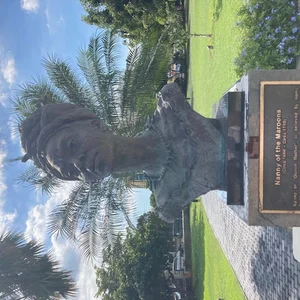

A central figure of Maroon resistance in Jamaica during the 18th century, Nanny led the Windward Maroons from their stronghold in the Blue Mountains. A warrior and spiritual leader of Akan origin (present-day Ghana), she led the struggle against British colonial slavery for decades. A Jamaican national heroine, her life is transmitted primarily through Maroon oral tradition.
Nanny of the Maroons
Nanny of the Maroons (Queen Nanny)
Ghana, colonie de Jamaïque
10 min read
Frequently asked questions
Famous Quotes
« "Liberty or death." (attributed by Maroon oral tradition; not verified by any contemporary written source)»
Key Facts
- c. 1686: probable birth, most likely in West Africa (Akan/Ashanti people, present-day Ghana) — date and origin drawn from Maroon oral tradition
- 1720s–1739: leads the Windward Maroons from Nanny Town in the Blue Mountains of Jamaica
- 1739: a peace treaty is signed between the Maroons and the British, granting land and autonomy — Nanny is mentioned in an official document as a land grantee
- c. 1740: founding or consolidation of New Nanny Town (Moore Town), a Maroon community still in existence today
- c. 1755: date of death according to oral traditions; in 1976, she is officially proclaimed a National Hero of Jamaica
Works & Achievements
Nanny established and led for several decades an autonomous fortified village in the Blue Mountains — a true independent Maroon state capable of holding its own militarily against British colonial power. This political and military achievement stands as her central legacy.
Nanny coordinated guerrilla operations against British troops throughout the First Maroon War, developing ambush tactics and territorial defense strategies suited to the mountainous terrain — tactics that would have a lasting influence on the art of colonial guerrilla warfare.
Oral tradition credits Nanny with freeing several hundred enslaved people from surrounding plantations, welcoming them into the Maroon community and giving them a social place and a collective identity rooted in resistance and African heritage.
At the close of the First Maroon War, Nanny or her representatives negotiated with British authorities for recognition of Maroon autonomy and the granting of a 500-acre territory — the legal foundation of Moore Town, a Maroon community that still exists today.
Nanny played a central role in preserving and adapting Akan spiritual, musical, and linguistic traditions within the Jamaican Maroon community, laying the groundwork for a distinctive cultural identity that lives on in the ceremonies of Moore Town.
Anecdotes
According to Maroon oral tradition, Nanny possessed the power to deflect musket balls fired by British soldiers: some accounts claim she caught them with her body or clothing and sent them back against the enemy. While legendary in nature, this attribute reflects the extraordinary spiritual and military prestige she held among the Maroons and the terror she inspired in the British.
Nanny Town, the fortified village Nanny commanded in the Blue Mountains, was said to be impregnable. Perched at over 900 meters elevation in the gorges of the Rio Grande river, it was protected by hidden traps, sentinels concealed in dense vegetation, and sound signals made with horns — the 'abeng', a wooden horn used by Akan warriors — allowing defense to be coordinated across long distances.
Nanny is credited with freeing approximately 800 enslaved people over the course of a few years in the early 18th century, integrating them into the Maroon community and organizing them as soldiers or cultivators. Her ability to transform traumatized runaways into seasoned fighters made her as much a political leader as a founding mother for the Eastern Maroons.
In 1740, a year after the peace treaty between the Maroons and the British, colonial records mention that a woman called 'Nanny' officially received a land grant of 500 acres named 'New Nanny Town', known today as Moore Town. This is one of the few written documents that indirectly attests to her real existence beyond oral tradition.
The Eastern Maroons practiced a syncretic spirituality blending Akan beliefs with Caribbean adaptations. Nanny was regarded as an 'obeah woman' — that is, a practitioner of Akan spiritual arts — and her authority as leader rested as much on her religious standing as on her military abilities. This dual role mirrors that of warrior-priestesses in the Ashanti kingdoms of West Africa.
Primary Sources
An official colonial deed from 1740 records the allocation of 500 acres of land to a Maroon woman known as 'Nanny' and her community, in recognition of their participation in the peace negotiations following the 1739 treaty.
The articles of the 1739 treaty recognize the autonomy of the Maroon communities of the Blue Mountains, granting them land and the right to govern themselves in exchange for ceasing hostilities against the British colony.
Maroon elders describe Nanny as an Akan warrior and priestess who led her people through spiritual power as much as through arms, with abilities said to allow her to thwart British soldiers' assaults in the gorges of the Blue Mountains.
Several reports sent to London between 1720 and 1739 describe the difficulties royal troops faced in locating and attacking Maroon villages perched in the eastern mountains of Jamaica, referencing deadly ambushes and organized resistance.
Ritual songs passed down orally within the Moore Town community invoke Nanny as founding ancestor and spiritual protector, blending words of Akan origin with Caribbean formulas rooted in Jamaican Maroon tradition.
Key Places
A fortified village founded by Nanny in the steep gorges of the Rio Grande river, at over 900 meters above sea level. The command center of the Eastern Maroon resistance, it was destroyed by the British in 1734, but its ruins remain a sacred site for the Moore Town Maroons.
A Maroon village founded after the 1739 treaty on land granted to Nanny, located in the parish of Portland. The capital of the Eastern Maroons to this day, it preserves the cultural, linguistic, and spiritual traditions inherited from Nanny and the Akan resistance.
A mountain range peaking at over 2,200 meters, the main theater of the Maroon Wars and a natural refuge for the communities led by Nanny. The density of the rainforest and the complexity of the terrain made British military operations extremely difficult.
A traditional burial site where Maroon oral tradition places Nanny's grave, at the heart of Moore Town. It is a place of remembrance and pilgrimage for the Maroon community, who regularly gather there to honor their founding ancestor.
The West African region from which Nanny is said to originate, according to oral tradition, which holds that she was born in an Akan kingdom. This heritage shaped her cultural identity, spiritual practices, and warfare techniques — all transplanted to Jamaica in the context of resistance to slavery.
Typical Objects

A communication instrument made from a cow horn, used by Maroon warriors to transmit long-distance signals across the mountains. Nanny is said to have used it strategically to coordinate the defenses of Nanny Town during British attacks.

A short, thick blade essential in the dense forests of the Blue Mountains, used for both clearing vegetation and combat. Maroon warriors mastered a form of close-quarters fighting with the machete that made them formidable opponents in wooded terrain.

A vessel carved from a dried gourd, used in Akan and Maroon spiritual ceremonies. As an obeah woman, Nanny is said to have used calabashes filled with medicinal plants and ritual substances to heal the wounded and strengthen the morale of her fighters.

Maroons of Akan origin wore fabrics with colorful geometric patterns, similar to Ghanaian kente cloth, blended with local adaptations using cotton and plant fibers. These garments served as a powerful marker of their African heritage.

Nanny was renowned for her knowledge of Jamaican forest plants, which she used to treat battle wounds and prepare protective herbal remedies. This ethnobotanical knowledge, inherited from Akan traditions and enriched by local expertise, was central to her role as a spiritual leader.

Maroon oral tradition describes a great cauldron that boiled without any visible fire, placed at the entrance to Nanny Town to lure British soldiers into a trap. Though rooted in myth, this object symbolizes the tactical cunning and supernatural powers attributed to Nanny.
School Curriculum
Vocabulary & Tags
Key Vocabulary
Tags
Daily Life
Morning
Nanny rises before dawn alongside the sentinels, guided by overnight reports on British movements in the valley. She begins the day with an Akan ritual prayer — invoking the ancestors and protective orishas — before overseeing the guard rotations and inspecting the camp's natural fortifications.
Afternoon
Afternoons are devoted to the military training of warriors: ambush techniques, abeng signaling, and silent movement through the forest. Nanny also oversees communal farming work — food gardens of root vegetables, bananas, and medicinal plants — which ensure the Maroon village's self-sufficiency in the face of British blockades.
Evening
At sunset, Nanny presides over communal ceremonies: palavers to settle disputes, healing rituals for the wounded, and kumina singing and dancing sessions that keep alive the connection to Akan ancestors. Her role as spiritual leader finds its fullest expression in these moments, which bind together the collective identity of the Windward Maroons.
Food
The Maroons' diet is entirely self-sufficient: yams, sweet potatoes, corn, and plantains grown in hidden highland gardens, supplemented by hunting wild boar (feral pigs that had returned to the wild), fishing in mountain streams, and gathering tropical fruits and medicinal herbs. Spices such as Jamaican allspice season dishes rooted in Akan culinary traditions, adapted to local ingredients.
Clothing
Nanny wears wraps with Akan-inspired geometric patterns, dyed with local plants in ochre, red, and indigo, paired with necklaces of seeds, bones, and protective amulets. Her attire as spiritual leader includes decorative elements marking her status: feathers, shells, and adinkra motifs embroidered or painted on the cloth. In combat situations, she adopts plainer clothing that allows for free movement through the forest.
Housing
Nanny lives in a round Akan-style hut, built from forest timber and topped with a palm-leaf roof, integrated into the defensive layout of Nanny Town. The interior holds a ritual space with ceremonial objects, dried herbs, and symbolic representations of the ancestors. The village as a whole is organized around natural defensive positions — boulders, cliffs, and narrow passes — that make it nearly impregnable to frontal assault.
Historical Timeline
Period Vocabulary
Visual Style
Peinture épique mêlant art akan et tradition caribéenne : Nanny, figure de pouvoir spirituel et militaire, se détache des forêts brumeuses des Blue Mountains dans des coloris profonds de vert, ocre et or.
Sound Ambience
Forêt tropicale dense des Blue Mountains jamaïcaines, ponctuée de signaux de corne abeng et de tambours cérémoniels maroons résonnant dans les gorges de la rivière Rio Grande.
Liens externes & ressources
Références
Œuvres
Fondation et organisation de Nanny Town
vers 1700–1734
Libération et intégration d'esclaves fugitifs
vers 1700–1739
Négociation du traité de paix et obtention des terres de Moore Town
1739–1740
Transmission de la culture akan en Jamaïque
XVIIIe siècle