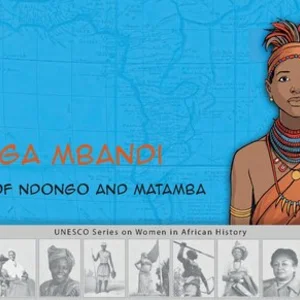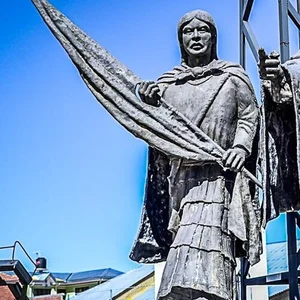

Queen of Ndongo and later Matamba (Mbundu people, present-day Angola), Nzinga Mbandi was a formidable political and military strategist who resisted Portuguese expansionism and the Atlantic slave trade throughout the 17th century. An iconic figure of pre-colonial African resistance, she negotiated, waged war, and allied with the Dutch to defend her people's sovereignty.
Nzinga Mbandi
Nzinga Mbandi (Ana de Sousa Nzinga Mbande)
Royaume de Ndongo
9 min read
Frequently asked questions
Famous Quotes
« "I am queen of Ndongo, not a servant of the Portuguese." (attributed by oral tradition during the 1622 negotiations)»
« "My ancestors taught me that land is not surrendered — it is inherited and defended." (attributed by Mbundu oral tradition)»
Key Facts
- Born around 1583 in the kingdom of Ndongo, into the Mbundu royal family (present-day Angola).
- In 1622, she negotiated with Portuguese governor João Correia de Sousa in Luanda — a famous episode in which, according to tradition, she sat on a kneeling servant to assert herself as the Portuguese governor's equal.
- After the assassination of her brother, King Ngola Mbandi (around 1624), she seized power over Ndongo and then conquered the kingdom of Matamba (around 1630).
- She allied with the Dutch against the Portuguese between 1641 and 1648, demonstrating remarkable international diplomacy.
- She died in 1663 in Matamba, having maintained her kingdom's independence for decades.
Works & Achievements
Nzinga's first major diplomatic act, this negotiation with the Portuguese governor resulted in a treaty temporarily recognizing the sovereignty of Ndongo. Nzinga demonstrated remarkable political skill, using both symbolism (the throne episode) and her conversion to Christianity as leverage.
After losing Ndongo, Nzinga transformed Matamba into an organized kingdom that served as a refuge for escaped slaves and a military base against the Portuguese. This state-building effort, which spanned more than thirty years, stands as her greatest political achievement.
Nzinga negotiated a strategic alliance with the Dutch West India Company to attack the Portuguese on two fronts. This unprecedented coalition between an African queen and a Protestant European power is a testament to her exceptional geopolitical vision.
After decades of war, Nzinga secured a treaty recognizing Matamba's independence and barring the Portuguese from crossing her territory to capture slaves. This treaty was a major diplomatic victory for African sovereignty.
Nzinga incorporated deserting soldiers, escaped slaves, and warriors of diverse origins into a disciplined military formation known as the kilombo. This organizational innovation allowed her to sustain a lasting resistance against colonial armies.
Anecdotes
In 1622, Nzinga traveled to Luanda to negotiate with the Portuguese governor João Correia de Sousa. He refused to offer her a seat, intending to humiliate her by forcing her to remain standing like a subject. Nzinga signaled one of her servants to get down on all fours and sat on her back, presenting herself as an equal to the governor.
To legitimize her alliance with the Portuguese, Nzinga agreed to be baptized in 1622 under the name Ana de Sousa — with the governor himself as her godfather. This purely strategic gesture did not stop her from taking up arms against the Portuguese just a few years later, demonstrating a remarkable mastery of diplomacy and political pragmatism.
In the late 1640s, Nzinga allied with the Dutch West India Company to drive the Portuguese out of Angola. She led her troops into battle herself, dressed in male warrior attire and carrying a bow and war axes. She commanded military operations well into old age, possibly past sixty.
After conquering the kingdom of Matamba around 1630, Nzinga transformed the territory into a refuge state for escaped slaves and Portuguese army deserters known as kilombo. She organized a resistance army that defied the Portuguese for decades, making Matamba a true stronghold of African sovereignty in Central Africa.
Near the end of her life, Nzinga negotiated a peace agreement with Portugal in 1657. She reconciled with Christianity, invited Capuchin missionaries to her court, and had a church built in Matamba. She died in December 1663, at around 80 years of age, surrounded by her dignitaries, leaving behind an independent kingdom.
Primary Sources
Mbundu griots and storytellers passed down the great deeds of Nzinga: her negotiations with the Portuguese, her military victories, and her ability to unite peoples under her banner. These accounts, collected by missionaries in the 17th century, form the living memory of the queen's reign.
The Capuchin missionary Cavazzi, who stayed at Nzinga's court during her final years, describes the queen as a woman of great political intelligence and a skilled negotiator who ran a well-organized court and received ambassadors with strict protocol.
In this letter, Nzinga seeks the support of the Holy See and reaffirms her Christian faith, while denouncing the excesses of Portuguese slave traders who are violating the agreements reached. She presents herself as the legitimate sovereign of a Christian kingdom allied with Rome.
This Portuguese diplomatic report describes the political structures of the kingdoms of Central Africa, trade with Ndongo, and the growing tensions between local rulers and colonizers — providing the context in which Nzinga came to power.
Mbundu warrior songs celebrate Nzinga as a lioness-mother protecting her people: 'She did not flee before the red-haired men; she held the land of her fathers.' These oral compositions long served as the primary means of keeping her memory alive among the Angolan people.
Key Places
The royal residence of the Ndongo kingdom, Kabasa was the political heart of the Mbundu people. It was here that Nzinga grew up, received a royal education, and asserted her ambitions for power before being driven out by the Portuguese.
The seat of Portuguese colonial government, Luanda was the setting of the famous 1622 negotiation in which Nzinga stood her ground against the governor. The city embodies both colonial domination and the queen's diplomatic resistance.
After being driven from Ndongo, Nzinga conquered the kingdom of Matamba around 1630 and made it her base of resistance. She turned it into a sanctuary state for escaped enslaved people and ruled there until her death in 1663.
The main river of present-day central Angola, the Kwanza served as a strategic border and a battleground between Nzinga and the Portuguese. Several decisive battles were fought along its banks.
Typical Objects

A symbol of royal power in Ndongo, the war axe was carried by rulers during ceremonies and battles. Nzinga is often depicted with this royal attribute, signifying her authority both political and military.

Characteristic weapons of Mbundu warriors, the bow and quiver accompanied Nzinga into battle according to 17th-century chronicles. Carrying these weapons was also a symbolic act of solidarity with her soldiers.

During the 1622 negotiations in Luanda, when the Portuguese governor refused to offer her a seat, Nzinga had one of her attendants kneel down and sat upon her back. This act became a lasting symbol of her dignity and refusal to submit.

The lukano, a bracelet carved from human tendons, was the supreme symbol of power among the kings of Ndongo. Its possession legitimized the ruler; Nzinga's struggle to obtain an equivalent became central to the succession conflicts of her era.

After her baptism in 1622 and later reconversion near the end of her life, Nzinga wore the symbols of the Christian faith. For her, these objects represented less a spiritual conviction than a diplomatic tool for negotiating with Catholic European powers.

The war drum was used to coordinate the movements of Mbundu armies in battle and during royal ceremonies. The sound of the ngoma symbolized the queen's authority over her troops and marked the rhythm of court rituals.
School Curriculum
Vocabulary & Tags
Key Vocabulary
Tags
Daily Life
Morning
Nzinga began her day with spiritual rituals blending ancestral Mbundu practices and, in her later years, Christian prayers. She received reports from her military chiefs and advisors on the state of Matamba's borders and the movements of Portuguese troops.
Afternoon
Afternoons were devoted to diplomatic audiences, the administration of the kingdom, and council sessions with her generals. She sometimes personally participated in troop training or presided over judicial proceedings as supreme sovereign.
Evening
In the evenings, the court gathered for ceremonies marked by drumming and praise songs. Griots recited the great deeds of Mbundu royal ancestors, reinforcing Nzinga's legitimacy. Banquets brought together dignitaries, warriors, and foreign emissaries.
Food
The diet at the court of Matamba was based on root vegetables (cassava, yam), legumes, dried fish from the Kwanza River, game meat, and tropical fruits. Sorghum beer (pombe) was consumed during ceremonies.
Clothing
Nzinga wore brightly colored raphia fabrics, often dyed in ochre, red, and indigo, draped in the Mbundu tradition. She adorned herself with heavy bead ornaments, copper bracelets, and elaborate headdresses marking her royal status. In times of war, she dressed in male warrior attire.
Housing
The royal residence at Matamba was a large compound of wattle-and-daub huts with thatched roofs, protected by palisades. The palace included audience halls, places of worship, and quarters reserved for the women of the court. Capuchin missionaries had a chapel built there toward the end of her reign.
Historical Timeline
Period Vocabulary
Visual Style
Style baroque africanisé, mêlant la richesse des cours royales africaines du XVIIe siècle à l'esthétique des illustrations de missionnaires jésuites et capucins : contrastes puissants, couleurs terreuses et dorées, parures mbundu.
Sound Ambience
Ambiance sonore de la cour royale de Matamba au XVIIe siècle : tambours de guerre, chants d'éloge mbundu, forêt équatoriale et fleuve Kwanza en toile de fond.
Liens externes & ressources
Références
Œuvres
Négociation de Luanda et traité de 1622
1622
Construction du royaume de Matamba en État de résistance
vers 1630-1663
Alliance militaire avec les Hollandais
1641-1648
Traité de paix avec le Portugal
1657
Organisation du kilombo (armée de résistants)
vers 1630-1650