Imaginary interview with Rabindranath Tagore
by Charactorium · Rabindranath Tagore (1861 — 1941) · Literature · Music · Philosophy · 6 min read
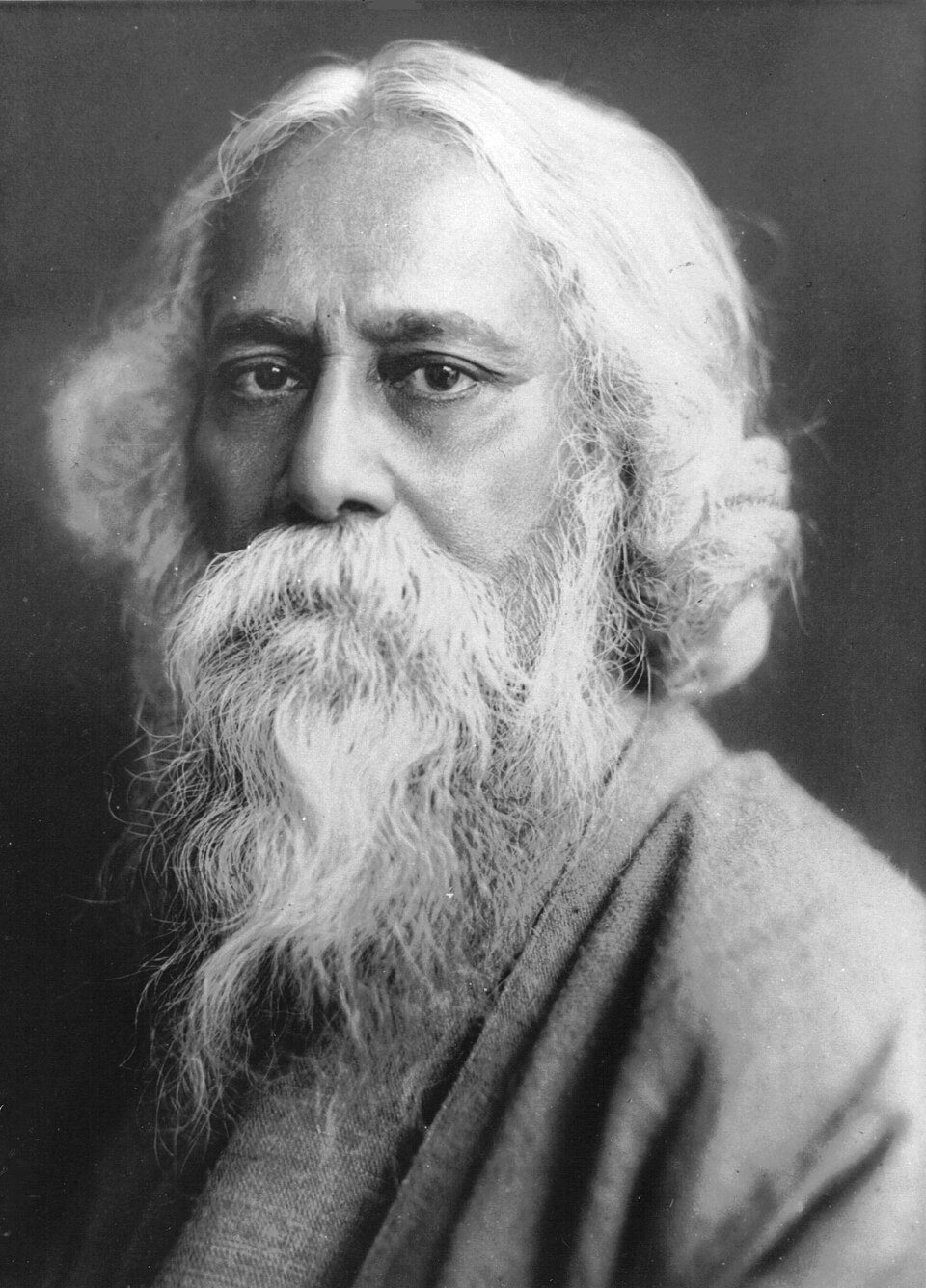
Late afternoon at Santiniketan, under the mango trees whose shadows lengthen. An old man in a light draped robe, shawl on his shoulder, closes a Bengali notebook covered with corrections. He agrees to speak, in a low voice, as if singing.
—Do you remember the day you decided to give back your knighthood?
Spring 1919. They had made me Sir four years earlier, under the seal of King George V, and I had accepted without thinking, as one accepts rain. Then came the news of Amritsar: at Jallianwala Bagh, soldiers had fired into a trapped crowd, hundreds dead, women and children. I did not sleep. The title suddenly weighed on my shoulders like something obscene. I wrote to the Viceroy Lord Chelmsford on May 31, and I told him what my conscience could no longer keep silent: “the time has come when badges of honour make our shame glaring in their incongruous context of humiliation, and I, for my part, wish to stand, shorn of all special distinction, side by side with my countrymen.”
The title suddenly weighed on my shoulders like something obscene.
—Were you not afraid of the consequences of such a gesture under the Raj?
Fear, you see, is the only prison that the British Raj could not build for me; I would have had to inflict it upon myself, and I refused. I was a poet, not a politician, and I knew my voice did not have the force of a boycott. But a word, sometimes, cuts where the army dares not. To renounce publicly, to write to the Viceroy, was to remind that no medal redeems blood shed in a square. I have been reproached for my silence on other struggles, and I will be reproached for this one as insolence. No matter. A man who keeps on his chest a decoration given by the hand that killed his brother ceases to be a man. I preferred to become simply a Bengali among Bengalis again.
Fear is the only prison the Raj could not build for me.
—Why did you want to hold school outdoors, under the trees?
Because a child shut between four walls first learns obedience, and only afterwards the world; I wanted to reverse the order. In 1901, at Santiniketan — the name means “the abode of peace” —, I laid some mats under the trees and began. The morning opened with songs, the lesson followed the flight of birds, grammar waited until the light was settled. I was inspired by the ancient ashrams, those retreats where master and pupil lived side by side, not one above the other. A banyan tree is better than a blackboard: it does not repeat, it makes things grow. I saw sad children come alive again simply because the sky was given back to them.
A banyan tree is better than a blackboard: it does not repeat, it makes things grow.
—How did that little school become a university open to the world?
The school grew like a child: first it learns its own language, then it wants to speak to its neighbours. In 1921, I transformed Santiniketan into Visva-Bharati, a university where East and West could sit on the same mat without one serving the other. I feared isolation as much as submission; a nation that knows only its own face ends up one-eyed. I brought scholars from Europe, China, Persia, and sent my students to listen to the world. They studied Sanskrit and physics, Chinese painting and Bengali weaving. My dream was not to produce clerks for the Raj, but whole human beings, capable of feeling that a foreign civilization is not a threat, but another room in the same house.
A nation that knows only its own face ends up one-eyed.
—What did you seek to impart that colonial schools did not give?
Inner freedom, without which all knowledge is merely a well-ordered burden. The colleges of the Raj trained docile clerks; I wanted fearless minds. I placed at the head of my collection Gitanjali this wish that was also my educational program: “Where the mind is without fear and the head is held high; where knowledge is free [...] into that heaven of freedom, my Father, let my country awake.” At Santiniketan, in the afternoon, children wrote, sang, planted trees, and in the evening they performed plays. I did not want them to recite India: I wanted them to inhabit it, and in inhabiting it to understand that no boundary can enclose a truly awakened thought.
I did not want them to recite India: I wanted them to inhabit it.
—How could one man write the songs of two nations?
I never composed an anthem; I composed songs, and it was the peoples who later turned them into flags. Amar Shonar Bangla was born in 1905, when Viceroy Curzon partitioned Bengal with a stroke of the pen: my grief for my torn land became a song, which Bangladesh would adopt long after me. Jana Gana Mana, from 1911, celebrated the diversity of a whole subcontinent, and India would choose it as its own. That makes me, they say, the only man whose voice two countries sing. But I confess: I prefer to think these melodies belong to Rabindra Sangeet, to those thousands of songs I sowed, and not to states. A song that becomes law loses a bit of its soul.
I never composed an anthem; it was the peoples who turned them into flags.
—Your songs accompanied the Swadeshi movement. Was singing, for you, a form of combat?
In 1905, when the partition of Bengal sparked the Swadeshi movement — the word means “of one’s own country” —, people burned English cloth in the squares. I had no torch, I had a melody. I went from gathering to gathering, and we sang together, strangers weaving their voices as one weaves wrists. A song does not break a window, but it makes a thousand hearts beat in the same rhythm, and that no administration can forbid. Yet I soon grew wary: when the boycott turned into hatred of the other, I stepped back. I refused that love of Bengal become contempt for a neighbour. My homeland, I wanted it sung, never turned into that machine the West calls nation.
I had no torch, I had a melody.
—In 1930, in Berlin, you discussed with Albert Einstein. What did you debate?
The most dizzying thing of all: does truth exist without anyone to perceive it? Einstein, that day in July 1930, defended a solid world, independent of us, that would turn just the same if humanity died out. I, the poet, could not accept that. I told him my conviction, which I still hold: “the truth of the universe is a human truth [...] this universe is a human universe.” A table, a star, a beauty have meaning only when encountered by a consciousness; remove the gaze, there remains only a qualityless silence. He smiled, patient as a scientist before a child. We did not convince each other. But rarely has a disagreement seemed so luminous to me: two men leaning, each with their tools, over the same abyss.
Remove the gaze, there remains only a qualityless silence.
—This idea that nothing true exists outside consciousness — where does it come from?
It comes from the same source as my songs and my school: the conviction that man is not an intruder in the universe, but the organ through which the universe knows itself. In my lectures on Sadhana, I tried to put it differently: we reach our greatest selves when we discover ourselves part of a great whole, in harmony with what surpasses us. A scientist like Einstein measures that whole; the poet dissolves into it. Where the West separates the observing subject and the observed object, my tradition holds them bound. That is why I distrust that cold nation the West erects: it treats men as cogs in a machine, whereas truth, the only truth, is always born from an encounter between two living presences.
Man is the organ through which the universe knows itself.
—It is said that you took up painting very late, starting from your corrections. How so?
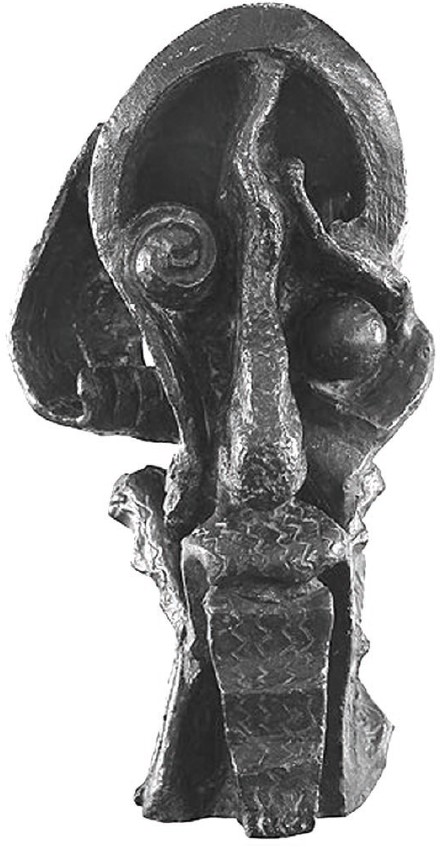
I was past sixty, an age when one is supposed to put away one’s tools, not take up new ones. Yet my Bengali notebooks were covered with corrections; a crossed-out word leaves a blot, and that blot, one evening, looked at me. Instead of erasing it, I extended it: an animal appeared, then a strange face, then another. My corrections were dreaming in my place. From this wounded writing were born thousands of drawings, dark, without academic grammar, which I had never learned to make. At nearly seventy, I discovered a mute language. They were exhibited in Europe, those canvases, in the 1930s, and people marvelled that a poet had the hands of a painter. I myself marvelled most at having waited so long to let my mistakes speak.
My corrections were dreaming in my place.
—What would you say to someone who thinks it is too late to create differently?
That old age is the most beautiful of workshops, provided you do not furnish it with regrets. I had sung, written Gora, built Santiniketan, and believed my work was done; then a simple correction opened a continent to me. The late gesture has this precious quality: it no longer seeks to please. I painted for myself alone, without master, without school, with the very ink that had served my poems. A man is never finished as long as an unexpected form can still emerge from his hand. I tell my students as I tell myself: never close the notebook completely. Life, up to the last breath, delights in correcting what it has written, and it is in those corrections, often, that the truest face is hidden.
Old age is the most beautiful of workshops, provided you do not furnish it with regrets.
This imaginary interview was generated by artificial intelligence from sources documented in Rabindranath Tagore's profile. It dramatises what the figure might have said based on what we know about them, but does not constitute attested historical testimony. For primary sources and factual documentation, refer to the full profile.