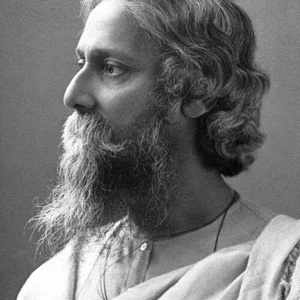

Indian (Bengali) poet, novelist, composer, and philosopher, a leading figure of the Bengal Renaissance. The first non-European to win the Nobel Prize in Literature, in 1913, for his collection Gitanjali. A humanist thinker and educator, he founded the university at Santiniketan.
Rabindranath Tagore(1861 — 1941)
Rabindranath Tagore
Raj britannique
6 min read
Frequently asked questions
Famous Quotes
« Where the mind is without fear and the head is held high.»
« If you shed tears when you miss the sun, you also miss the stars.»
Key Facts
- Born in 1861 in Calcutta into a large, cultured Bengali family
- Published Gitanjali (Song Offerings) in Bengali in 1910, translated into English in 1912
- Awarded the Nobel Prize in Literature in 1913, the first non-European laureate
- Founded the school and later the Visva-Bharati university at Santiniketan in 1921
- Composed the national anthems of India (Jana Gana Mana) and Bangladesh; died in 1941
Works & Achievements
Collection of mystical and lyrical poems that earned Tagore the Nobel Prize in Literature, introducing Indian poetry to the West.
Song that became the national anthem of India in 1950, celebrating the country's unity and diversity.
Patriotic song about Bengal that became the national anthem of Bangladesh in 1971, making Tagore the author of two national anthems.
Major novel exploring identity, religion, and nationalism in colonial India, regarded as one of his major works in prose.
Novel pitting idealism against radical nationalism amid the Swadeshi movement, adapted for film by Satyajit Ray.
International university founded by Tagore, embodying his educational ideal of openness between the cultures of East and West.
Body of more than two thousand songs composed by Tagore, a musical genre in its own right that remains very much alive in Bengal.
Final great lecture, lucid and disenchanted, in which Tagore reflects on the moral failure of modernity while keeping faith in humanity.
Anecdotes
In 1913, Tagore became the first non-European to receive the Nobel Prize in Literature, for *Gitanjali*. He had translated his own Bengali poems into English, and the Irish poet **W. B. Yeats**, dazzled, wrote the preface to the collection that introduced him to the West.
In 1915, King **George V** knighted him (“Sir”). But in 1919, horrified by the Jallianwala Bagh massacre at Amritsar, where British soldiers killed hundreds of Indian civilians, Tagore publicly renounced his title in a letter to the viceroy, as a sign of protest.
Tagore is the only author in the world to have composed the national anthems of two countries: “Jana Gana Mana” for India and “Amar Shonar Bangla” for Bangladesh. His song also inspired the national anthem of Sri Lanka.
In 1930, in Berlin, he had a famous conversation with **Albert Einstein** about the nature of reality, truth, and beauty. The physicist defended a reality independent of humankind, while the poet maintained that no truth could exist without a consciousness to perceive it.
Tagore did not take up painting seriously until his late sixties. His drawings often grew out of the crossings-out and corrections in his manuscripts, which he transformed into animal shapes or strange faces, giving rise to a body of work of more than two thousand canvases.
Primary Sources
Where the mind is without fear and the head is held high; where knowledge is free [...] into that heaven of freedom, my Father, let my country awake.
The time has come when badges of honour make our shame glaring in their incongruous context of humiliation, and I for my part wish to stand, shorn of all special distinctions, by the side of my countrymen.
We reach the greatest of ourselves when we realise that we are but a part of a great whole, in harmony with the universe.
A nation, in the sense in which the word is used in the West, is that aspect of a whole population which organises itself for a mechanical purpose.
The truth of the universe is a human truth. [...] This universe is a human universe.
Key Places
Vast Tagore family residence in the heart of Calcutta, an intellectual and artistic hub of the Bengal Renaissance. Rabindranath was born and died there.
A rural spot in Bengal where Tagore founded his school in 1901 and then Visva-Bharati University in 1921, championing open-air education open to the wider world.
City where Tagore stayed as a young man for his studies and where the English translation of *Gitanjali* was published in 1912, launching his international fame.
Site of the 1919 massacre by British troops, which led Tagore to renounce his knighthood as a sign of protest.
Swedish capital where the Nobel Prize is awarded; Tagore delivered there belatedly, in 1921, the customary acceptance speech tied to his 1913 honour.
Typical Objects
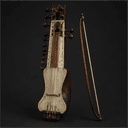
A bowed string instrument from Bengal, halfway between the sitar and the violin, prominent in the music of Santiniketan. Tagore associated it closely with his own compositions, the *Rabindra Sangeet*.
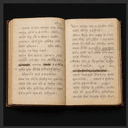
Notebooks covered in Tagore's Bengali handwriting, where poems and songs were endlessly reworked. His crossings-out sometimes gave birth to his first drawings.
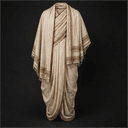
Tagore most often wore a long, light draped garment and a shawl, together with a long white beard, which became his iconic image. His attire displayed a simple, Indian elegance.

The everyday writing tools of a man who produced thousands of poems, novels, essays and letters. The ink also served for his late sketches.
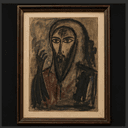
Painted works created mostly after his sixties, with dark, expressive figures, made without any academic training. They were exhibited in Europe from the 1930s onward.
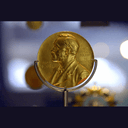
An award received in 1913 for *Gitanjali*, a symbol of the worldwide recognition of Indian literature. The original medal was later stolen from the Santiniketan museum in 2004.
📷 CC BY-SA 4.0 · Wikimedia Commons ↗School Curriculum
Vocabulary & Tags
Key Vocabulary
Daily Life
Morning
Tagore would rise very early, often before dawn, to meditate and write in peace. At **Santiniketan**, the day began with songs and lessons given outdoors, beneath the trees.
Afternoon
The afternoon was devoted to writing poems, novels, or essays, as well as to the abundant correspondence he kept up with the entire world. He also oversaw the running of his school and university.
Evening
Evenings often brought together students, artists, and visitors around music, recitations, or theatrical performances. Tagore loved to sing his own compositions and discuss philosophy late into the night.
Food
Born into a well-off Bengali family, he ate refined Indian cuisine based on rice, vegetables, river fish, and lentils. Partial vegetarianism and moderation were valued among his reform-minded circle.
Clothing
He wore long, light draped robes and a shawl, in an Indian style that was both simple and dignified. His long white beard and flowing hair made him one of the most recognizable figures of all.
Housing
He lived in the vast family mansion of **Jorasanko** in **Calcutta**, and later in the modest houses of **Santiniketan**, designed for living as close to nature as possible. These places blended bourgeois comfort with an ideal of rural, communal life.