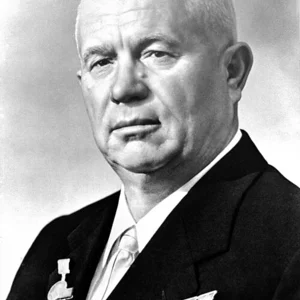

Soviet leader from 1953 to 1964, Khrushchev succeeded Stalin and launched a policy of de-Stalinization. A central figure of the Cold War, he confronted the United States during the Cuban Missile Crisis of 1962.
Nikita Khrushchev(1894 — 1971)
Nikita Khrushchev
Union soviétique, Empire russe, Russie soviétique
9 min read
Frequently asked questions
Famous Quotes
« We will bury you.»
« Politicians are the same all over: they promise to build a bridge even where there is no river.»
Key Facts
- 1953: Rises to power after Stalin's death by becoming First Secretary of the CPSU
- 1956: Delivers the 'Secret Speech' at the 20th Congress of the CPSU, denouncing Stalin's crimes
- 1957: Oversees the launch of Sputnik, the first artificial satellite in history
- 1962: Manages the Cuban Missile Crisis, the tensest episode of the Cold War
- 1964: Ousted in an internal palace coup and replaced by Leonid Brezhnev
Works & Achievements
Speech delivered at the 20th Congress of the Communist Party of the Soviet Union, denouncing Stalin's crimes and paranoia. This founding text of de-Stalinization shook communist parties worldwide and opened a decade of relative liberalization in the USSR.
Under Khrushchev's leadership, the USSR launched the first artificial satellite (1957) and sent the first human into space with Yuri Gagarin (1961). These achievements served both Soviet prestige and Cold War propaganda.
A large-scale agricultural drive to bring uncultivated land in Kazakhstan and Siberia under the plow in order to solve Soviet food shortages. The results were mixed: yields collapsed after a few years due to soil erosion.
Agreement signed by the USSR, the United States, and the United Kingdom banning nuclear weapons tests in the atmosphere, underwater, and in outer space. The first arms-control treaty of the Cold War, it was a direct outcome of the lessons learned from the Cuban Missile Crisis.
A decision made under Khrushchev's authority to stop the mass exodus of East Germans to the West (3 million people since 1945). The Wall became the worldwide symbol of Europe's division and of the Cold War.
Memoirs secretly dictated onto tape recorder after his removal from power, published in the United States without the knowledge of Soviet authorities. A unique document on the inner workings of Soviet power, they reveal the doubts and regrets of a man pushed aside.
Anecdotes
During the secret speech delivered at the 20th Congress of the Communist Party in February 1956, Khrushchev revealed Stalin's crimes before stunned Soviet delegates. The room fell into a heavy silence: no one dared to applaud or protest. The speech, meant to remain secret, was quickly leaked to the West by the CIA.
In October 1960, during a session of the UN General Assembly in New York, Khrushchev reportedly banged his desk with his shoe to protest a Philippine speech accusing the Soviet Union of colonialism. The scene became legendary, even though historians still debate exactly what happened.
During the Cuban Missile Crisis in October 1962, Khrushchev and Kennedy exchanged urgent messages for thirteen days on the brink of nuclear war. Khrushchev wrote to Kennedy: 'We and you ought not now to pull on the ends of the rope in which you have tied the knot of war.' The final agreement saw Soviet missiles withdrawn from Cuba in exchange for American guarantees of non-invasion.
In 1957, Khrushchev challenged the United States to an economic race, promising that the USSR would produce more butter and meat per capita than Americans by 1970. This publicly displayed agricultural ambition stood in stark contrast to the recurring shortages affecting the Soviet population.
After his removal from power in October 1964, Khrushchev became the first Soviet leader to be forced into retirement rather than executed or imprisoned. He spent his final years at his dacha, where he secretly dictated his memoirs into a tape recorder. These recordings were clandestinely smuggled to the West and published in 1970.
Primary Sources
Stalin acted not through persuasion, explanation, and patient cooperation with people, but by imposing his concepts and demanding absolute submission to his opinion. Whoever opposed this concept or tried to prove his viewpoint and the correctness of his position was doomed to removal and subsequent annihilation.
Mr. President, I propose that we commit ourselves not to engage in an act of aggression. We are sensible people and understand that we must avoid a nuclear war that would annihilate everything humanity has created.
My enemies were afraid to let me live. Even in retirement, they fear me. But I am alive, and that proves something has changed in our country since Stalin.
We too are capable of showing things, and in certain areas we will surpass you. When we have caught up with you and overtaken you, we will wave to you.
Key Places
Seat of Soviet power where Khrushchev led the USSR from 1953 to 1964. It was from here that he orchestrated de-Stalinization, managed international crises, and received foreign delegations.
Country residence where Khrushchev spent his years of forced retirement after 1964. It was in this secluded place that he dictated his memoirs under KGB surveillance.
Khrushchev's birthplace, where he was born in 1894 into a poor peasant family. This humble background would shape his relationship with the farming world and Soviet agriculture.
The scene of several of Khrushchev's most memorable speeches, including the famous shoe-banging incident in 1960. The UN served as a global stage where he could directly confront the United States.
The American presidential retreat where Khrushchev met with Eisenhower in September 1959 during his historic visit to the United States. These talks briefly symbolized a thaw in relations between the two blocs.
The setting of the Cuban Missile Crisis in 1962, when Khrushchev had Soviet nuclear missiles installed just 90 miles from the American coastline. The confrontation with Kennedy brought the world to the brink of nuclear war.
Typical Objects

Installed in 1963 following the Cuban Missile Crisis, this direct communication system between the Kremlin and the White House symbolizes the dangerous coexistence of the two superpowers. Khrushchev had pushed for such a device to prevent a misunderstanding from triggering nuclear war.

The Soviet satellite launched in 1957 was one of the achievements Khrushchev took greatest pride in. Replicas of Sputnik adorned his office and meeting rooms, serving as a symbol of the Soviet technological superiority he claimed over the United States.

Khrushchev, who came from the mining peasant communities of the Donbas, enjoyed being photographed in the fields during his visits to collective farms. His outward attachment to the land and to working-class agriculture was a deliberate part of his political image.

After his removal from power in 1964, Khrushchev secretly dictated his memoirs onto a Soviet reel-to-reel recorder at his dacha. These recordings were smuggled to the West and published under the title Khrushchev Remembers.

In diplomatic photographs and during his travels abroad, Khrushchev consistently wore a Western-style hat — a visible sign of the relative cultural openness of his era compared to the Stalinist years.

In the 1950s, Khrushchev launched a nationwide campaign to expand corn cultivation across the USSR, convinced it would solve Soviet food shortages. The ear of corn became his ironic symbol in the Western press, which nicknamed him 'Nikita the Corn Man.'
School Curriculum
Vocabulary & Tags
Key Vocabulary
Tags
Daily Life
Morning
Khrushchev rises early, often before 7 a.m., a habit inherited from his working-class childhood. He reviews the KGB and ministry reports delivered the previous evening, then has a simple breakfast — kasha, black bread, tea — with his wife Nina in their Kremlin apartment or at their dacha in Gorki-9.
Afternoon
Afternoons are filled with Politburo meetings, audiences with ambassadors or foreign delegations, and inspections of agricultural or industrial sites. Khrushchev travels frequently to the provinces to visit collective farms and personally lecture their directors.
Evening
Evenings at the Kremlin can stretch very late, following the Stalinist tradition of drawn-out working dinners with plenty to drink. Khrushchev regularly hosts writers, artists, and scientists at banquets where cultural policy is decided informally. During times of crisis, he rarely goes to bed before midnight.
Food
Khrushchev eats simply, with a fondness for the Ukrainian food of his childhood: borscht, varenyky (dumplings), pork, and poultry. A champion of corn as a miracle crop, he regularly eats it himself. He drinks vodka in company but in moderation, mindful of the image he projects.
Clothing
In public, Khrushchev wears dark Soviet-cut suits — often ill-fitted to his stocky frame — along with medals and decorations at official ceremonies. On trips abroad, he sometimes adopts a Western-style hat as a signal of openness. In private and during his agricultural tours, he favors simpler attire: a work jacket and cap.
Housing
At the Kremlin, Khrushchev has official apartments within the historic compound. His preferred residence is the dacha at Gorki-9 on the outskirts of Moscow, surrounded by birch forests. After his removal from power in 1964, he is placed under house arrest at a dacha in Petrovo-Dalnee, under the discreet but constant watch of the KGB.
Historical Timeline
Period Vocabulary
Visual Style
Esthétique réaliste-soviétique des années Khrouchtchev : rouges profonds du Kremlin, gris béton des immeubles collectifs, affiches de propagande spatiale et photographies documentaires en noir et blanc de la Guerre froide.
Sound Ambience
Ambiance sonore de l'URSS des années 1950-1960 : marches militaires soviétiques, discours radiodiffusés, bruits de la bureaucratie du Kremlin et rumeur des grandes parades de la Place Rouge.