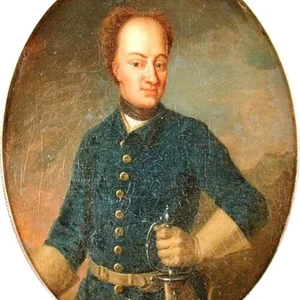

King of Sweden from 1697 to 1718, Charles XII was one of the greatest military commanders of his era. He led the Great Northern War against a European coalition, winning the Battle of Narva (1700) before suffering a crushing defeat at Poltava (1709). He died during the siege of Fredriksten, marking the end of Swedish dominance in Europe.
Charles XII of Sweden
Charles XII of Sweden
Suède
9 min read
Frequently asked questions
Key Facts
- 1697: ascended the Swedish throne at the age of 15
- 1700: decisive victory at the Battle of Narva against Peter the Great's army
- 1709: catastrophic defeat at Poltava (present-day Ukraine) at the hands of Russia
- 1709–1714: forced exile in Ottoman territory following Poltava
- 1718: death during the siege of Fredriksten (Norway), marking the end of Sweden's era as a great power
Works & Achievements
Charles XII's first great victory, won against an overwhelmingly larger Russian coalition under extreme winter conditions. This battle established his reputation as an invincible strategist and consolidated Swedish dominance over the Baltic.
A series of victories that forced Augustus II to abdicate the Polish throne and sign a humiliating peace. These campaigns established Charles XII in the eyes of all Europe as the foremost military commander of his age.
Charles XII honed the Swedish offensive tactic built on speed, the charge, and close-quarters combat. The Carolian army under his command was considered the most disciplined and formidable in Northern Europe.
A bold attempt to strike into the heart of Russia and decisively crush Peter the Great. Despite early successes, the campaign ended in the disaster of Poltava, which brought Swedish hegemony in Northern Europe to an end.
An extensive body of correspondence preserved in the Swedish archives, bearing witness to the personal, centralized control Charles XII exercised over his foreign policy. These letters are an essential source for understanding his political and military vision.
Anecdotes
In November 1700, Charles XII was just 18 years old when he faced a Russian army of 40,000 men at the Battle of Narva with only 8,000 Swedish soldiers. Taking advantage of a snowstorm that blinded the Russian forces, he ordered a bold frontal charge and won a crushing victory within hours, capturing much of the enemy high command. Peter the Great, humiliated, fled the battlefield.
Charles XII was renowned for his ascetic way of life, refusing all luxury even as king. He wore the same blue soldier's uniform for years, slept on a simple straw mattress like his men, ate their ordinary rations, and abstained entirely from alcohol. His contemporaries were struck by this king who lived more like a common soldier than a monarch.
After his defeat at Poltava in 1709, Charles XII took refuge in the Ottoman Empire at Bender (in present-day Moldova). After four years, he stubbornly refused to leave despite repeated demands from the sultan. In 1713, the incident known as the Kalabalik took place: Charles XII physically resisted with a handful of men against thousands of Ottoman soldiers sent to expel him, before finally being captured after a full-blown brawl.
The death of Charles XII during the siege of Fredriksten in Norway on November 30, 1718, remains one of the great mysteries of Swedish history. Struck by a bullet to the temple while in the approach trench, it was never determined whether the shot came from a Danish enemy or from one of his own officers eager to end an endless war. This question continues to fuel debate among historians.
Charles XII never married and left no legitimate heir. Having ascended the throne at 15, he devoted himself entirely to warfare, declaring that the Swedish army would be his wife. His death without a direct heir brought an end to the Palatinate-Zweibrücken line and hastened the irreversible decline of Swedish great-power status.
Primary Sources
He had a firmness that was not devoid of gentleness in conversation. One could see in him a man who wished to be obeyed, but who did not seek to intimidate. There was no prince in Europe more sober, more hardworking, nor more intrepid.
I pray you to believe that I have no other aim than the glory of our royal house and the good of our homeland, and that I could not bring myself to accept a peace that would not be honorable for Sweden.
His Majesty, wounded in the foot, was carried on a litter across the battlefield and continued to command his troops. But our infantry, exhausted and short of ammunition, could no longer withstand the Muscovite pressure.
The King slept only a few hours each night, shared the life of common soldiers, and personally inspected the guard posts at all hours. His presence alone was enough to revive the courage of the most battle-worn troops.
His Majesty refused to hear talk of peace on any terms that would not have restored to Sweden all its lost provinces. This intransigence, which some judged heroic, others held to be the principal cause of the kingdom's misfortunes.
Key Places
Capital of the kingdom and seat of the Swedish royal court, where Charles XII was born in 1682 and ascended to the throne in 1697. He left quickly for his military campaigns and never returned, governing his kingdom from field headquarters.
Site of the great Swedish victory in November 1700, where Charles XII defeated a Russian army five times larger than his own. This battle revealed his tactical genius and made him one of the most feared military figures in Europe.
Scene of the catastrophic defeat in July 1709 against Peter the Great. The Swedish army, exhausted by the Russian winter and running short of ammunition, was crushed. This battle marked the irreversible turning point of the Great Northern War and the end of Swedish hegemony.
A city in the Ottoman Empire where Charles XII took refuge after Poltava and stayed for several years. It was here that the famous Kalabalik took place in 1713, when Ottoman troops attempted to forcibly expel him from his quarters.
The Norwegian fortress before which Charles XII met his death on 30 November 1718, struck by a bullet to the temple while in the approach trench. This site symbolically marks the end of Sweden's status as a great European power.
Typical Objects

Charles XII wore a plain blue uniform with no royal ornaments, keeping it until it wore out. This austere garment became a symbol of his total identification with his soldiers and a deliberate political rejection of the splendor typical of European courts.

The king's personal weapon, carried at all times even outside of battle. Charles XII was renowned for his swordsmanship and did not hesitate to fight in the front ranks of the melee, much to the despair of his generals.

Charles XII spent many hours studying maps of his campaigns, personally planning his maneuvers. Reconnaissance of the terrain was central to his offensive strategy, and he frequently conducted scouting missions on horseback himself.

Light, mobile artillery was a key element of the Swedish Gå-på tactic. These pieces accompanied the infantry in its lightning charges, providing close fire support that was a hallmark of the Carolian army.

Worn by the king at all times, even outside of military operations, these boots reflected a way of life entirely devoted to war. His contemporaries noted that he rarely took them off, even to sleep.

After being wounded in the foot during the Russian campaign, Charles XII was forced to command his armies from a litter, most notably at the Battle of Poltava. This object illustrates his stubborn determination to lead his troops in battle despite his injuries.
School Curriculum
Vocabulary & Tags
Key Vocabulary
Tags
Daily Life
Morning
Charles XII rose at the first light of dawn, a habit forged by years on campaign. He would personally inspect the guard posts and army positions, refusing to delegate this task to his officers. He then took a frugal meal — black bread, meat, and water — before holding a war council with his generals.
Afternoon
Campaign afternoons were devoted to maneuvers, troop training, and strategic planning over maps. Charles XII often reconnoitered enemy positions on horseback, sometimes within musket range of the opposing forces, to the great dismay of his officers. He made all major military decisions alone, consulting his generals only for information, rarely to be challenged.
Evening
Evenings were spent in his tent or makeshift quarters, surrounded by a small circle of close officers. Charles XII abstained from alcohol — unlike virtually every other soldier of his era — and enjoyed reading ancient historians, particularly Quintus Curtius on Alexander the Great. He would dictate his correspondence before retiring early.
Food
Charles XII's diet was remarkably austere for a monarch: black bread, boiled or roasted meat, simple vegetables, and water. He refused fine wines and elaborate dishes even during the rare periods spent in comfortable quarters. On campaign, he routinely shared his soldiers' rations, which earned him extraordinary respect and devotion from the troops.
Clothing
The king wore his plain blue colonel's uniform of the Swedish infantry at all times — simple, with no royal adornments — paired with tall cavalry boots. He rejected the powdered wigs fashionable at every European court, keeping his hair short and natural. This spartan dress was as much a political statement as a personal commitment to military life.
Housing
On campaign — which is to say, for nearly his entire reign — Charles XII lodged in a simple military tent or requisitioned houses, refusing luxury quarters. During his Ottoman exile at Bender, he lived in a modest building that he gradually transformed into a fortified camp. He rarely stayed in Swedish royal palaces, viewing court life as a waste of time incompatible with his military duties.
Historical Timeline
Period Vocabulary
Visual Style
Baroque militaire nordique du début du XVIIIe siècle : peinture à l'huile dramatique aux forts contrastes d'ombre et de lumière, uniformes bleu roi suédois, paysages enneigés et batailles épiques évoquant la rigueur austère des Carolins sous les cieux gris de la Baltique.
Sound Ambience
Ambiance sonore d'un camp militaire suédois carolien du début du XVIIIe siècle : tambours d'infanterie, canonnades lointaines, hennissements de chevaux de cavalerie, armes entrechoquées, ordres criés en suédois sur fond de vent glacial du grand Nord.