Imaginary interview with Rachel Wall
by Charactorium · Rachel Wall (1760 — 1789) · Military · Society · 6 min read

Boston, a damp cell not far from the Common, early October 1789. Outside, the boards of a scaffold are already being nailed. A woman in her thirties, hands reddened by service and by salt, agrees to speak before the rope speaks for her.
—They say you are the first American-born female pirate. How do you bear that strange title?
Born around 1760 near Carlisle, Pennsylvania, in a Presbyterian house where we prayed more than we laughed, I never dreamed of such a nickname. There were tales of women who had sailed the seas, but they were creatures from the Old World, from across the ocean. I came from this soil, from these colonies that were fighting to stop being colonies. So when they whisper that I might be the first to scour the coasts born among the thirteen colonies, I don't know whether to blush or laugh. A flibustier plunders for himself, without letter or master; that's the word that fits me better than 'lady.' The sea doesn't ask where you come from, only what you dare.
The sea doesn't ask where you come from, only what you dare.
—You lived two lives, you say. Tell us about the one that began at daybreak.
My mornings, those on land, smelled of cold ashes. On Beacon Hill, in a fine house where I served, I rose before dawn to relight the fire, draw water, heat the masters' breakfast while they still slept. Long skirt, laced bodice, apron, and on my hair the linen cap they call a bonnet. No one in those kitchens would have imagined that the same woman, in summer, watched the horizon from a schooner. That was my double life: servant in winter, something else in summer. People think a pirate can only be a pirate from cradle to gallows. I scrubbed pots between campaigns, and came back to Boston like returning to the fold, head down and hands clean.
Servant in winter, something else in summer — people think a pirate can only be a pirate.
—Let's come to that famous stratagem. How did you lure passing ships?
That was the business of summers 1781 and 1782, around the Isles of Shoals, that cluster of wind-beaten rocks offshore. After a storm passed, George and I had only to finish heaven's work: we damaged our own rigging, laid the sails in disarray, like a ship battered by the night. Then they left me alone on deck. A woman calling for help, arms raised, arouses no suspicion in sailors' hearts. They approached to rescue us — and left stripped, those who left. A dozen vessels, they say, fell into our trap. The finest lie, you see, is not the one you shout; it's the one you let them guess.
The finest lie is not the one you shout; it's the one you let them guess.
—What became of the trap once night fell?
Night was our best accomplice. When daylight was no longer enough to paint our distress, I took the deck lantern, that swinging light, and slowly swung it at arm's length, like a lost ship that no longer knows where land lies. A fire that sways on black waters grips a sailor's heart more surely than a cry. The schooner waited, lurking, ready to slip along the jagged coast if things went wrong — for a good two-masted vessel forgives many faults. Believe me, it takes more nerve to hold a bait lantern all night than to brandish a cutlass in a boarding.
A fire that sways on black waters grips a sailor's heart more surely than a cry.
—And George, your husband, what kind of man was he before he became your accomplice?
George Wall had sea legs before he married me, around 1780. They say he served as a privateer during the war — a man with a letter of marque, authorized by his side to chase enemy ships, which is not quite a brigand. But when the cannons fell silent and the Treaty of Paris in 1783 sealed the peace, a privateer without war is just a poor devil with no booty. So we slipped, he and I, from legal privateering to plundering for our own purse. The line is thin, you know, between the man they decorate and the one they hang: it hangs on a piece of paper signed by a governor.
The line is thin between the man they decorate and the one they hang: it hangs on a piece of paper.
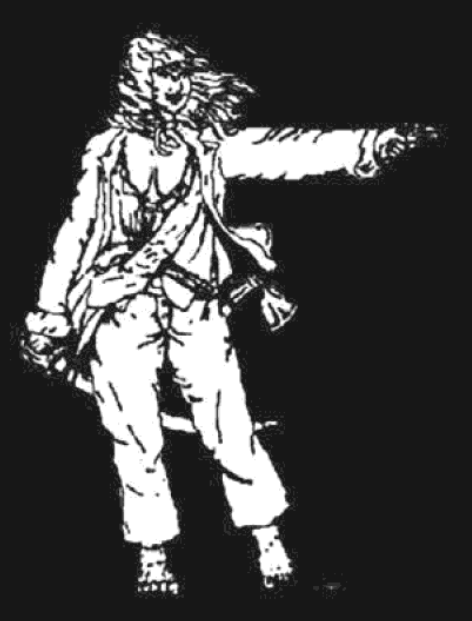
—The sea took George. What remained of your freebooter life then?
A storm tore him from me in 1782, somewhere offshore, and with him went my privateer life. I had no schooner, no accomplice, no lantern to swing in the night. I had my hands and Boston. So I became again what I was between summers: a maid among the docks and kitchens, scrubbing, mending, carrying water. People think that once you've tasted the open sea you can never bend to the broom — false. I bent. Salt cod, sailor's biscuit, corn mush, and in the evening a prayer in the old Presbyterian way. A pirate's widow washing the rich folks' dishes: that's how legends end, in the shadows, long before the rope.
A pirate's widow washing the rich folks' dishes: that's how legends end.
—Yet it's not piracy that brings you to the scaffold. What happened in the streets of Boston?
The whole irony of my fate lies there. In 1789, I was accused of having, in broad daylight, assaulted a young woman named Margaret Bender and snatched her bonnet and effects. A bonnet! That cloth cap I myself wore every morning. I plundered a dozen ships at sea without being troubled, and it's a street robbery, a paltry bit of linen, that threw me in irons. The magistrates called it highway robbery — a crime punishable by death. See the cruel twist: the sea forgave me everything, and the cobblestones of Boston condemn me for almost nothing.
I plundered a dozen ships without being troubled, and it's a bonnet that hangs me.
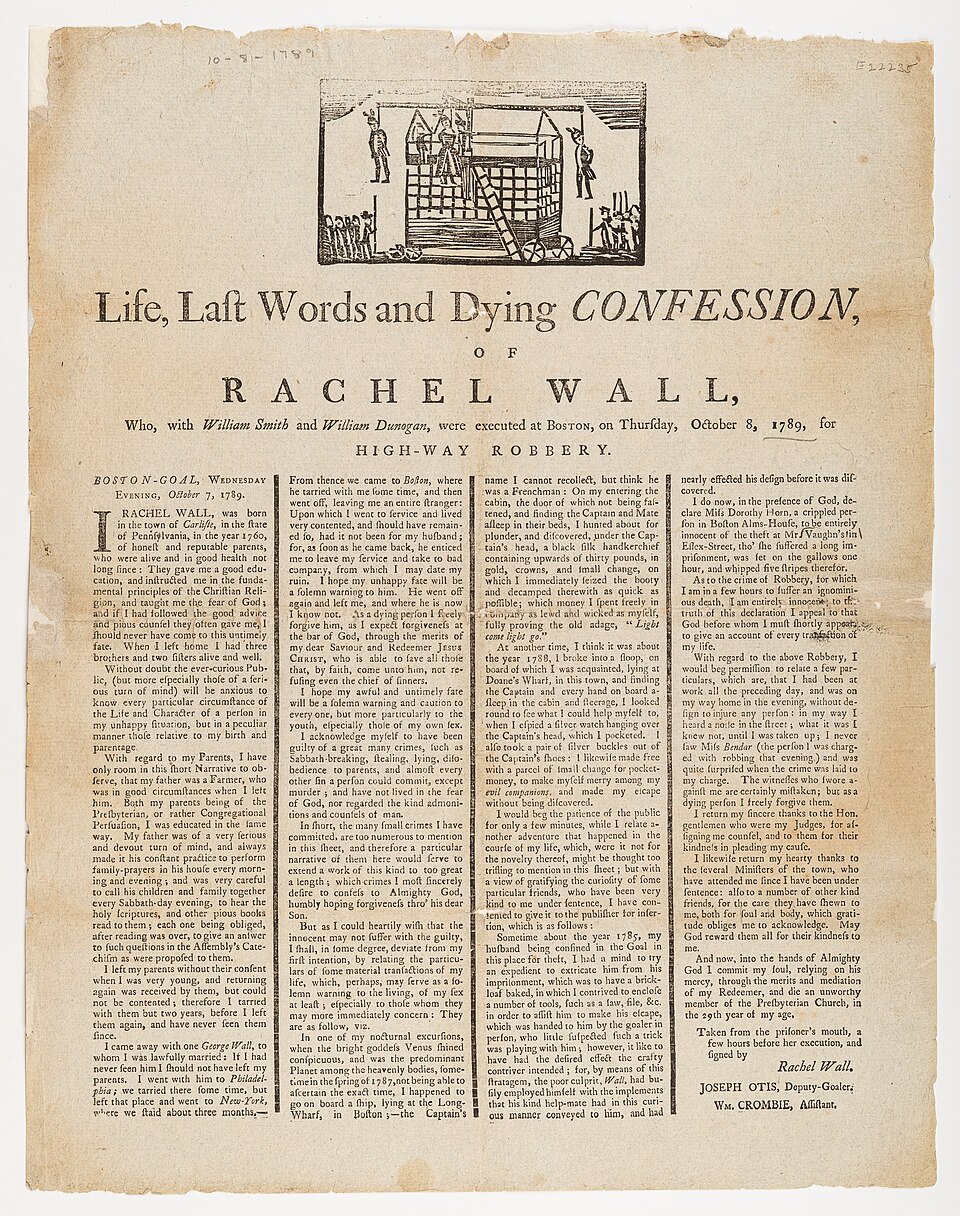
—Why does a simple street robbery, in your judges' eyes, deserve the same rope as murder?
Because the law of this country does not always measure the crime by the pain it causes, but by the fear it inspires. Robbing someone by violence on the public road — that's what they call highway robbery — and that suffices to bring you to the wooden gallows they raise on the Boston Common. Before the Supreme Judicial Court of Massachusetts, my years at sea only counted against me: a woman who has scoured the coasts can only be a ready-made culprit. They judge me not just for a snatched bonnet; they judge me for everything I have been. The gallows here does not so much punish as warn: it wants to make the watching crowd tremble.
They judge me not just for a snatched bonnet; they judge me for everything I have been.
—Your last words will be printed on a broadside sold the very day. What did you have recorded there?
Yes, my story will end on a printed sheet, one of those broadsides hawked while they hang you — the life and confession of the condemned, as a moral lesson for onlookers. There I confessed many sins: contempt for the Sabbath, theft, lying, disobedience to my parents, nearly every fault a soul can commit. Nearly all, save one: murder. I never took anyone's life, and I insist that be written in black and white. Let this confession of 1789 serve as a mirror to whoever reads it: one may have stolen on sea and land without ever having blood on one's hands.
Nearly every fault a soul can commit — nearly all, save murder.
—On that same broadside, you nevertheless claim innocence. How do you reconcile the two?
That is no mental game. I frankly confess what I did: the privateering, the plundering, the long list of my transgressions — but for this theft specifically, the bonnet of little Bender that earns me the rope, I declare myself entirely innocent. So they hang me for the only crime I deny. That is my truth, and I leave it to those who come after. If, by some chance, I am still read a century from now, on the coasts of New England where my name already lingers in sailors' tales, I would like them to remember this: a woman may be guilty of a thousand things and hanged for the one of which she is innocent. The gallows on the Boston Common will take me on Thursday; let my word at least outlive it.
They hang me for the only crime I deny.
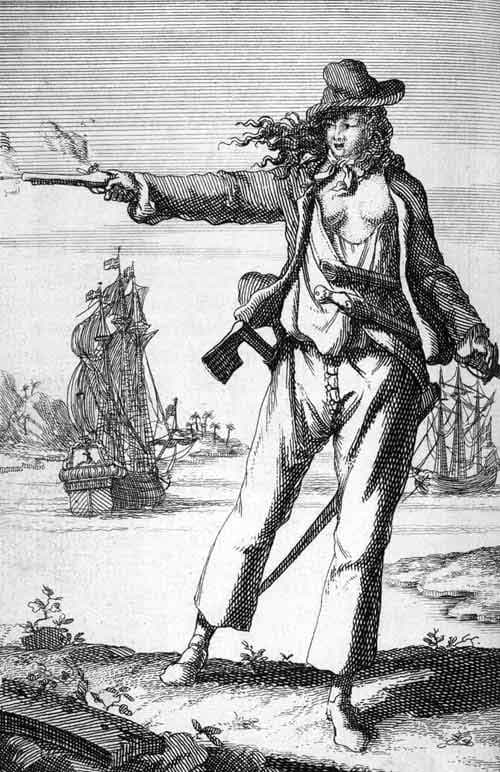
This imaginary interview was generated by artificial intelligence from sources documented in Rachel Wall's profile. It dramatises what the figure might have said based on what we know about them, but does not constitute attested historical testimony. For primary sources and factual documentation, refer to the full profile.