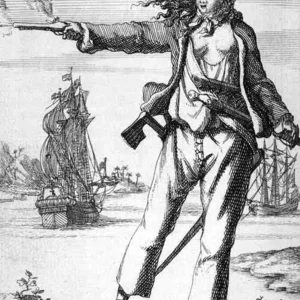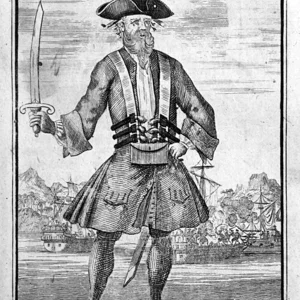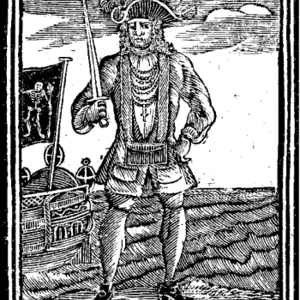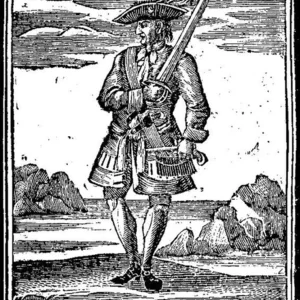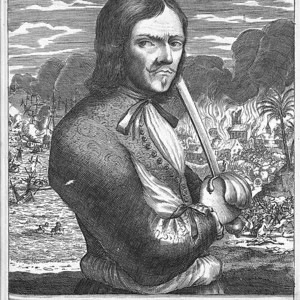

Rachel Wall (c. 1760-1789) is considered the first female pirate born in America. Together with her husband, she plundered the coasts of New England from Essex Island, luring ships with fake distress signals. Hanged in Boston in 1789, she was one of the last women to be executed in Massachusetts.
Rachel Wall(1760 — 1789)
Rachel Wall
États-Unis
6 min read
Frequently asked questions
Key Facts
- Born around 1760 in Pennsylvania, she ran off with the fisherman George Wall and turned to piracy in the early 1780s
- The couple operated off Essex Island (Massachusetts), faking ships in distress to rob the boats that came to their rescue
- She is credited with the capture of about a dozen ships and the deaths of several sailors
- Arrested for violent robbery, she was tried in Boston and found guilty
- Hanged on October 8, 1789, she was one of the last women executed in Massachusetts and the first female pirate born in America
Works & Achievements
A piracy method consisting of feigning a shipwreck to lure in rescuers; it remained the most famous exploit attributed to Rachel Wall.
A nickname that wrote Rachel Wall into the history of Atlantic piracy and sets her apart from the female pirates who came from Europe.
A printed broadside of her “last words,” at once an object of popular devotion and an essential primary source for historians.
Her hanging marked the end of executions of women in that state, making it a milestone in American judicial history.
Her story has fed legends, tales, and books about the pirates of the Massachusetts and New Hampshire coasts.
Anecdotes
Off the Isles of Shoals, Rachel and her husband George had devised a fearsome trap: after a storm, they would deliberately damage the rigging of their schooner, and Rachel, alone on deck, would call out for help to passing ships. When the sailors came to the rescue, they were robbed. According to her confession, the couple plundered about a dozen vessels in this way between 1781 and 1782.
Rachel Wall is often described as the first woman pirate born on American soil, around 1760 in Pennsylvania. Unlike career pirates, she sailed only for a few summers and returned to live in Boston as a servant the rest of the year, thus leading a double life.
The crime that led her to the gallows was not piracy but a street robbery: in 1789 she was accused of assaulting a young woman named Margaret Bender and snatching her bonnet in Boston. She was tried for “highway robbery,” an offense then punishable by death.
As was the custom of the time, her “last words” were printed on a broadside sold on the day of the execution. In it she confessed to many sins and even to piracy, but proclaimed her innocence of the robbery for which she was condemned and swore she had never killed anyone.
On 8 October 1789, Rachel Wall was hanged on Boston Common alongside two men, William Smith and William Dunogan. She went down in history as the last woman executed in Massachusetts.
Primary Sources
I acknowledge myself to have been guilty of a great many crimes, such as Sabbath-breaking, stealing, lying, disobedience to parents, and almost every other sin a person could commit, except murder.
As for the crime of robbery, for which I am now to suffer, I am entirely innocent.
Rachel Wall is indicted for having, in Boston, violently robbed a young woman of her bonnet and belongings on the public highway.
On Thursday, October 8, Rachel Wall, William Smith, and William Dunogan, convicted of highway robbery, were executed on Boston Common before a large crowd.
Key Places
Region where Rachel was born around 1760 into a Presbyterian family, before fleeing to the coast with George Wall.
Small rocky archipelago off the coast of New Hampshire and Maine, from which the Wall couple watched for and trapped ships after storms.
Major New England port where Rachel lived and worked as a servant between her piracy ventures.
Wealthy Boston neighborhood where Rachel worked as a servant, just steps from the ships she sometimes robbed in the harbor.
Vast public green in Boston, site of the hangings: Rachel Wall was executed there on 8 October 1789.
Typical Objects

A fast two-masted sailing ship, very common in New England, ideal for catching merchant vessels by surprise and then slipping away along the jagged coastline.

A lantern waved on deck at night to fake a ship in distress. It was the main bait in the trap the Walls set for would-be rescuers.

A short, broad sword, the pirates' favorite weapon for boarding in the cramped quarters of a ship.

A single-shot firearm that was slow to reload; pirates often carried several at once so as not to be caught off guard.

A cloth headdress worn by 18th-century women. It was the theft of one such bonnet in Boston that earned Rachel her death sentence.

A printed sheet sold on execution day, recounting the condemned's life and “last words.” Rachel Wall's remains our main source.

A wooden structure raised for public hangings, like the one on Boston Common where Rachel was executed before the crowd.
School Curriculum
Vocabulary & Tags
Key Vocabulary
Tags
Daily Life
Morning
In Boston, as a domestic servant, Rachel rose early to light the fire, draw water, and prepare breakfast for the Beacon Hill household. During the pirate summers, her mornings were instead spent on the Isles of Shoals, scanning the horizon after the storms.
Afternoon
Ordinary days were filled with housework, mending, and errands at the harbor market. At sea, the couple repaired and disguised the schooner's damage to make the trap convincing.
Evening
In the evening, in Boston, the household shared a modest supper, sometimes followed by prayers in the Presbyterian tradition. Out at sea, it was at night that the deadly ruse played out, by the glow of the lantern swung on the deck.
Food
Their food was that of New England seafarers: salted cod, ship's biscuit (hardtack), corn porridge, fresh fish, and root vegetables. Rum and cider often accompanied the meals.
Clothing
Rachel wore the simple dress of a common woman: a long skirt, a laced bodice, an apron, and a linen cap (bonnet). At sea, sturdier woolen clothing was preferred, more resistant to damp and wind.
Housing
On land, she lived in cramped quarters, in the servants' rooms of a house or near the Boston docks. On her ventures, her “home” was the confined space of a schooner or the isolated huts battered by the winds of the Isles of Shoals.
Historical Timeline
Period Vocabulary
Liens externes & ressources
Références
Œuvres
Le stratagème de la fausse détresse
1781-1782
Réputation de première femme pirate née en Amérique
XVIIIe siècle
Dying Confession de Rachel Wall
1789
Dernière femme exécutée dans le Massachusetts
1789
Figure du folklore maritime de Nouvelle-Angleterre
XIXe-XXIe siècle