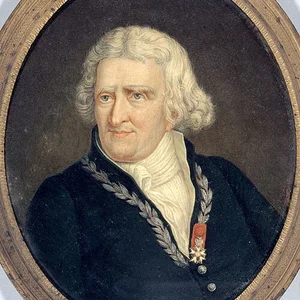

French military pharmacist and agronomist (1737-1813), famous for popularizing the potato as a food staple in France. A prisoner of war in Prussia, he discovered the nutritional value of the tuber and convinced Louis XVI to lift the ban on its cultivation.
Antoine Parmentier(1737 — 1813)
Antoine Parmentier
France
8 min read
Frequently asked questions
Famous Quotes
« The potato is the bread of the poor.»
Key Facts
- 1737: Born in Montdidier, Picardy
- 1757–1763: A prisoner of war in Prussia, fed on potatoes, he discovers their nutritional value
- 1771: Wins the prize from the Académie de Besançon for a memoir on foods that could replace wheat in times of famine
- 1786: Louis XVI grants him land at Sablons to grow potatoes; he stations armed guards around the fields to spark public curiosity
- 1813: Dies in Paris; buried at Père-Lachaise, his grave traditionally surrounded by potato plants
Works & Achievements
A foundational scientific thesis in which Parmentier demonstrated through chemical analysis the nutritional qualities of the potato. This work earned him recognition from the Académie des Sciences and launched his crusade to popularize the tuber.
A comprehensive treatise on the art of bread-making and improving flour quality. Parmentier sought to optimize the diet of ordinary people by improving breadmaking practices, which were crucial to preventing recurring famines.
A practical and scientific work aimed at farmers, describing cultivation techniques and the many food and industrial uses of the potato. Published in the year of the Revolution, it responded to a major social emergency.
A memoir intended to persuade provincial authorities to adopt potato cultivation. Parmentier tailors his arguments to the climatic and agricultural conditions of southern France.
A practical text written during the Revolution to address the urgent food crisis. Parmentier simplifies his advice for farmers and the most modest families in order to combat food shortages.
Anecdotes
During the Seven Years' War (1756-1763), Parmentier was captured five times by the Prussians. Fed on potatoes while in prison, he discovered that this tuber — scorned in France as animal fodder — was not only edible but nourishing. That experience forged his conviction: the potato could save the French from famine.
To persuade peasants to grow the potato, Parmentier devised an ingenious stratagem: he obtained from Louis XVI a plot of land at Sablons, near Paris, which he had conspicuously guarded by royal soldiers during the day. At night, the guards withdrew on orders. The peasants, believing they were stealing something precious, came to dig up the tubers — and then planted them in their own gardens.
Convinced by Parmentier, Louis XVI wore a potato flower in his buttonhole at a reception at Versailles around 1785-1786. Queen Marie-Antoinette followed suit, wearing those purple blooms in her hair. This royal gesture immediately turned the potato into a symbol of modernity and good taste at court.
Parmentier organized several memorable dinners at which every dish — soup, bread, biscuits, cakes — was made from potato. He invited influential figures, including Benjamin Franklin, then ambassador of the United States to Paris, so they could judge for themselves the flavor and nutritional value of the tuber. These meals were talked about across Europe.
At his death in 1813, Parmentier declined the financial honors offered to him for his services to the nation. As a token of popular gratitude, potato plants were laid on his grave at Père-Lachaise — a tradition that visitors still carry on today in homage to the man who transformed French eating habits.
Primary Sources
The potato is a wholesome, nourishing food, pleasant to the taste, and capable of advantageously replacing bread in years of scarcity.
The cultivation of the potato alone can prevent those terrible crises that cause so many unfortunate souls to perish, and that periodically afflict the most civilized nations.
The art of making bread is more important to society than is generally thought; it is one of the arts most necessary to civilized life.
The southern provinces of France have light, dry soils perfectly suited to the cultivation of this precious tuber, whose benefits for the poor are beyond measure.
Key Places
Parmentier's birthplace, in the present-day Somme department. A statue of him stands in the main square, and the town regularly celebrates his memory with cultural events centered on the potato.
A field granted to Parmentier by Louis XVI in 1785 for growing potatoes. This is where the famous ruse of the royal guards took place — deliberately enticing peasants to steal and spread the prized tuber.
The institution where Parmentier served as chief pharmacist for many years. He conducted research there on the nutrition and health of soldiers, and maintained his principal laboratory on the premises.
The setting where Parmentier presented the potato to Louis XVI and won royal backing. It was here that the king famously wore a potato flower in his buttonhole, launching a fashionable craze for the tuber at court.
Parmentier's burial place since 1813. His tomb is adorned with carved potato plants, and visitors still leave tubers there today as a tribute to the man who transformed French eating habits.
Typical Objects

An indispensable tool for the military pharmacist, Parmentier used it to grind and analyze plant substances. He relied on it for his first chemical analyses of the potato to determine its nutritional composition.

The purple or white flower of the potato plant became the symbol of Parmentier's campaign. Presented to Louis XVI, it was worn as a buttonhole by the king at official receptions to make the tuber desirable in the eyes of the court.

A device used in military pharmacy laboratories to analyze and purify substances. Parmentier used it for his research on the starch found in the potato and for his studies on flours.

The military pharmacist carried his preparations and remedies into the field in sturdy leather satchels. Parmentier used his during campaigns to distribute care to wounded or malnourished soldiers.

Parmentier owned an extensive library of scientific works. His own treatises, richly illustrated with engraved botanical plates, described the morphology and cultivation of food plants, most notably the potato.

For his agronomic experiments at the Champ de Sablons, Parmentier used ordinary farming tools. He did not hesitate to work the soil himself in order to demonstrate potato cultivation and harvesting techniques to peasant farmers.
School Curriculum
Vocabulary & Tags
Key Vocabulary
Daily Life
Morning
Parmentier rose early and began his day with visits to the pharmacy laboratory, where he analyzed plant and flour samples. As much a man of the field as of the study, he recorded his observations in notebooks with rigorous scientific precision.
Afternoon
Afternoons were often devoted to agronomic experiments, particularly at the Champ de Sablons where he supervised potato cultivation. He also received visitors — scholars, agronomists, officers — to discuss military nutrition and popular food supply.
Evening
In the evenings, Parmentier wrote his memoirs and corresponded with academicians, ministers, and foreign scholars. He regularly attended sessions of the Société Royale d'Agriculture de Paris, where he championed the merits of new food crops.
Food
Parmentier practiced what he preached: he regularly ate potatoes in all their forms — boiled, in soup, in bread. His daily diet was modest, close to what he recommended for soldiers and the poor: nourishing, economical, and varied.
Clothing
As a military pharmacist, Parmentier wore the regulation uniform of health officers in the royal army: a blue coat with gold buttons, white breeches and stockings. In his civilian life, he adopted the bourgeois dress of the Enlightenment: frock coat, waistcoat, and powdered wig.
Housing
Parmentier lived for many years in Paris, in apartments near the Hôtel des Invalides where he worked. His lodgings, modest for a man of his standing and reputation, were cluttered with books, herbaria, and laboratory instruments.
Historical Timeline
Period Vocabulary
Liens externes & ressources
Références
Œuvres
Examen chymique de la pomme de terre
1773
Le Parfait Boulanger
1778
Traité sur la culture et les usages des pommes de terre, de la patate et du topinambour
1789
Mémoire sur les avantages que la province de Languedoc peut retirer de la culture de la pomme de terre
1786
Instruction sur la manière de cultiver et d'employer les pommes de terre
1793