
Edward Teach, known as Blackbeard, was one of the most famous pirates of the early 18th century. He roamed the Caribbean and the Atlantic coast of North America aboard the Queen Anne's Revenge, spreading terror through his carefully cultivated reputation, before being killed in battle in 1718.
Blackbeard(1680 — 1718)
Edward Teach
royaume de Grande-Bretagne
7 min read
Frequently asked questions
Key Facts
- Probably born around 1680 in Bristol (England); his origins are poorly documented
- In 1717 he seized a French slave ship that he renamed the Queen Anne's Revenge, his flagship
- Blockaded the port of Charleston (South Carolina) in 1718 to ransom the city
- Killed on 22 November 1718 in a fight against the expedition led by Lieutenant Robert Maynard of the Royal Navy
Works & Achievements
By converting a French slave ship into a 40-gun warship, Teach equipped himself with one of the most powerful pirate vessels in the Caribbean.
A spectacular feat in which Blackbeard paralyzed a major colonial city and extracted a ransom, showing the boldness and impunity of the pirates of the era.
At the height of his power, Blackbeard commanded several ships and hundreds of men, which made him a major threat to Atlantic trade.
Blackbeard turned his reputation into a weapon: his smoking beard, his nickname, and his dramatic displays made him so feared that many of his targets surrendered without a fight.
His sham surrender to the governor of North Carolina, followed by a swift return to crime, illustrates the failure of the early amnesty policies against piracy.
Anecdotes
To terrify his opponents before the fighting even began, Blackbeard would tuck lit cannon fuses under his hat and into his long, braided black beard. Wrapped in acrid smoke, his face ringed with curling wisps, he looked—according to one chronicler of the time—like "a fury straight from hell." More often than not, his victims surrendered without a single shot being fired.
In May 1718, Blackbeard blockaded the entrance to the harbor of Charles Town (present-day Charleston) for nearly a week, seizing the ships that tried to enter or leave. Yet the ransom he demanded was not gold: he asked for a chest of medicine, probably to treat a sick crew. The town eventually gave in, and he released his hostages.
In 1717, Teach captured a large French slave ship, La Concorde, which he turned into a fearsome warship. Renamed the Queen Anne's Revenge and armed with some forty cannons, it became his flagship and the symbol of his power in the Caribbean.
In mid-1718, Blackbeard accepted the royal pardon offered to pirates who gave up their trade, and settled for a time in Bath, North Carolina. But the lure of plunder proved stronger: a few months later, he had returned to the sea and to piracy.
On November 22, 1718, Lieutenant Robert Maynard of the Royal Navy tracked down Blackbeard near Ocracoke Island. During a ferocious boarding fight, the pirate is said to have taken five bullets and some twenty saber blows before collapsing. Maynard had his head hung from the bow of his ship to prove his death and claim the reward.
Primary Sources
His beard was black, which he suffered to grow of an extravagant length. In time of action, he stuck lighted matches under his hat, which, appearing on each side of his face, his eyes naturally looking fierce and wild, made him look like a fury sprung from hell.
A reward of one hundred pounds shall be paid to anyone who kills or captures the man named Edward Teach, commonly called Blackbeard, along with lesser sums for the other pirates of his crew.
Blackbeard fought with great fury until he finally fell, after receiving five gunshot wounds and some twenty cuts from a cutlass.
Key Places
Major merchant port on England's west coast, traditionally cited as the birthplace of Edward Teach, though without absolute certainty.
Lair of the “golden age” pirates, where Teach learned his trade under Benjamin Hornigold. The town was a genuine “pirate republic” before the arrival of Woodes Rogers.
Colonial port whose harbor Blackbeard blockaded in May 1718, taking hostages to demand a chest of medicine.
Coastal passage where the Queen Anne's Revenge ran aground in June 1718, perhaps deliberately, to reduce the size of the crew sharing the loot.
Small town where Blackbeard settled after receiving the royal pardon, briefly leading a seemingly settled life.
Site of the final battle on 22 November 1718, where Blackbeard was killed by the men of Lieutenant Robert Maynard.
Typical Objects

A short, sturdy saber with a slightly curved blade, ideal for close combat on the crowded decks of a ship. It was the pirates' weapon of choice during boarding actions.

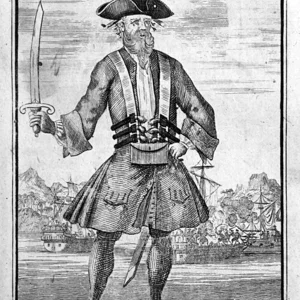
According to accounts, Blackbeard wore several pairs of flintlock pistols hung from a bandolier across his chest. Slow to reload, they were meant to be drawn one after another.

Cords soaked in saltpeter that burned slowly to light the cannons. Blackbeard would tuck them under his hat to wreathe himself in smoke and give himself a demonic look.

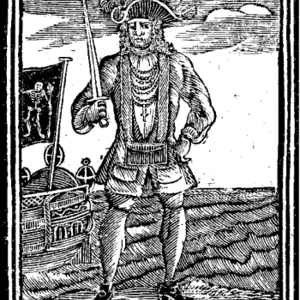
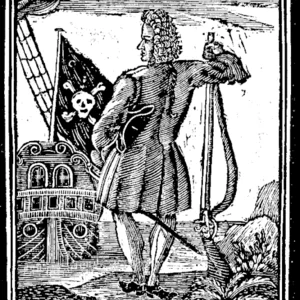
A flag raised to signal the ship's pirate nature and push its prey into surrendering. The one attributed to Blackbeard is said to depict a horned skeleton holding an hourglass and piercing a heart.

A former French slave ship named La Concorde, captured and then armed with around forty cannons to become Blackbeard's flagship. Its wreck was found in 1996 off the coast of North Carolina.

A telescope used to spot sails on the horizon long before the enemy could. Essential for picking out prey and watching for warships.
School Curriculum
Vocabulary & Tags
Key Vocabulary
Tags
Daily Life
Morning
At dawn, the crew took turns standing watch while the captain and the quartermaster scanned the horizon with a spyglass. They checked the course, the sails and the rigging, watching for any sail that might be prey.
Afternoon
The afternoon was devoted to maintaining the ship and its weapons: cleaning the cannons, sharpening the cutlasses, mending the sails. It was also the time to share out the loot according to the agreed “code,” with each share fixed in advance.
Evening
In the evening, anchored in a safe cove, the mood loosened up: rum, songs, card or dice games, and tales of boarding raids. These festive moments strengthened the bond of a crew bound by harsh discipline.
Food
Everyday fare relied on ship's biscuit and salted meat and fish, all of it often infested with weevils after weeks at sea. They drank plenty of rum and stagnant water; for lack of fresh fruit, scurvy was a constant threat, which is why they raided to obtain fresh provisions and turtles.
Clothing
Blackbeard wore a long coat, a tricorne hat and tall boots, with a bandolier of pistols slung across his chest. His trademark remained his huge black beard, sometimes braided and adorned with ribbons.
Housing
On board, space was cramped and damp: only the captain had a cabin at the stern, while the crew slept in tightly packed hammocks. On land, pirates camped on remote islands, and Blackbeard briefly occupied a house in Bath after his pardon.
Historical Timeline
Period Vocabulary
Liens externes & ressources
Références
Œuvres
Capture et armement du Queen Anne's Revenge
1717
Blocus du port de Charles Town
mai 1718
Constitution d'une flotte de pirates
1717-1718
Construction d'une image terrifiante
1716-1718
Acceptation du pardon royal puis retour à la piraterie
1718