Imaginary interview with Ramakrishna
by Charactorium · Ramakrishna (1836 — 1886) · Spirituality · Philosophy · 6 min read

Late afternoon at Dakshineswar, along the Ganges. In the small room adjoining the Kālī temple, a thin man, dressed in a simple cotton dhoti, smiles between silences. He has just emerged from a sudden rapture and agrees to answer, in a low voice, as if singing.
—Do you remember the first time the world slipped away from you, when you lost all awareness?
I was a child in Kamarpukur, perhaps six years old, walking on a dike between rice paddies. A flight of white cranes crossed a storm-laden sky, so white against that black that something inside me gave way. I fell, was carried home unconscious, and they thought it was a child's fainting spell. It was no fainting spell. It was beauty entering like a blade and cutting the thread that holds you to yourself. Later, they put a name to it: samadhi. But at six I had no name, only the sky, the cranes, and a joy that hurt. Since then, the Mother takes me like that, without warning, in the middle of a song or a word.
Beauty enters like a blade and cuts the thread that holds you to yourself.
—How did you come to seize the temple sword before the image of the goddess?
I was a priest at the temple, and I could no longer bear reciting prayers like a parrot before a stone. Where was She? I spent my nights weeping before the Statue of Kālī, wringing my hands, crying out to the Mother. One day the waiting became unbearable: what was the point of living another day without seeing Her? I ran to the khadga, the sacrificial sword hanging on the sanctuary wall, determined to cut my throat. The moment my hand closed on the blade, everything vanished — the walls, the river, my own body — into an ocean of living light. It was She. Since then, I know that one obtains nothing from the divine by bargaining; you must want God as a drowning man wants air.
You must want God as a drowning man wants air.
—What remains of a man after such a vision of the Divine Mother?
Almost nothing remains, and that is the treasure. In the days that followed, I could no longer distinguish day from night; I placed flowers on my own head instead of the statue, for I saw no difference. A disciple later noted my prayer: “O Mother, I have cast good and evil at Your feet, give me pure devotion.” That was all I wanted. The priest who lights the ārtī lamp at sunset believes he serves the goddess; I, that evening, the goddess served me, held me as a mother holds a child who has cried too much. They thought me mad at Dakshineswar. They were right: I became mad for Her, and I have never recovered.
—Why would a priest of Kālī want to live as a Muslim and then pray before Christ?
Because one day I asked myself: if the Mother is everywhere, how could She not be in the prayer of the man in the turban who prostrates toward Mecca? So, in 1866, I lived for a few days as a Muslim; I repeated the name of Allah, ate their food, almost forgot the temple. And God came, by that path too. Later, before an image of Christ, a light came out of the picture and flooded me; for days I thought only of Him. I drew from it a simple certainty, which I expressed thus: “So many beliefs, so many paths. You can reach God by all paths, as you can reach the roof by a staircase of stone, wood, or bamboo.”
So many beliefs, so many paths; you reach the roof by a staircase of stone, wood, or bamboo.
—How did you respond to those who found it scandalous that a Hindu embraced other religions?
I did not argue with them; I told them about water. See: in the same pond, one draws with a jar and calls it jal, another with a skin and says pani, a third says water — it is the same water. To fight over the name is to die of thirst at the edge of the pond. The men of the Brahmo Samaj, those reformers from Calcutta who came to see me around 1875, liked to discuss God like a theorem; I told them that you do not taste honey by reading the word “honey.” I had drunk from several jars — Kālī's, Allah's, Christ's — and the water everywhere tasted the same, of Mother. It was not polite tolerance: it was something my tongue had actually tasted.
You do not taste honey by reading the word “honey.”
—You could barely read: how did you teach the highest truths?
Precisely because I could not read, I never had to unlearn books. I looked around me and the world offered me its images. An ant climbs a mountain of sugar: it carries away a grain and thinks it is full — so we are before the infinity of God. The rope, in the half-light, that you mistake for a snake and that makes you tremble: that is the world that frightens us as long as we do not know what it really is. Water and ice: God without form and God with form, one substance, cooled by the devotee's love. My young disciples noted all this; one of them, whom we called “M.,” filled notebooks. I spoke as the Mother opened my mouth, with rice, ponds, ants.
I never had to unlearn books.
—What would you say to someone who believes that one must first understand everything before believing?
I would answer that he is like a man who, arriving in an orchard, sits down to count the leaves and branches instead of eating the mangoes. What is the use of knowing how many trees, how many gardeners? Eat your mango, feel the juice run, and you will know more of God than all the leaf-counters. The scholars from Calcutta came with their reasonings neatly folded like new dhotis; I let them talk, then I sang the Mother's name, and often their fine reasonings melted like salt in water. What I call bhakti, the devotion of the heart, does not wait for the head's permission. The crying child does not recite proofs of his mother's existence to her: he cries, and she comes.
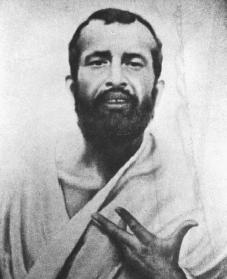
—Do you remember the skeptical young man who came to ask if you had seen God?
Narendranath. It was around 1881. A boy with a broad forehead, a singer's voice, but a hard eye, who doubted everything. He went from saint to saint with a single question, the real one, that others dared not ask: “Have you seen God?” The others equivocated. I answered simply: “Yes, I see Him as I see you here, but much more intensely.” He stood speechless. For I was not speaking to him of an opinion or a scripture: I was speaking as one speaks of a man one has touched. I was waiting for him, that child, without knowing it; the Mother sent him to me. I knew at once that he was made of different stuff, and that one day he would carry far what I had only tasted.
I was not speaking to him of an opinion: I was speaking as of a man one has touched.
—What did you hope to transmit to that circle of young disciples gathered around you?
At the end, at Cossipore, the disease was eating my throat and I could hardly swallow; but those boys never left me, they kept vigil, they sang for me. I left them no book, no closed doctrine. I left them a thirst. I wanted them to renounce, to become sannyāsī, not to flee the world but to love God without reserve, and then to tell men that all jars draw the same water. What I could no longer say with my fading voice, I transmitted with a look, a touch of the hand. Later they would form something around my name; little did I care about the name. What I wanted was that after me the Mother would still have mouths to speak Herself.
—Your sudden raptures, in the middle of conversation, sometimes frightened your visitors. How did you experience them from within?
From within, there is no “I” to experience them — that is the secret. In the afternoon, under the trees, a devotee would ask a question, I would begin to answer, and in the middle of a word the Mother's name would rise and carry me away; my body remained there, motionless, eyes fixed, while I was elsewhere, or rather nowhere, dissolved. People would worry, touch my shoulder; I would return slowly, as from a river, still stammering Her name. People think samadhi is a sleep; it is the opposite, it is the only time when one is fully awake, and one discovers that ordinary wakefulness was the true sleep. Ice melts into water, I would say: that is exactly what becomes of man when the Mother looks him in the face.
This imaginary interview was generated by artificial intelligence from sources documented in Ramakrishna's profile. It dramatises what the figure might have said based on what we know about them, but does not constitute attested historical testimony. For primary sources and factual documentation, refer to the full profile.