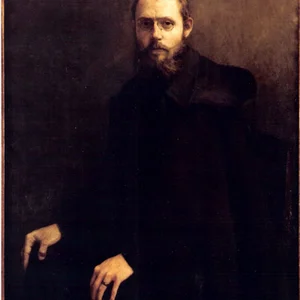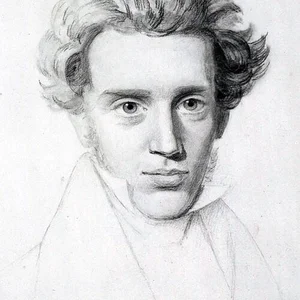

Danish philosopher and theologian (1813-1855), regarded as the father of existentialism. A critic of the Hegelian system and of institutional Christianity, he placed individual existence, choice, and faith at the heart of his thought.
Søren Kierkegaard(1813 — 1855)
Søren Kierkegaard
Royaume de Danemark
6 min read
Frequently asked questions
Famous Quotes
« Life can only be understood backwards, but it must be lived forwards.»
« Anxiety is the dizziness of freedom.»
Key Facts
- Born in 1813 in Copenhagen into a Lutheran family marked by his father's piety and melancholy
- Broke off his engagement to Regine Olsen in 1841, a decisive event for his work
- Published 'Either/Or' (Enten-Eller) in 1843, then 'The Concept of Anxiety' and 'Fear and Trembling'
- Late in life waged a fierce polemic against the official Danish Church (1854-1855)
- Died in 1855 in Copenhagen at the age of 42, his work only being rediscovered in the 20th century
Works & Achievements
A major work contrasting the aesthetic and the ethical stages of existence; it launched his fame.
A meditation on the sacrifice of Abraham and the “leap of faith,” at the heart of his religious thought.
A philosophical essay exploring the notion of repetition as a category of existence.
An analysis of anxiety as the “dizziness of freedom,” pioneering for psychology and existentialism.
A short treatise on faith, truth, and the paradox of the incarnation, signed Johannes Climacus.
A vast response to the “Fragments,” where he develops the idea that “subjectivity is truth” and criticizes Hegel.
A study of despair as a spiritual sickness of the “self,” among his most profound texts.
A series of combative pamphlets against the official Danish Church, published shortly before his death.
Anecdotes
Kierkegaard published most of his major books under quirky pseudonyms like Johannes de Silentio, Victor Eremita, and Climacus. This wasn't to hide himself, but to let several “voices” speak, each defending opposing visions of life, leaving readers to choose for themselves.
In 1841, he broke off his engagement to Regine Olsen, even though he loved her deeply. This painful break haunted all of his work: he believed that his calling as a thinker and his melancholy were incompatible with marriage, and Regine remained a central figure throughout his writings.
In Copenhagen, Kierkegaard became the target of a satirical newspaper, The Corsair, which cruelly caricatured him because of his uneven legs and his appearance. Made into the laughingstock of passersby in the street, he drew from it a reflection on the suffering of being misunderstood by the crowd.
Near the end of his life, he spent almost his entire inherited fortune waging a fierce one-man pamphlet campaign against the official Danish Church, which he judged to be lukewarm and hypocritical. He collapsed in the street in 1855 and died a few weeks later, at the age of 42, nearly penniless.
His father, a merchant who had grown wealthy, was gnawed by guilt over having once cursed God and committed a sin in his youth. Kierkegaard spoke of a family “thorn in the flesh” and a great inner “earthquake” that deeply shaped his anguished view of existence.
Primary Sources
Marry, and you will regret it; do not marry, and you will also regret it; marry or do not marry, you will regret it either way.
Faith is precisely this paradox, that the single individual is higher than the universal.
Anxiety is the dizziness of freedom.
Life can only be understood backwards, but it must be lived forwards.
Key Places
Kierkegaard's birthplace, where he spent almost his entire life, wrote his work, and died. He loved to walk through it and observe its inhabitants.
Where Kierkegaard studied theology and philosophy and, in 1841, defended his thesis on the concept of irony in Socrates.
Kierkegaard went there in 1841–1842 after his breakup with Regine to attend the lectures of the philosopher Schelling and begin writing “Either/Or.”
Copenhagen's cathedral, tied to the city's religious life; here Kierkegaard confronted the State Church that he criticized so vehemently.
The place where Kierkegaard was buried in 1855, in the family vault. His funeral gave rise to tensions with the official Church.
Typical Objects

Kierkegaard often wrote while standing, pacing between several desks on which different manuscripts lay. This object symbolizes his feverish and intense literary output.

Instruments of Kierkegaard's immense handwritten body of work, which filled thousands of pages of journals and books in just over a decade.

Kierkegaard kept an extensive personal journal in which he jotted down thoughts, prayers, and reflections. These notebooks are today an essential source for understanding his thinking.

A great walker, Kierkegaard roamed the streets of Copenhagen chatting with passersby, something he called his “crowd baths.” His cane accompanied these daily walks.

Trained as a theologian, Kierkegaard placed Scripture at the center of his faith and read it constantly, contrasting the Christianity of the New Testament with the official Church of his time.

A series of polemical leaflets that Kierkegaard published and distributed himself at the end of his life to attack the Danish state Church.
School Curriculum
Vocabulary & Tags
Key Vocabulary
Daily Life
Morning
Kierkegaard rose to write very early, often standing at one of his writing desks in a bourgeois apartment in Copenhagen. His pen raced at a feverish pace, producing in just a few hours pages destined for his books or his journal.
Afternoon
In the afternoon, he would go out for long walks through the city streets, what he called his “people baths.” There he struck up conversations with people of all walks of life, observed the passers-by, and fed his thinking through contact with ordinary people.
Evening
In the evening, he returned to his desk to reread, revise, and record his thoughts in his journals. He sometimes went to the theatre, which he adored, slipping in between two acts to keep up the illusion of an idle life.
Food
Born into a well-off family, Kierkegaard ate well and enjoyed coffee, which he is said to have prepared in an extravagant manner by filling the cup with sugar. His fragile health and irregular lifestyle, however, undermined his well-being.
Clothing
He dressed in the bourgeois fashion of Copenhagen: a frock coat, waistcoat, top hat, and cane. His slightly stooped figure and uneven legs made him recognizable and were mocked by the caricaturists.
Housing
Thanks to his father's inheritance, he lived in comfortable apartments that he changed often, cluttered with books and manuscripts. At the end of his life, his spending and his campaign against the Church nearly exhausted his entire fortune.
Historical Timeline
Period Vocabulary
Liens externes & ressources
Références
Œuvres
Ou bien… ou bien (Enten-Eller)
1843
Crainte et Tremblement
1843
La Répétition
1843
Le Concept de l'angoisse
1844
Miettes philosophiques
1844
Post-scriptum définitif et non scientifique
1846
La Maladie à la mort
1849