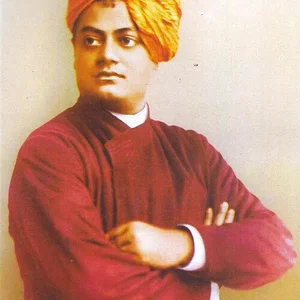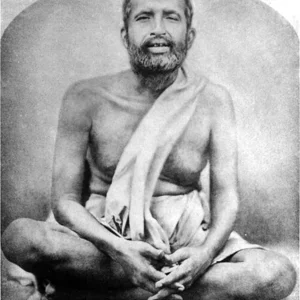

A 19th-century Bengali Hindu mystic and saint, a priest of the goddess Kali at the Dakshineswar temple near Calcutta. His spiritual quest led him to experience several religious paths (Hinduism, Islam, Christianity) and to teach the fundamental unity of all religions. He was the spiritual master of Vivekananda.
Ramakrishna(1836 — 1886)
Ramakrishna
Raj britannique, Legislatures of British India
6 min read
Frequently asked questions
Famous Quotes
« As many faiths, so many paths.»
Key Facts
- Born in 1836 in Kamarpukur, in Bengal (India), under the name Gadadhar Chattopadhyay
- Became a priest of the Kali temple at Dakshineswar near Calcutta around 1855
- Explored various religious traditions (Tantrism, Islam, Christianity) during the 1860s and 1870s
- Formed a circle of disciples, including Vivekananda, who would spread his teaching in the West
- Died in 1886 of throat cancer
Works & Achievements
His central teaching, holding that all religions are valid paths to the same God, grounded in his own experiences of Hinduism, Islam, and Christianity.
Ramakrishna made the young skeptic Narendranath his disciple; Vivekananda would carry this message all the way to the Parliament of the World's Religions in Chicago in 1893.
A teaching method made of simple stories (the rope and the snake, water and ice) that made the deepest spiritual truths accessible.
The group of young devotees gathered around him at Cossipore would form, after his death, the Ramakrishna Mission founded by Vivekananda in 1897.
Although Ramakrishna wrote nothing himself, his conversations recorded by the disciple “M.” constitute one of the great spiritual works of modern India.
Anecdotes
From childhood in Bengal, Ramakrishna experienced states of ecstasy: at the age of six, upon seeing a flock of white cranes cross a stormy sky, he is said to have lost consciousness, overwhelmed by the beauty of the sight. These mystical raptures, called *samadhi*, stayed with him throughout his life.
As a priest of the temple of Kali at Dakshineswar, he refused to recite prayers mechanically. It is said that he implored the goddess with such intensity that he threatened to cut his throat with the sanctuary's sword if she did not reveal herself — until the day he claimed to have had a vision of the Divine Mother.
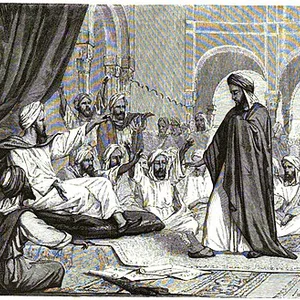
Curious about all religions, Ramakrishna wanted to experience Islam: he lived for a time as a Muslim, reciting the prayers, then practiced Christianity after contemplating an image of Christ. From these experiences he concluded that all paths lead to the same God.
When the young Narendranath (the future Vivekananda), a skeptical student, asked him whether he had seen God, Ramakrishna calmly replied: “Yes, I see Him as clearly as I see you, but even more intensely.” This answer shook the young man deeply and made him his foremost disciple.
Almost illiterate, Ramakrishna taught through parables drawn from everyday Bengali life — water and ice, the snake and the rope, the sugar that the ant tastes without ever being able to consume it all. His disciples recorded his words in the *Ramakrishna Kathamrita*.
Primary Sources
As many beliefs, so many paths. One can reach God by every path, just as one can reach the rooftop by a staircase of stone, of wood, or of bamboo.
He would say: “O Mother, I have cast good and evil at Thy feet; grant me pure devotion.” His heart longed for nothing but the realization of the Divine Mother.
When asked, “Have you seen God?”, he replied, “Yes, I see Him as I see you here, but far more intensely.”
Key Places
Rural village in the Hooghly district of Bengal, where Ramakrishna was born and grew up in a family of poor Brahmins.
Great temple on the bank of the Ganges, north of Calcutta, where Ramakrishna served as a priest of Kali and lived through his major mystical experiences.
Capital of British India in the 19th century and the heart of the Bengal Renaissance; its reformist circles helped spread Ramakrishna's teaching.
Suburb of Calcutta where Ramakrishna, suffering from throat cancer, spent his final months surrounded by his disciples and where he died in 1886.
Village near Kamarpukur, birthplace of Sarada Devi, the wife and spiritual companion of Ramakrishna.
Typical Objects

The image (mūrti) of Kālī venerated at the Dakshineswar temple, before which Ramakrishna officiated and entered into ecstasy. It depicts the divine Mother, dark-skinned, adorned with a garland of severed heads.
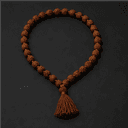
A string of 108 beads, often made of rudraksha seeds or tulsi beads, used to count repetitions of the divine name (japa). An everyday tool of the Bengali devotee.

The ritual saber (khadga) of Kālī's sanctuary, used for sacrifices. Ramakrishna is said to have seized it, threatening to take his own life if he did not obtain a vision of the goddess.
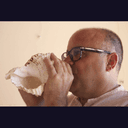
A sea shell blown like a trumpet during rituals (pūjā) and ārtī offerings in Hindu temples. Its call marks the beginning of ceremonies.
📷 CC BY-SA 4.0 · Wikimedia Commons ↗
A multi-wicked lamp waved before the deity during the evening service. The flame symbolizes the offering of light to the divine Mother.
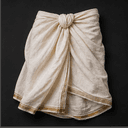
A piece of white cloth knotted around the waist, the traditional garment of the men of Bengal. Ramakrishna wore it simply, in the manner of ascetics.
School Curriculum
Vocabulary & Tags
Key Vocabulary
Daily Life
Morning
At the temple of Dakshineswar, Ramakrishna would rise before dawn and spend long hours in meditation and prayer before the image of Kali. The morning was often set to the rhythm of devotional songs (bhajan) and the invocation of the divine name.
Afternoon
In the afternoon, he received visitors and disciples beneath the trees or in his small room, answering their questions with parables. He might suddenly enter samadhi, losing all awareness of the outside world.
Evening
The evening was devoted to the arti ritual, with lamps, conch shells and bells before the goddess. Ramakrishna would then converse late into the night with his young devotees, sometimes singing until he reached ecstasy.
Food
He led a frugal life, living mainly on rice, vegetables and milk, in keeping with ascetic simplicity. Very demanding about the purity of food, he would sometimes refuse to eat anything that came from hands he judged impure.
Clothing
He wore a simple white cotton dhoti and often remained bare-chested, without any ornament, in the manner of renunciants. His modest dress contrasted with his growing fame in Bengal.
Housing
He lived in a small room adjoining the temple of Dakshineswar, overlooking the Ganges. The place was bare: a camp bed, a few holy images and the essentials for prayer.
Historical Timeline
Period Vocabulary
Liens externes & ressources
Références
Œuvres
Doctrine de l'harmonie des religions
années 1860-1886
Formation de Swami Vivekânanda
1881-1886
Enseignement par paraboles
années 1880
Cercle de disciples (futur Ordre de Râmakrishna)
1885-1886
Râmakrishna Kathâmrita (recueil de ses propos)
consigné 1882-1886, publié à partir de 1897