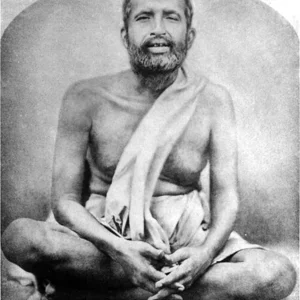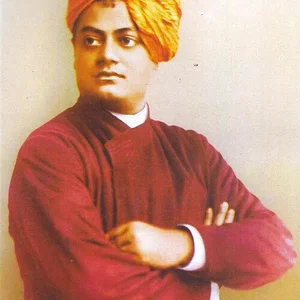

Indian Hindu monk and disciple of the mystic Ramakrishna, he was one of the foremost figures who brought Hindu spirituality (vedanta and yoga) to the West in the late 19th century. His speech at the World's Parliament of Religions in Chicago in 1893 made him famous.
Vivekananda(1863 — 1902)
Vivekananda
Raj britannique
5 min read
Frequently asked questions
Famous Quotes
« Arise, awake, and stop not till the goal is reached.»
Key Facts
- Born in 1863 in Calcutta under the name Narendranath Datta
- Becomes the chief disciple of the mystic Ramakrishna in the 1880s
- Delivers a famous speech at the World's Parliament of Religions in Chicago in 1893
- Founds the Ramakrishna Mission in 1897 to combine spirituality with social action
- Dies in 1902 in Belur, near Calcutta
Works & Achievements
A plea for tolerance and the universality of religions that introduced Hinduism to the West.
A work presenting the yoga of concentration and meditation to a Western audience; an enormous success.
A teaching on the yoga of selfless action, with service as a spiritual path.
A presentation of Advaita Vedanta (non-duality) and the yoga of knowledge.
An organization combining spiritual life with social action (education, health, relief), still active today.
The founding of the monastery that became the worldwide headquarters of the monastic order he established.
A series of speeches delivered during his triumphant tour of India, calling for national and spiritual awakening.
Anecdotes
Born Narendranath Datta into a well-off family in Calcutta, the young Vivekananda was a rationalist mind who doubted the existence of God. He is said to have bluntly asked several spiritual masters: “Have you seen God?” Only Ramakrishna answered yes, which deeply moved the young man and led him to become his disciple.
On September 11, 1893, unknown and almost penniless, he stepped up to the podium of the World's Parliament of Religions in Chicago. His first words — “Sisters and brothers of America” — set off an ovation that lasted several minutes from the thousands in the audience, before he had even begun his speech.
Before becoming a famous monk, he spent years wandering across India as a “parivrajaka” (itinerant monk), often walking barefoot and begging for his food, in order to discover the real poverty of his country.
On his triumphant return to India in 1897, he was welcomed as a national hero and founded the Ramakrishna Mission, an organization combining spirituality with concrete social action (schools, hospitals, famine relief).
He died very young, at 39, on July 4, 1902, after meditating. He had himself predicted that he would not live beyond the age of forty.
Primary Sources
Sisters and Brothers of America! [...] I am proud to belong to a religion which has taught the world both tolerance and universal acceptance.
All knowledge and all power are within us. We have to manifest them. All the knowledge that man possesses proceeds from his own mind.
Arise, awake, and stop not till the goal is reached.
They alone live who live for others; the rest are more dead than alive.
Key Places
Vivekananda's birthplace and a major center of the Bengal Renaissance in the 19th century.
Temple dedicated to the goddess Kali on the banks of the Ganges where Ramakrishna lived; the site of their decisive meeting.
Monastery founded by Vivekananda on the western bank of the Ganges, the worldwide headquarters of the Ramakrishna Mission, where he died.
City where the World's Parliament of Religions was held in 1893, the springboard for his international fame.
The southernmost tip of India where Vivekananda meditated in 1892, today a memorial dedicated to him.
Typical Objects

Ochre-saffron colored garment of the Hindu sannyasins (renunciant monks), which became his emblematic image during his lectures in the West.

A water vessel, often made from a gourd or metal, carried by wandering Hindu ascetics for their daily needs and ritual ablutions.

A string of 108 beads, often made of rudraksha wood, used to count the repetitions of mantras during meditation.

A voracious reader, Vivekananda annotated the texts of the Vedanta, the Upanishads and the Bhagavad Gita, as well as Western works of science and philosophy.

A long staff carried by the sannyasin during his journeys on foot across India, a symbol of his wandering and his detachment.
School Curriculum
Vocabulary & Tags
Key Vocabulary
Daily Life
Morning
As a monk, Vivekananda rose very early for meditation and prayer at sunrise. Mornings were devoted to the study of sacred texts and to pranayama (breathing exercises).
Afternoon
In the afternoon, he taught his disciples, received visitors and debated philosophy. During his tours in the West, he gave lectures and yoga classes to a curious public.
Evening
Evenings blended long spiritual conversations, devotional songs (bhajans) — he had a beautiful voice and loved to sing — and meditation once again before rest.
Food
As a monk, he observed great simplicity in his diet, often vegetarian, but while travelling he ate whatever was offered to him. He nonetheless enjoyed a good cup of tea and Bengali cuisine.
Clothing
He wore the saffron robe and turban (gerua) of the sannyasins, a simple cotton garment that became his recognizable image throughout the world.
Housing
During his years of wandering, he slept in temples, makeshift shelters or with local families. Later, he resided at the Belur Math monastery, on the banks of the Ganges.
Historical Timeline
Period Vocabulary
Liens externes & ressources
Références
Œuvres
Discours de Chicago au Parlement mondial des religions
1893
Karma-Yoga
1896
Jnana-Yoga
1899
Fondation de la Ramakrishna Mission
1897
Belur Math
1898
Conférences « De Colombo à Almora »
1897