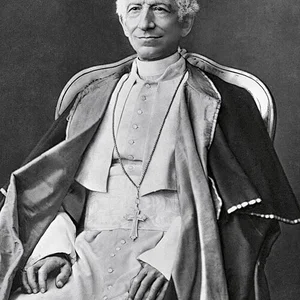

Pope from 1878 to 1903, Leo XIII modernized the social doctrine of the Church with the encyclical Rerum Novarum (1891). He sought to reconcile Catholicism with the modern world and liberal democracies.
Leo XIII(1810 — 1903)
Leo XIII
États pontificaux, royaume d'Italie
8 min read
Frequently asked questions
Famous Quotes
« Misery and fortune are the necessary lot of human society.»
« Religion and the Catholic Church must be present in human institutions.»
Key Facts
- 1878: Elected pope under the name Leo XIII, succeeding Pius IX
- 1891: Publication of the encyclical Rerum Novarum on the condition of workers
- 1879: Encyclical Aeterni Patris, restoring Thomism as the official philosophy of the Church
- 1884: Encyclical Humanum Genus against Freemasonry
- 1903: Death after 25 years of pontificate, one of the longest in modern history
Works & Achievements
The founding encyclical of Catholic social teaching. It defends the dignity of labor, the right to a just wage and to private property, while condemning both capitalist exploitation and socialist collectivism.
An encyclical that restored the philosophy of Saint Thomas Aquinas to the heart of Catholic education. It sparked a powerful neo-Thomist movement in universities and seminaries around the world.
An encyclical outlining the relationship between the Church and modern states. Leo XIII accepted the principle of separation of powers while affirming the Church's authority over moral questions.
A historic decision granting historians from around the world access to the papal archives. It was an act of confidence in historical scholarship and a major break from the closed-door policies of his predecessors.
An encyclical on the scientific study of the Bible, encouraging Catholics to use the methods of philology and archaeology to better understand Scripture, in keeping with the faith.
A scientific institution created to assert the compatibility of the Catholic faith with modern science. Leo XIII sought to refute the notion that the Church had been opposed to scientific progress ever since the Galileo affair.
Anecdotes
Elected pope in 1878 at the age of 68, Leo XIII was widely seen as a transitional pope — too old to leave a lasting mark on the Church. He defied all expectations by reigning for 25 years until his death at 93, becoming one of the longest-serving popes in history.
In 1891, Leo XIII published the encyclical Rerum Novarum, the founding text of Catholic social teaching. For the first time, a pope took a stand on the condition of working people, defending the right to a fair wage and to form trade unions, while condemning both unbridled capitalism and revolutionary socialism.
A passionate scholar, Leo XIII opened the Vatican Secret Archives to researchers from around the world in 1881, breaking with centuries of closed-door policy. This bold decision allowed non-Catholic historians to access thousands of priceless documents on the history of the Church.
In 1898, Thomas Edison sent a film crew to the Vatican to record the pope. Leo XIII blessed the camera and thus became one of the first heads of state to appear in a motion picture. The footage traveled around the world and reinforced his image as a pope open to modernity.
Before becoming pope, Gioacchino Pecci served as Bishop of Perugia for 32 years. During that time, he wrote an annual pastoral letter addressing the major intellectual challenges of his day, shaping his thinking on the relationship between faith and modernity long before his accession to the papal throne.
Primary Sources
Wages ought to be sufficient to support a frugal and well-behaved wage earner. If through necessity or fear of a worse evil the workman accepts harder conditions because an employer or contractor will give no better, he is the victim of force and injustice.
Among the scholastic doctors, Thomas Aquinas stands preeminent. Having inherited the work of all his predecessors, he enriched and adorned it; having gathered and assembled their teachings, he arranged and amplified them in such a way that he is rightly regarded as the glory and bulwark of the Catholic Church.
God has divided the government of the human race between two powers: ecclesiastical and civil — the former set over divine affairs, the latter over human affairs. Each is sovereign in its own sphere.
The Church received the Sacred Books from the hands of the Apostles as a precious heritage of the family. She is their guardian and faithful interpreter, and her foremost duty is to preserve them from any corruption.
The Church has nothing to fear from historical truth. We decree that the Secret Archives of the Holy See be opened to scholars and researchers, so that the light of history may dispel prejudice.
Key Places
A small town in the Lepini Mountains where Gioacchino Pecci was born on March 2, 1810, into a minor noble family. This rural birthplace of the future pope is today a site of remembrance, home to a museum dedicated to Leo XIII.
The city where Pecci served as bishop for 32 years (1846–1878). It was here that he developed his thinking on the social question and the relationship between the Church and democracy, publishing widely noted pastoral letters each year.
The residence and center of papal power. After 1870 and the seizure of Rome by Italy, Leo XIII considered himself a "prisoner of the Vatican" and pointedly refused to leave its walls in protest against the loss of the Papal States.
A major Jesuit institution where Pecci studied theology and philosophy in his youth. This rigorous formation instilled in him a lifelong commitment to the scholastic method, which he championed throughout his pontificate.
Typical Objects

A gold papal ring engraved with an image of Saint Peter fishing, used to seal apostolic briefs. For Leo XIII, this ring symbolized his mission to reconcile the Church with the modern world.

A triple-crowned headdress worn during solemn ceremonies, symbolizing the pope's spiritual and temporal authority. Leo XIII still wore it at major audiences despite his advanced age.

Papal texts written in Latin and circulated to all Catholic bishops around the world. Leo XIII published 86 of them during his pontificate — a record in Church history.

The masterwork of medieval scholastic philosophy, which Leo XIII placed at the heart of Catholic intellectual formation. He had this work laid on the altar during the First Vatican Council.

A scientific instrument symbolizing Leo XIII's openness to science. He founded the Vatican Observatory in 1891, asserting that faith and scientific reason are not in opposition.

The everyday tools of papal diplomacy. Leo XIII was a skilled diplomat who sought to restore the Church's relations with European states, notably republican France and Bismarck's Germany.
School Curriculum
Vocabulary & Tags
Key Vocabulary
Daily Life
Morning
Leo XIII rose at dawn to celebrate Mass in his private chapel, then devoted several hours to reading and the recitation of the canonical hours. He would then dictate his correspondence to his secretaries, responding in Latin to bishops from around the world.
Afternoon
The afternoon was reserved for audiences: cardinals, diplomats, heads of state, and pilgrims filed through the Vatican's ceremonial halls. Despite his advanced age, he conducted discussions himself in several languages and dictated the broad outlines of his encyclicals.
Evening
In the evenings, Leo XIII withdrew to his library to read works of philosophy, theology, or history. He sometimes composed poems in Latin, a literary passion he cultivated throughout his life. He retired early, leading a life of strict monastic regularity.
Food
The Pope followed a sober and frugal diet, in keeping with his ecclesiastical tradition. His meals consisted mainly of soups, vegetables, bread, and some white meats. His exceptional longevity was often attributed to this disciplined way of life.
Clothing
Leo XIII wore the pontifical white cassock and white zucchetto daily, symbols of purity and his office. During solemn ceremonies, he donned the gold-embroidered cope, the mitre, and the stole. In winter, he added the red mozzetta and the pellegrina.
Housing
Leo XIII resided in the papal apartments of the Apostolic Palace in the Vatican, vast rooms adorned with frescoes and tapestries. His personal library, containing thousands of volumes, was his favorite room. After 1870, he never left the Vatican enclosure, presenting himself as a symbolic prisoner.
Historical Timeline
Period Vocabulary
Visual Style
Le style visuel de Léon XIII s'ancre dans le portrait académique de la fin du XIXe siècle : vêtements pontificaux immaculés, intérieurs dorés du Vatican, lumière de bougie sur des manuscrits anciens, dans une atmosphère de gravité intellectuelle et de solennité romaine.
Sound Ambience
L'univers sonore de Léon XIII mêle le chant grégorien des offices, le tintement solennel des cloches vaticanes et le murmure des prières en latin dans les salles de marbre du palais apostolique.