Imaginary interview with Renata Tebaldi
by Charactorium · Renata Tebaldi (1922 — 2004) · Music · Performing Arts · 5 min read
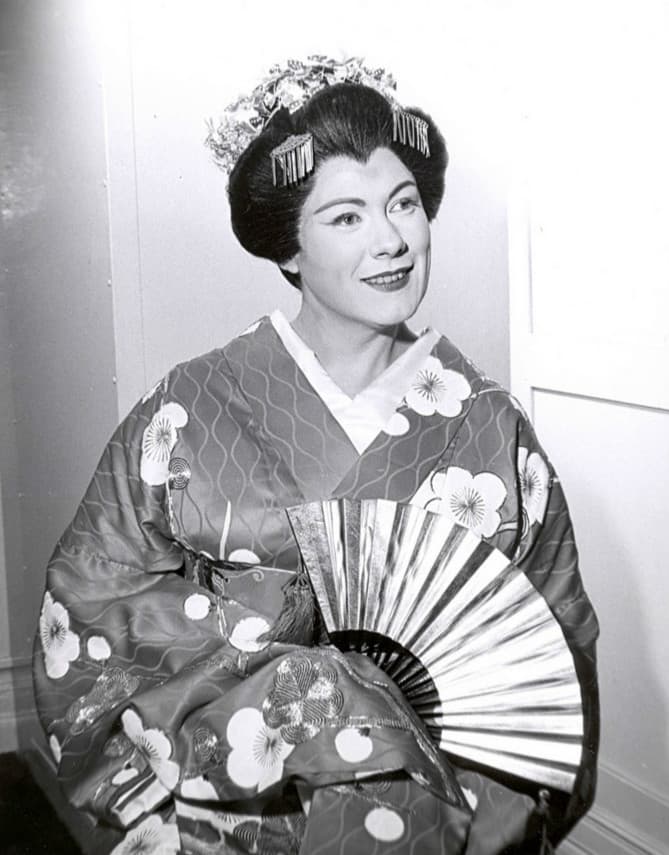
San Marino, winter 2004. In a villa surrounded by a silent garden, far from the bustle of great cities, Renata Tebaldi receives informally, a score open on the upright piano. Her voice speaks low — an old habit of never forcing before noon — but the memories immediately rise to a high pitch.
—How did that 1946 audition for the reopening of La Scala unfold?
The hall was still scarred by bombs; you could almost smell the settled dust. I was twenty-four and trembling like a leaf. I sang, and then there was silence — such a long silence that I thought I had failed. And Arturo Toscanini stood there, motionless, before uttering those words I will never forget: “Questa è la voce d’angelo.” You never recover from such a phrase at that age. That reopening concert, broadcast on national radio, carried me at once into millions of Italian homes that had heard no music since the war.
Such a long silence that I thought I had failed.
—What did that theater mean for Italy emerging from war?
You have to imagine what it was: a Scala gutted by Allied bombing, and a people who had nothing left — neither bread nor certainty. Reopening that theater, under the baton of Toscanini returned from exile, was not a whim of music lovers: it was saying that Italy was beginning to breathe again. Singing that night meant offering people proof that beauty had survived. That day I understood that a voice could be a national consolation. My career was not born of ambition; it was born of that need — the need of a bloodless country to hear itself sing again.
—The rivalry with Maria Callas was one of the most talked-about in opera. How did you experience it?
Oh, that war! The Tebaldiani and the Callasiani fought with applause and boos in theaters around the world, as if you could judge two women by the noise. When Time magazine interviewed me in 1956, I answered what I truly thought: “Miss Callas and I have only one thing in common: we both sing at the opera.” I sincerely wished her all the success. We were not enemies; we were two natures. She brought the fire of theater; I, I believe, brought line and purity of tone. The public wanted a duel; we simply existed side by side.
The public wanted a duel; we simply existed side by side.
—You remained on stage when she retired. How did that feel?
When Maria ended her stage career in the late sixties, I felt something strange — not triumph, no — rather a loneliness. I was called the “undisputed queen,” but a queen without a rival rules a colder kingdom. The truth is, her presence had made me better: you never surpass yourself as well as when you are in front of someone you secretly admire. I continued singing my Desdemona, my Aida, with the thought that a part of great lyric theater had fallen silent. The rivalry had exhausted us both, but it had also made us greater.
—In the mid-1950s, your voice once abandoned you. Do you remember that moment?
How could I forget? Vocal fatigue set in like an intimate betrayal — the instrument that had given you everything suddenly began to waver. I refused all engagements; I imposed a total, almost monastic retreat. I went back to work, discreetly, with Carmen Melis, the one who had trained me at the Parma Conservatory: starting vocal exercises like a beginner, relearning how to place each note. Silence was my hardest teacher. And when I returned to the Metropolitan Opera, the ovation lasted several minutes, unbroken. My voice had not only returned but was fuller, more controlled. You don’t recover from such fear; you learn to sing with it.
Silence was my hardest teacher.
—How does such an ordeal change the way you approach singing?
Before, I sang with the carelessness of a natural gift; I had been told that God had placed the right note on my cords, and I believed it a little. After that crisis in the fifties, I understood that gift is not enough — you must protect it, nurture it, be wary of it. That is when my rituals were born: not speaking loudly before noon, an hour of complete silence before each performance, a strict diet — no alcohol, no dairy, nothing acidic on performance days. These are not diva quirks. They are the discipline of a survivor. The voice is a fragile body lodged within yours; you do not mistreat it twice.
—Your Decca records reached a huge audience. What did that recording adventure mean to you?
From 1949, Decca became my home, my exclusive label for twenty years. We recorded integrales — complete operas, all acts, all roles — on those thirty-three-and-a-third microgroove records that had just changed everything. Think of it: a peasant woman in Calabria, a worker in Detroit, could now put my Bohème from 1951 on their record player and cry with Mimì without ever setting foot in a theater. Opera ceased to be a privilege of the rich in tails. My vinyls sold by the millions. I believe that perhaps there, more than at La Scala, I truly sang for everyone.
Opera ceased to be a privilege of the rich in tails.
—Among those recordings, which holds a special place for you?
My Tosca from 1959, under the baton of Molinari-Pradelli, I’ve been told became an absolute reference, and I am proud of it without false modesty. But my heart also goes to that Bohème from 1951 with tenor Giacinto Prandelli: Mimì coughs, fades, and the vocal line had to remain tender until the last breath. On my scores, everything was covered in pencil annotations — phrasing, breaths, support. A recording is not a moment of grace captured by chance; it is a thousand invisible corrections. What moves me is knowing that those grooves will continue to sing when my living voice is silent.
—It is said that you maintained a rare bond with your admirers. How did you nurture it?
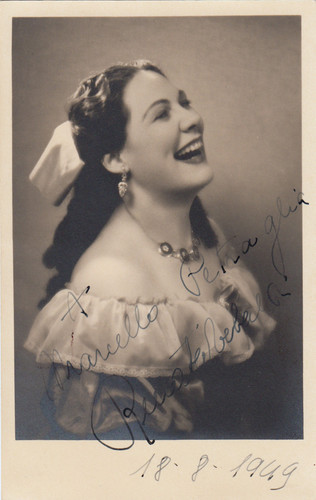
My Tebaldiani! They wrote me hundreds of letters each week from all over the world, and I answered myself — not a secretary, me, by hand. After every performance, I received them in my dressing room for an hour, signed autographs until I got cramps, and I never forgot a face I had seen again. Those telegrams, those letters — I carefully kept some of them: for me, that was the only true measure of what a voice can give. A diva who despises her audience lies to herself. They had pulled me out of the rubble in 1946; I owed them my open door and my name written at the bottom of a photograph.
I answered myself — not a secretary, me, by hand.
—What would you say about the meaning this audience gave to your entire career?
You see, I sang at La Scala, at the Met, stayed at the Waldorf Astoria, wore velvet gowns embroidered with gold. But what remains is none of that splendor. It is those ordinary people who waited at the stage door, in the cold, to hand me a flower or a scrap of paper. A voice is only worth the hearts it reaches. I like to think that if I am remembered, it will not be just for a sustained high note or a timbre, but for always looking my audience in the eyes. That is where, in that wordless exchange, true theater lies.
A voice is only worth the hearts it reaches.
This imaginary interview was generated by artificial intelligence from sources documented in Renata Tebaldi's profile. It dramatises what the figure might have said based on what we know about them, but does not constitute attested historical testimony. For primary sources and factual documentation, refer to the full profile.